

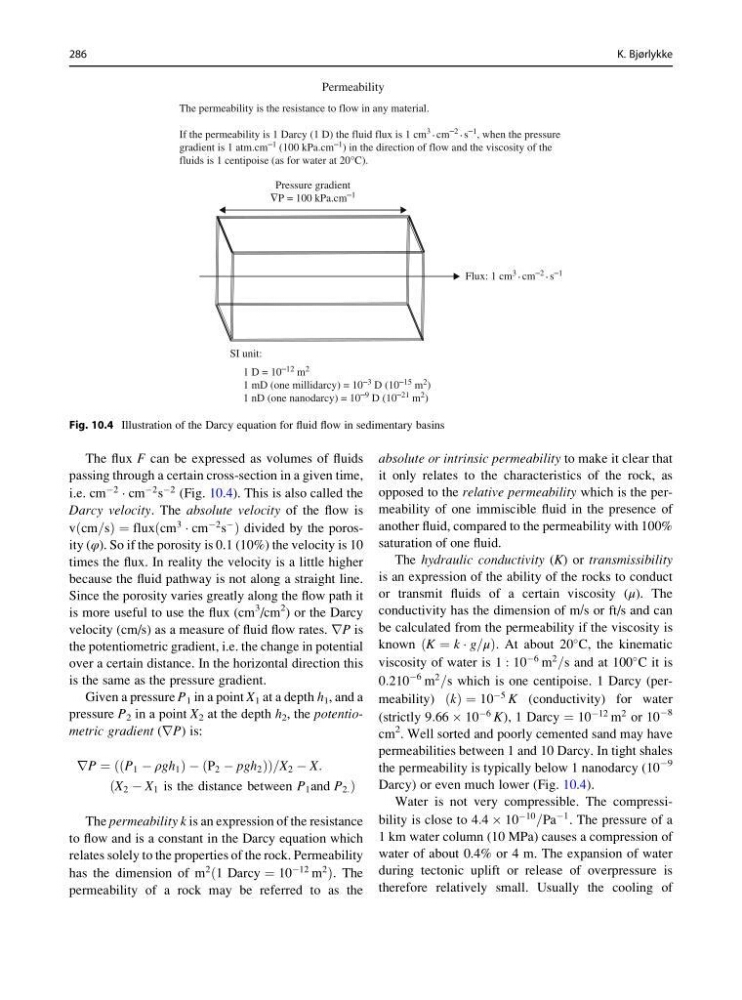
The flux F can be expressed as volumes of fluids
passing through a certain cross-section in a given time,
i.e. cm
À2
Á cm
À2 s
À2 (Fig. 10.4). This is also called the
Darcy velocity. The absolute velocity of the flow is
v cm=s
ð
Þ¼flux cm
3
Á cm
À2 s
À
ð
Þdivided by the porosity (φ). So if the porosity is 0.1 (10%) the velocity is 10
times the flux. In reality the velocity is a little higher
because the fluid pathway is not along a straight line.
Since the porosity varies greatly along the flow path it
is more useful to use the flux (cm
3 /cm
2 ) or the Darcy
velocity (cm/s) as a measure of fluid flow rates. rP is
the potentiometric gradient, i.e. the change in potential
over a certain distance. In the horizontal direction this
is the same as the pressure gradient.
Given a pressure P 1 in a point X 1 at a depth h 1 , and a
pressure P 2 in a point X 2 at the depth h 2 , the potentiometric gradient (rP) is:
rP ¼ P 1 À ρgh 1
ð
ÞÀ P 2 À pgh 2
ð
Þ
ð
Þ =X 2 À X:
X 2 À X 1 is the distance between P 1 and P 2:
ð
Þ
The permeability k is an expression of the resistance
to flow and is a constant in the Darcy equation which
relates solely to the properties of the rock. Permeability
has the dimension of m
2 1 Darcy ¼ 10
À12 m
2
ð
Þ . The
permeability of a rock may be referred to as the
absolute or intrinsic permeability to make it clear that
it only relates to the characteristics of the rock, as
opposed to the relative permeability which is the permeability of one immiscible fluid in the presence of
another fluid, compared to the permeability with 100%
saturation of one fluid.
The hydraulic conductivity (K) or transmissibility
is an expression of the ability of the rocks to conduct
or transmit fluids of a certain viscosity (μ). The
conductivity has the dimension of m/s or ft/s and can
be calculated from the permeability if the viscosity is
known K ¼ k Á g=μ
ð
Þ . At about 20
C, the kinematic
viscosity of water is 1 : 10
À6 m
2
=s and at 100
C it is
0:210
À6 m
2
=s which is one centipoise. 1 Darcy (permeability) k
ð Þ ¼ 10
À5 K (conductivity) for water
(strictly 9:66 Â 10
À6 K), 1 Darcy ¼ 10
À12 m
2 or 10
À8
cm
2 . Well sorted and poorly cemented sand may have
permeabilities between 1 and 10 Darcy. In tight shales
the permeability is typically below 1 nanodarcy (10
À9
Darcy) or even much lower (Fig. 10.4).
Water is not very compressible. The compressibility is close to 4:4 Â 10
À10
=Pa
À1 . The pressure of a
1 km water column (10 MPa) causes a compression of
water of about 0.4% or 4 m. The expansion of water
during tectonic uplift or release of overpressure is
therefore relatively small. Usually the cooling of
Pressure gradient
∇P = 100 kPa.cm –1
Flux: 1 cm 3 . cm –2 . s –1
The permeability is the resistance to flow in any material.
If the permeability is 1 Darcy (1 D) the fluid flux is 1 cm 3 . cm –2 . s –1 , when the pressure
gradient is 1 atm.cm –1 (100 kPa.cm –1 ) in the direction of flow and the viscosity of the
fluids is 1 centipoise (as for water at 20°C).
SI unit:
1 D = 10 –12 m 2
1 mD (one millidarcy) = 10 –3 D (10 –15 m 2 )
1 nD (one nanodarcy) = 10 –9 D (10 –21 m 2 )
Permeability
Fig. 10.4 Illustration of the Darcy equation for fluid flow in sedimentary basins
286
K. Bjørlykke
passing through a certain cross-section in a given time,
i.e. cm
À2
Á cm
À2 s
À2 (Fig. 10.4). This is also called the
Darcy velocity. The absolute velocity of the flow is
v cm=s
ð
Þ¼flux cm
3
Á cm
À2 s
À
ð
Þdivided by the porosity (φ). So if the porosity is 0.1 (10%) the velocity is 10
times the flux. In reality the velocity is a little higher
because the fluid pathway is not along a straight line.
Since the porosity varies greatly along the flow path it
is more useful to use the flux (cm
3 /cm
2 ) or the Darcy
velocity (cm/s) as a measure of fluid flow rates. rP is
the potentiometric gradient, i.e. the change in potential
over a certain distance. In the horizontal direction this
is the same as the pressure gradient.
Given a pressure P 1 in a point X 1 at a depth h 1 , and a
pressure P 2 in a point X 2 at the depth h 2 , the potentiometric gradient (rP) is:
rP ¼ P 1 À ρgh 1
ð
ÞÀ P 2 À pgh 2
ð
Þ
ð
Þ =X 2 À X:
X 2 À X 1 is the distance between P 1 and P 2:
ð
Þ
The permeability k is an expression of the resistance
to flow and is a constant in the Darcy equation which
relates solely to the properties of the rock. Permeability
has the dimension of m
2 1 Darcy ¼ 10
À12 m
2
ð
Þ . The
permeability of a rock may be referred to as the
absolute or intrinsic permeability to make it clear that
it only relates to the characteristics of the rock, as
opposed to the relative permeability which is the permeability of one immiscible fluid in the presence of
another fluid, compared to the permeability with 100%
saturation of one fluid.
The hydraulic conductivity (K) or transmissibility
is an expression of the ability of the rocks to conduct
or transmit fluids of a certain viscosity (μ). The
conductivity has the dimension of m/s or ft/s and can
be calculated from the permeability if the viscosity is
known K ¼ k Á g=μ
ð
Þ . At about 20
C, the kinematic
viscosity of water is 1 : 10
À6 m
2
=s and at 100
C it is
0:210
À6 m
2
=s which is one centipoise. 1 Darcy (permeability) k
ð Þ ¼ 10
À5 K (conductivity) for water
(strictly 9:66 Â 10
À6 K), 1 Darcy ¼ 10
À12 m
2 or 10
À8
cm
2 . Well sorted and poorly cemented sand may have
permeabilities between 1 and 10 Darcy. In tight shales
the permeability is typically below 1 nanodarcy (10
À9
Darcy) or even much lower (Fig. 10.4).
Water is not very compressible. The compressibility is close to 4:4 Â 10
À10
=Pa
À1 . The pressure of a
1 km water column (10 MPa) causes a compression of
water of about 0.4% or 4 m. The expansion of water
during tectonic uplift or release of overpressure is
therefore relatively small. Usually the cooling of
Pressure gradient
∇P = 100 kPa.cm –1
Flux: 1 cm 3 . cm –2 . s –1
The permeability is the resistance to flow in any material.
If the permeability is 1 Darcy (1 D) the fluid flux is 1 cm 3 . cm –2 . s –1 , when the pressure
gradient is 1 atm.cm –1 (100 kPa.cm –1 ) in the direction of flow and the viscosity of the
fluids is 1 centipoise (as for water at 20°C).
SI unit:
1 D = 10 –12 m 2
1 mD (one millidarcy) = 10 –3 D (10 –15 m 2 )
1 nD (one nanodarcy) = 10 –9 D (10 –21 m 2 )
Permeability
Fig. 10.4 Illustration of the Darcy equation for fluid flow in sedimentary basins
286
K. Bjørlykke