

10.4 Fluid Potentials
The flow of fluids in sedimentary basins follows simple fluid dynamics laws. Fluids do not necessarily flow
from higher to lower pressures, but from higher to
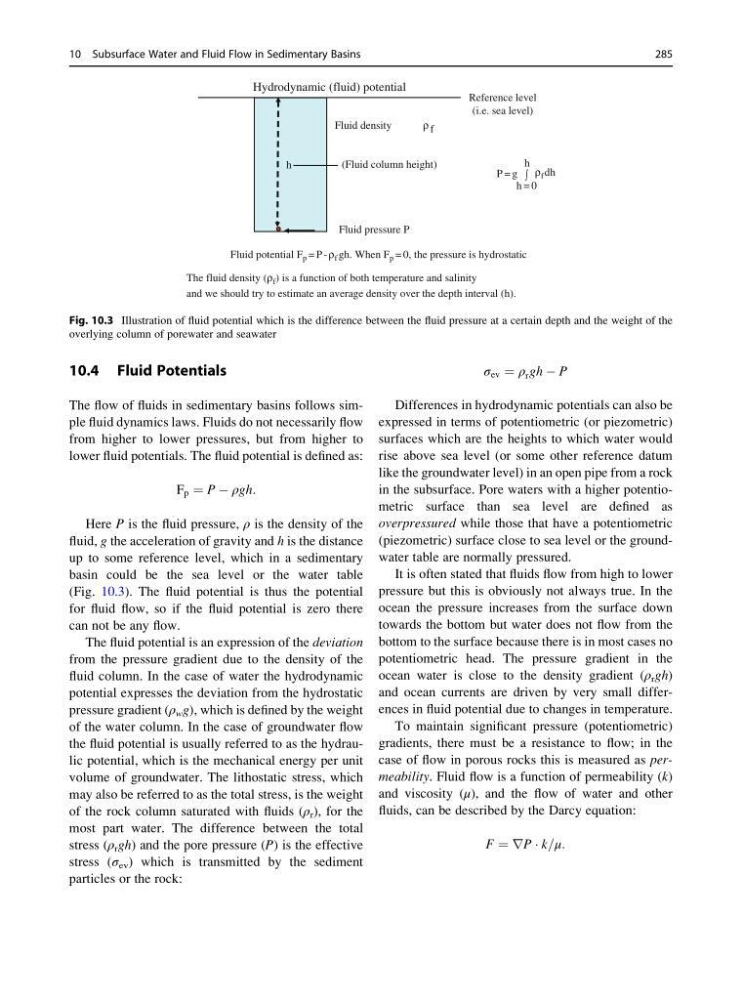
lower fluid potentials. The fluid potential is defined as:
F p ¼ P À ρgh:
Here P is the fluid pressure, ρ is the density of the
fluid, g the acceleration of gravity and h is the distance
up to some reference level, which in a sedimentary
basin could be the sea level or the water table
(Fig. 10.3). The fluid potential is thus the potential
for fluid flow, so if the fluid potential is zero there
can not be any flow.
The fluid potential is an expression of the deviation
from the pressure gradient due to the density of the
fluid column. In the case of water the hydrodynamic
potential expresses the deviation from the hydrostatic
pressure gradient (ρ w g), which is defined by the weight
of the water column. In the case of groundwater flow
the fluid potential is usually referred to as the hydraulic potential, which is the mechanical energy per unit
volume of groundwater. The lithostatic stress, which
may also be referred to as the total stress, is the weight
of the rock column saturated with fluids (ρ r ), for the
most part water. The difference between the total
stress (ρ r gh) and the pore pressure (P) is the effective
stress (σ ev ) which is transmitted by the sediment
particles or the rock:
σ ev ¼ ρ r gh À P
Differences in hydrodynamic potentials can also be
expressed in terms of potentiometric (or piezometric)
surfaces which are the heights to which water would
rise above sea level (or some other reference datum
like the groundwater level) in an open pipe from a rock
in the subsurface. Pore waters with a higher potentiometric surface than sea level are defined as
overpressured while those that have a potentiometric
(piezometric) surface close to sea level or the groundwater table are normally pressured.
It is often stated that fluids flow from high to lower
pressure but this is obviously not always true. In the
ocean the pressure increases from the surface down
towards the bottom but water does not flow from the
bottom to the surface because there is in most cases no
potentiometric head. The pressure gradient in the
ocean water is close to the density gradient (ρ r gh)
and ocean currents are driven by very small differences in fluid potential due to changes in temperature.
To maintain significant pressure (potentiometric)
gradients, there must be a resistance to flow; in the
case of flow in porous rocks this is measured as permeability. Fluid flow is a function of permeability (k)
and viscosity (μ), and the flow of water and other
fluids, can be described by the Darcy equation:
F ¼ rP Á k=μ:
Hydrodynamic (fluid) potential
Reference level
(i.e. sea level)
h
(Fluid column height)
Fluid density
ρ f
Fluid pressure P
Fluid potential F p = P - ρ f gh. When F p = 0, the pressure is hydrostatic
The fluid density (ρ f ) is a function of both temperature and salinity
and we should try to estimate an average density over the depth interval (h).
h
P = g ∫ ρ f dh
h = 0
Fig. 10.3 Illustration of fluid potential which is the difference between the fluid pressure at a certain depth and the weight of the
overlying column of porewater and seawater
10 Subsurface Water and Fluid Flow in Sedimentary Basins
285
The flow of fluids in sedimentary basins follows simple fluid dynamics laws. Fluids do not necessarily flow
from higher to lower pressures, but from higher to
lower fluid potentials. The fluid potential is defined as:
F p ¼ P À ρgh:
Here P is the fluid pressure, ρ is the density of the
fluid, g the acceleration of gravity and h is the distance
up to some reference level, which in a sedimentary
basin could be the sea level or the water table
(Fig. 10.3). The fluid potential is thus the potential
for fluid flow, so if the fluid potential is zero there
can not be any flow.
The fluid potential is an expression of the deviation
from the pressure gradient due to the density of the
fluid column. In the case of water the hydrodynamic
potential expresses the deviation from the hydrostatic
pressure gradient (ρ w g), which is defined by the weight
of the water column. In the case of groundwater flow
the fluid potential is usually referred to as the hydraulic potential, which is the mechanical energy per unit
volume of groundwater. The lithostatic stress, which
may also be referred to as the total stress, is the weight
of the rock column saturated with fluids (ρ r ), for the
most part water. The difference between the total
stress (ρ r gh) and the pore pressure (P) is the effective
stress (σ ev ) which is transmitted by the sediment
particles or the rock:
σ ev ¼ ρ r gh À P
Differences in hydrodynamic potentials can also be
expressed in terms of potentiometric (or piezometric)
surfaces which are the heights to which water would
rise above sea level (or some other reference datum
like the groundwater level) in an open pipe from a rock
in the subsurface. Pore waters with a higher potentiometric surface than sea level are defined as
overpressured while those that have a potentiometric
(piezometric) surface close to sea level or the groundwater table are normally pressured.
It is often stated that fluids flow from high to lower
pressure but this is obviously not always true. In the
ocean the pressure increases from the surface down
towards the bottom but water does not flow from the
bottom to the surface because there is in most cases no
potentiometric head. The pressure gradient in the
ocean water is close to the density gradient (ρ r gh)
and ocean currents are driven by very small differences in fluid potential due to changes in temperature.
To maintain significant pressure (potentiometric)
gradients, there must be a resistance to flow; in the
case of flow in porous rocks this is measured as permeability. Fluid flow is a function of permeability (k)
and viscosity (μ), and the flow of water and other
fluids, can be described by the Darcy equation:
F ¼ rP Á k=μ:
Hydrodynamic (fluid) potential
Reference level
(i.e. sea level)
h
(Fluid column height)
Fluid density
ρ f
Fluid pressure P
Fluid potential F p = P - ρ f gh. When F p = 0, the pressure is hydrostatic
The fluid density (ρ f ) is a function of both temperature and salinity
and we should try to estimate an average density over the depth interval (h).
h
P = g ∫ ρ f dh
h = 0
Fig. 10.3 Illustration of fluid potential which is the difference between the fluid pressure at a certain depth and the weight of the
overlying column of porewater and seawater
10 Subsurface Water and Fluid Flow in Sedimentary Basins
285