

10.2 Composition of Porewater in an Oil
Field
Analyses of porewater that is present in the oil field
along with the oil provide information about fluid
flow and migration of oil. Differences in salinity
and chemical composition between parts of a reservoir may indicate lack of communication by fluid
flow and also diffusion between compartments. The
isotopic composition of the formation water may also
help to indicate degrees of communication in a reservoir in addition to changes in the composition of
oil. Strontium isotopes have been used for this purpose. If there are primary differences in the composition of oil across an oil field this can be used to
monitor the contribution from the different parts
during production. During onshore production freshwater may be used for water injection into the reservoir. Offshore, seawater is injected, but this has a
composition which is distinctly different from the
formation water.
At any given time the amounts of solids in solution
are very small except in highly saline porewater near
evaporites. The solubility of most silicates and also
carbonate minerals is sufficiently low that the
porewater composition of sedimentary basins is
almost totally controlled by the solid phases.
Porewater in sedimentary basins often shows evidence
of stratification with respect to both salinity and isotopic composition, which precludes large scale mixing
of porewater. The composition of the formation water
in reservoirs may provide useful information about the
source of the water and communication within the
reservoir, in the same way as the composition of the
oil gives information about the source of the oil.
10.3 Fluid Flow in Sedimentary Basins
Fluid flow in sedimentary basins is important because
it determines the distribution of pore pressures in the
water phase, and also in oil and gas. High pore
pressures may also be a hazard when drilling wells.
The fluid phases have the capacity to transport solids
in solution, and heat by fluid flow (advection) and by
diffusion. The flow of fluids may be through the pore
network in the rock matrix or along fractures, and
this is a principal difference between these two types
of flow. This part of the chapter will discuss the
factors controlling the flow of fluids in sedimentary
basins.
The fluids are mostly water, but may also be oil and
gases including air, filling the pores between the grains
in the sediments. The grains are in most cases minerals
but some may be amorphous (e.g. silica – opal A, or
organic matter and kerogen). Porosity is the percentage (or fraction) of the rock volume which is filled
with fluids. This may be also expressed by the void
ratio which is the ratio between the volume of voids
(porosity) and solids. What is called void is not strictly
void but filled with fluids and is the same as porosity.
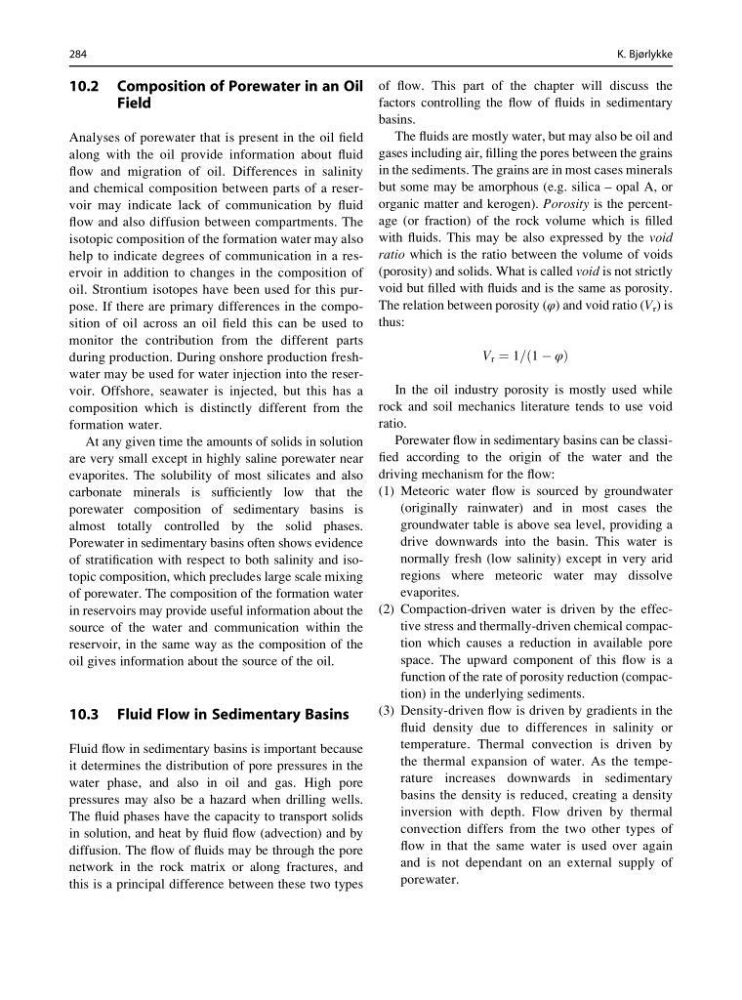
The relation between porosity (φ) and void ratio (V r ) is
thus:
V r ¼ 1= 1 À φ
ð
Þ
In the oil industry porosity is mostly used while
rock and soil mechanics literature tends to use void
ratio.
Porewater flow in sedimentary basins can be classified according to the origin of the water and the
driving mechanism for the flow:
(1) Meteoric water flow is sourced by groundwater
(originally rainwater) and in most cases the
groundwater table is above sea level, providing a
drive downwards into the basin. This water is
normally fresh (low salinity) except in very arid
regions where meteoric water may dissolve
evaporites.
(2) Compaction-driven water is driven by the effective stress and thermally-driven chemical compaction which causes a reduction in available pore
space. The upward component of this flow is a
function of the rate of porosity reduction (compaction) in the underlying sediments.
(3) Density-driven flow is driven by gradients in the
fluid density due to differences in salinity or
temperature. Thermal convection is driven by
the thermal expansion of water. As the temperature increases downwards in sedimentary
basins the density is reduced, creating a density
inversion with depth. Flow driven by thermal
convection differs from the two other types of
flow in that the same water is used over again
and is not dependant on an external supply of
porewater.
284
K. Bjørlykke
Field
Analyses of porewater that is present in the oil field
along with the oil provide information about fluid
flow and migration of oil. Differences in salinity
and chemical composition between parts of a reservoir may indicate lack of communication by fluid
flow and also diffusion between compartments. The
isotopic composition of the formation water may also
help to indicate degrees of communication in a reservoir in addition to changes in the composition of
oil. Strontium isotopes have been used for this purpose. If there are primary differences in the composition of oil across an oil field this can be used to
monitor the contribution from the different parts
during production. During onshore production freshwater may be used for water injection into the reservoir. Offshore, seawater is injected, but this has a
composition which is distinctly different from the
formation water.
At any given time the amounts of solids in solution
are very small except in highly saline porewater near
evaporites. The solubility of most silicates and also
carbonate minerals is sufficiently low that the
porewater composition of sedimentary basins is
almost totally controlled by the solid phases.
Porewater in sedimentary basins often shows evidence
of stratification with respect to both salinity and isotopic composition, which precludes large scale mixing
of porewater. The composition of the formation water
in reservoirs may provide useful information about the
source of the water and communication within the
reservoir, in the same way as the composition of the
oil gives information about the source of the oil.
10.3 Fluid Flow in Sedimentary Basins
Fluid flow in sedimentary basins is important because
it determines the distribution of pore pressures in the
water phase, and also in oil and gas. High pore
pressures may also be a hazard when drilling wells.
The fluid phases have the capacity to transport solids
in solution, and heat by fluid flow (advection) and by
diffusion. The flow of fluids may be through the pore
network in the rock matrix or along fractures, and
this is a principal difference between these two types
of flow. This part of the chapter will discuss the
factors controlling the flow of fluids in sedimentary
basins.
The fluids are mostly water, but may also be oil and
gases including air, filling the pores between the grains
in the sediments. The grains are in most cases minerals
but some may be amorphous (e.g. silica – opal A, or
organic matter and kerogen). Porosity is the percentage (or fraction) of the rock volume which is filled
with fluids. This may be also expressed by the void
ratio which is the ratio between the volume of voids
(porosity) and solids. What is called void is not strictly
void but filled with fluids and is the same as porosity.
The relation between porosity (φ) and void ratio (V r ) is
thus:
V r ¼ 1= 1 À φ
ð
Þ
In the oil industry porosity is mostly used while
rock and soil mechanics literature tends to use void
ratio.
Porewater flow in sedimentary basins can be classified according to the origin of the water and the
driving mechanism for the flow:
(1) Meteoric water flow is sourced by groundwater
(originally rainwater) and in most cases the
groundwater table is above sea level, providing a
drive downwards into the basin. This water is
normally fresh (low salinity) except in very arid
regions where meteoric water may dissolve
evaporites.
(2) Compaction-driven water is driven by the effective stress and thermally-driven chemical compaction which causes a reduction in available pore
space. The upward component of this flow is a
function of the rate of porosity reduction (compaction) in the underlying sediments.
(3) Density-driven flow is driven by gradients in the
fluid density due to differences in salinity or
temperature. Thermal convection is driven by
the thermal expansion of water. As the temperature increases downwards in sedimentary
basins the density is reduced, creating a density
inversion with depth. Flow driven by thermal
convection differs from the two other types of
flow in that the same water is used over again
and is not dependant on an external supply of
porewater.
284
K. Bjørlykke