

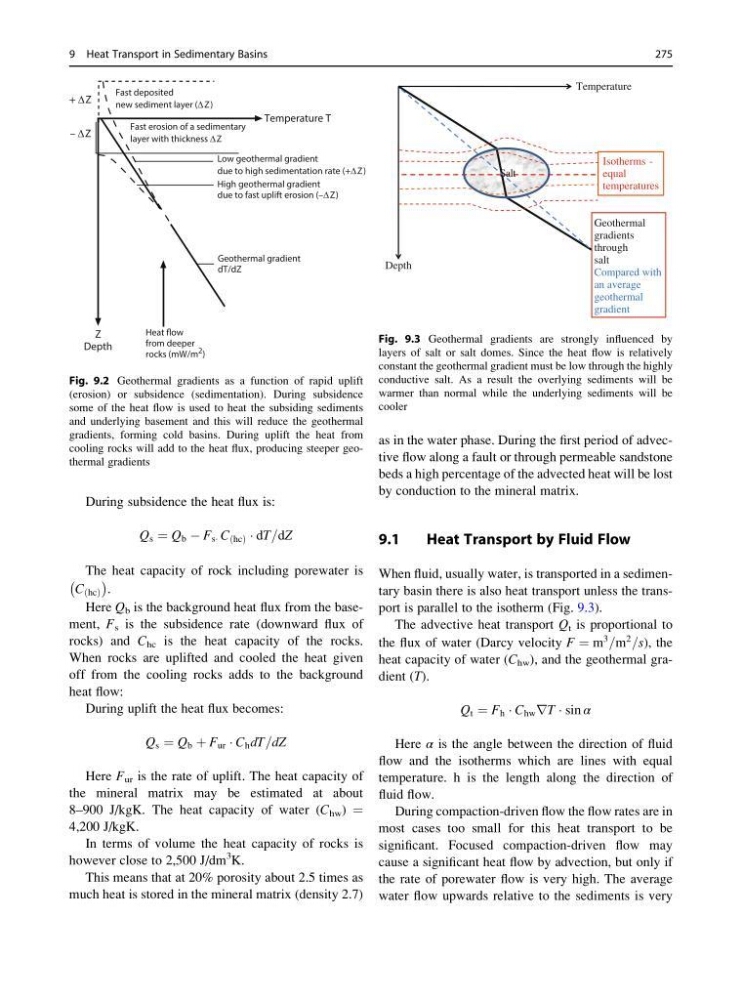
During subsidence the heat flux is:
Q s ¼ Q b À F sÁ C ðhcÞ Á dT=dZ
The heat capacity of rock including porewater is
C ðhcÞ
À
Á
.
Here Q b is the background heat flux from the basement, F s is the subsidence rate (downward flux of
rocks) and C hc is the heat capacity of the rocks.
When rocks are uplifted and cooled the heat given
off from the cooling rocks adds to the background
heat flow:
During uplift the heat flux becomes:
Q s ¼ Q b þ F ur Á C h dT=dZ
Here F ur is the rate of uplift. The heat capacity of
the mineral matrix may be estimated at about
8–900 J/kgK. The heat capacity of water (C hw ) ¼
4,200 J/kgK.
In terms of volume the heat capacity of rocks is
however close to 2,500 J/dm
3 K.
This means that at 20% porosity about 2.5 times as
much heat is stored in the mineral matrix (density 2.7)
as in the water phase. During the first period of advective flow along a fault or through permeable sandstone
beds a high percentage of the advected heat will be lost
by conduction to the mineral matrix.
9.1
Heat Transport by Fluid Flow
When fluid, usually water, is transported in a sedimentary basin there is also heat transport unless the transport is parallel to the isotherm (Fig. 9.3).
The advective heat transport Q t is proportional to
the flux of water (Darcy velocity F ¼ m
3
=m
2
=s), the
heat capacity of water (C hw ), and the geothermal gradient (T).
Q t ¼ F h Á C hw rT Á sin α
Here α is the angle between the direction of fluid
flow and the isotherms which are lines with equal
temperature. h is the length along the direction of
fluid flow.
During compaction-driven flow the flow rates are in
most cases too small for this heat transport to be
significant. Focused compaction-driven flow may
cause a significant heat flow by advection, but only if
the rate of porewater flow is very high. The average
water flow upwards relative to the sediments is very
Temperature T
+ Δ Z
– Δ Z
Z
Depth
Heat flow
from deeper
rocks (mW/m
2 )
Geothermal gradient
dT/dZ
High geothermal gradient
due to fast uplift erosion (–Δ Z )
Low geothermal gradient
due to high sedimentation rate (+Δ Z )
Fast erosion of a sedimentary
layer with thickness Δ Z
Fast deposited
new sediment layer (Δ Z )
Fig. 9.2 Geothermal gradients as a function of rapid uplift
(erosion) or subsidence (sedimentation). During subsidence
some of the heat flow is used to heat the subsiding sediments
and underlying basement and this will reduce the geothermal
gradients, forming cold basins. During uplift the heat from
cooling rocks will add to the heat flux, producing steeper geothermal gradients
Temperature
Depth
Isotherms -
equal
temperatures
Geothermal
gradients
through
salt
Compared with
an average
geothermal
gradient
Salt
Fig. 9.3 Geothermal gradients are strongly influenced by
layers of salt or salt domes. Since the heat flow is relatively
constant the geothermal gradient must be low through the highly
conductive salt. As a result the overlying sediments will be
warmer than normal while the underlying sediments will be
cooler
9 Heat Transport in Sedimentary Basins
275
Q s ¼ Q b À F sÁ C ðhcÞ Á dT=dZ
The heat capacity of rock including porewater is
C ðhcÞ
À
Á
.
Here Q b is the background heat flux from the basement, F s is the subsidence rate (downward flux of
rocks) and C hc is the heat capacity of the rocks.
When rocks are uplifted and cooled the heat given
off from the cooling rocks adds to the background
heat flow:
During uplift the heat flux becomes:
Q s ¼ Q b þ F ur Á C h dT=dZ
Here F ur is the rate of uplift. The heat capacity of
the mineral matrix may be estimated at about
8–900 J/kgK. The heat capacity of water (C hw ) ¼
4,200 J/kgK.
In terms of volume the heat capacity of rocks is
however close to 2,500 J/dm
3 K.
This means that at 20% porosity about 2.5 times as
much heat is stored in the mineral matrix (density 2.7)
as in the water phase. During the first period of advective flow along a fault or through permeable sandstone
beds a high percentage of the advected heat will be lost
by conduction to the mineral matrix.
9.1
Heat Transport by Fluid Flow
When fluid, usually water, is transported in a sedimentary basin there is also heat transport unless the transport is parallel to the isotherm (Fig. 9.3).
The advective heat transport Q t is proportional to
the flux of water (Darcy velocity F ¼ m
3
=m
2
=s), the
heat capacity of water (C hw ), and the geothermal gradient (T).
Q t ¼ F h Á C hw rT Á sin α
Here α is the angle between the direction of fluid
flow and the isotherms which are lines with equal
temperature. h is the length along the direction of
fluid flow.
During compaction-driven flow the flow rates are in
most cases too small for this heat transport to be
significant. Focused compaction-driven flow may
cause a significant heat flow by advection, but only if
the rate of porewater flow is very high. The average
water flow upwards relative to the sediments is very
Temperature T
+ Δ Z
– Δ Z
Z
Depth
Heat flow
from deeper
rocks (mW/m
2 )
Geothermal gradient
dT/dZ
High geothermal gradient
due to fast uplift erosion (–Δ Z )
Low geothermal gradient
due to high sedimentation rate (+Δ Z )
Fast erosion of a sedimentary
layer with thickness Δ Z
Fast deposited
new sediment layer (Δ Z )
Fig. 9.2 Geothermal gradients as a function of rapid uplift
(erosion) or subsidence (sedimentation). During subsidence
some of the heat flow is used to heat the subsiding sediments
and underlying basement and this will reduce the geothermal
gradients, forming cold basins. During uplift the heat from
cooling rocks will add to the heat flux, producing steeper geothermal gradients
Temperature
Depth
Isotherms -
equal
temperatures
Geothermal
gradients
through
salt
Compared with
an average
geothermal
gradient
Salt
Fig. 9.3 Geothermal gradients are strongly influenced by
layers of salt or salt domes. Since the heat flow is relatively
constant the geothermal gradient must be low through the highly
conductive salt. As a result the overlying sediments will be
warmer than normal while the underlying sediments will be
cooler
9 Heat Transport in Sedimentary Basins
275