

The temperature gradient rT dT=dz
ð
Þ
¼ Heat flow Q
ð Þ=Conductivity(cÞ:
(9.2)
In rocks with low conductivity (like mudstones and
shales) the geothermal gradients will be high and in
highly conductive rocks (like salt) the geothermal
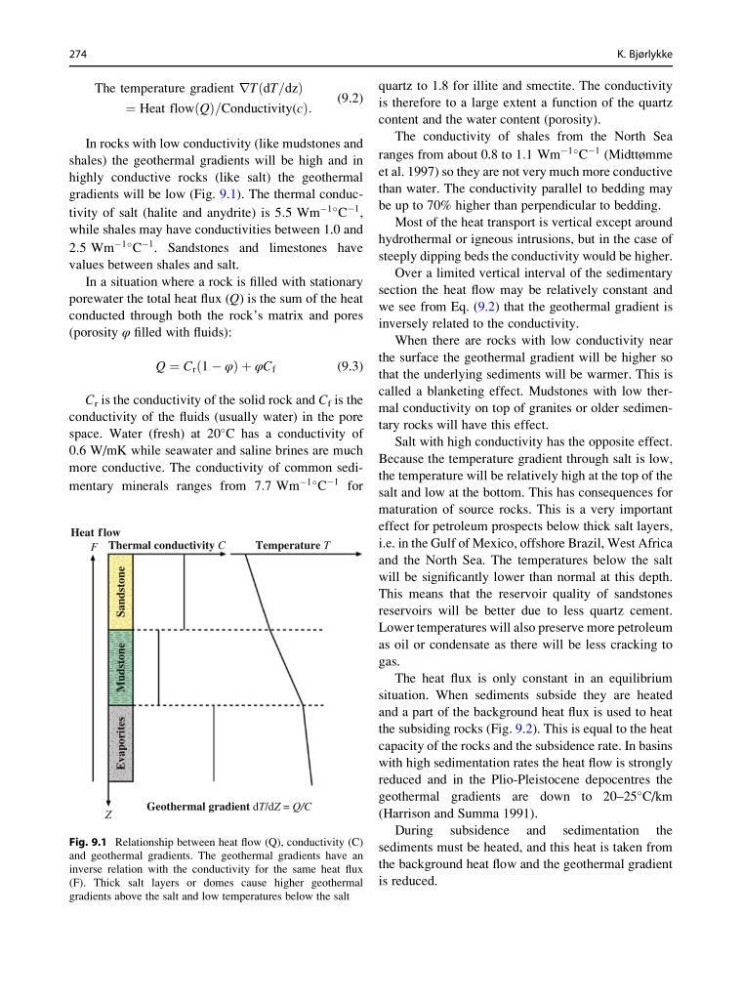
gradients will be low (Fig. 9.1). The thermal conductivity of salt (halite and anydrite) is 5:5 Wm
À1 C
À1 ,
while shales may have conductivities between 1.0 and
2:5 Wm
À1 C
À1 . Sandstones and limestones have
values between shales and salt.
In a situation where a rock is filled with stationary
porewater the total heat flux (Q) is the sum of the heat
conducted through both the rock’s matrix and pores
(porosity φ filled with fluids):
Q ¼ C r 1 À φ
ð
ÞþφC f
(9.3)
C r is the conductivity of the solid rock and C f is the
conductivity of the fluids (usually water) in the pore
space. Water (fresh) at 20
C has a conductivity of
0.6 W/mK while seawater and saline brines are much
more conductive. The conductivity of common sedimentary minerals ranges from 7:7 Wm
À1 C
À1 for
quartz to 1.8 for illite and smectite. The conductivity
is therefore to a large extent a function of the quartz
content and the water content (porosity).
The conductivity of shales from the North Sea
ranges from about 0.8 to 1:1 Wm
À1 C
À1 (Midttømme
et al. 1997) so they are not very much more conductive
than water. The conductivity parallel to bedding may
be up to 70% higher than perpendicular to bedding.
Most of the heat transport is vertical except around
hydrothermal or igneous intrusions, but in the case of
steeply dipping beds the conductivity would be higher.
Over a limited vertical interval of the sedimentary
section the heat flow may be relatively constant and
we see from Eq. (9.2) that the geothermal gradient is
inversely related to the conductivity.
When there are rocks with low conductivity near
the surface the geothermal gradient will be higher so
that the underlying sediments will be warmer. This is
called a blanketing effect. Mudstones with low thermal conductivity on top of granites or older sedimentary rocks will have this effect.
Salt with high conductivity has the opposite effect.
Because the temperature gradient through salt is low,
the temperature will be relatively high at the top of the
salt and low at the bottom. This has consequences for
maturation of source rocks. This is a very important
effect for petroleum prospects below thick salt layers,
i.e. in the Gulf of Mexico, offshore Brazil, West Africa
and the North Sea. The temperatures below the salt
will be significantly lower than normal at this depth.
This means that the reservoir quality of sandstones
reservoirs will be better due to less quartz cement.
Lower temperatures will also preserve more petroleum
as oil or condensate as there will be less cracking to
gas.
The heat flux is only constant in an equilibrium
situation. When sediments subside they are heated
and a part of the background heat flux is used to heat
the subsiding rocks (Fig. 9.2). This is equal to the heat
capacity of the rocks and the subsidence rate. In basins
with high sedimentation rates the heat flow is strongly
reduced and in the Plio-Pleistocene depocentres the
geothermal gradients are down to 20–25
C/km
(Harrison and Summa 1991).
During subsidence and sedimentation the
sediments must be heated, and this heat is taken from
the background heat flow and the geothermal gradient
is reduced.
Heat f low
Thermal conductivity C
Sandstone
Mudstone
Evaporites
Temperature T
Geothermal gradient dT/dZ = Q/C
F
Z
Fig. 9.1 Relationship between heat flow (Q), conductivity (C)
and geothermal gradients. The geothermal gradients have an
inverse relation with the conductivity for the same heat flux
(F). Thick salt layers or domes cause higher geothermal
gradients above the salt and low temperatures below the salt
274
K. Bjørlykke
ð
Þ
¼ Heat flow Q
ð Þ=Conductivity(cÞ:
(9.2)
In rocks with low conductivity (like mudstones and
shales) the geothermal gradients will be high and in
highly conductive rocks (like salt) the geothermal
gradients will be low (Fig. 9.1). The thermal conductivity of salt (halite and anydrite) is 5:5 Wm
À1 C
À1 ,
while shales may have conductivities between 1.0 and
2:5 Wm
À1 C
À1 . Sandstones and limestones have
values between shales and salt.
In a situation where a rock is filled with stationary
porewater the total heat flux (Q) is the sum of the heat
conducted through both the rock’s matrix and pores
(porosity φ filled with fluids):
Q ¼ C r 1 À φ
ð
ÞþφC f
(9.3)
C r is the conductivity of the solid rock and C f is the
conductivity of the fluids (usually water) in the pore
space. Water (fresh) at 20
C has a conductivity of
0.6 W/mK while seawater and saline brines are much
more conductive. The conductivity of common sedimentary minerals ranges from 7:7 Wm
À1 C
À1 for
quartz to 1.8 for illite and smectite. The conductivity
is therefore to a large extent a function of the quartz
content and the water content (porosity).
The conductivity of shales from the North Sea
ranges from about 0.8 to 1:1 Wm
À1 C
À1 (Midttømme
et al. 1997) so they are not very much more conductive
than water. The conductivity parallel to bedding may
be up to 70% higher than perpendicular to bedding.
Most of the heat transport is vertical except around
hydrothermal or igneous intrusions, but in the case of
steeply dipping beds the conductivity would be higher.
Over a limited vertical interval of the sedimentary
section the heat flow may be relatively constant and
we see from Eq. (9.2) that the geothermal gradient is
inversely related to the conductivity.
When there are rocks with low conductivity near
the surface the geothermal gradient will be higher so
that the underlying sediments will be warmer. This is
called a blanketing effect. Mudstones with low thermal conductivity on top of granites or older sedimentary rocks will have this effect.
Salt with high conductivity has the opposite effect.
Because the temperature gradient through salt is low,
the temperature will be relatively high at the top of the
salt and low at the bottom. This has consequences for
maturation of source rocks. This is a very important
effect for petroleum prospects below thick salt layers,
i.e. in the Gulf of Mexico, offshore Brazil, West Africa
and the North Sea. The temperatures below the salt
will be significantly lower than normal at this depth.
This means that the reservoir quality of sandstones
reservoirs will be better due to less quartz cement.
Lower temperatures will also preserve more petroleum
as oil or condensate as there will be less cracking to
gas.
The heat flux is only constant in an equilibrium
situation. When sediments subside they are heated
and a part of the background heat flux is used to heat
the subsiding rocks (Fig. 9.2). This is equal to the heat
capacity of the rocks and the subsidence rate. In basins
with high sedimentation rates the heat flow is strongly
reduced and in the Plio-Pleistocene depocentres the
geothermal gradients are down to 20–25
C/km
(Harrison and Summa 1991).
During subsidence and sedimentation the
sediments must be heated, and this heat is taken from
the background heat flow and the geothermal gradient
is reduced.
Heat f low
Thermal conductivity C
Sandstone
Mudstone
Evaporites
Temperature T
Geothermal gradient dT/dZ = Q/C
F
Z
Fig. 9.1 Relationship between heat flow (Q), conductivity (C)
and geothermal gradients. The geothermal gradients have an
inverse relation with the conductivity for the same heat flux
(F). Thick salt layers or domes cause higher geothermal
gradients above the salt and low temperatures below the salt
274
K. Bjørlykke