

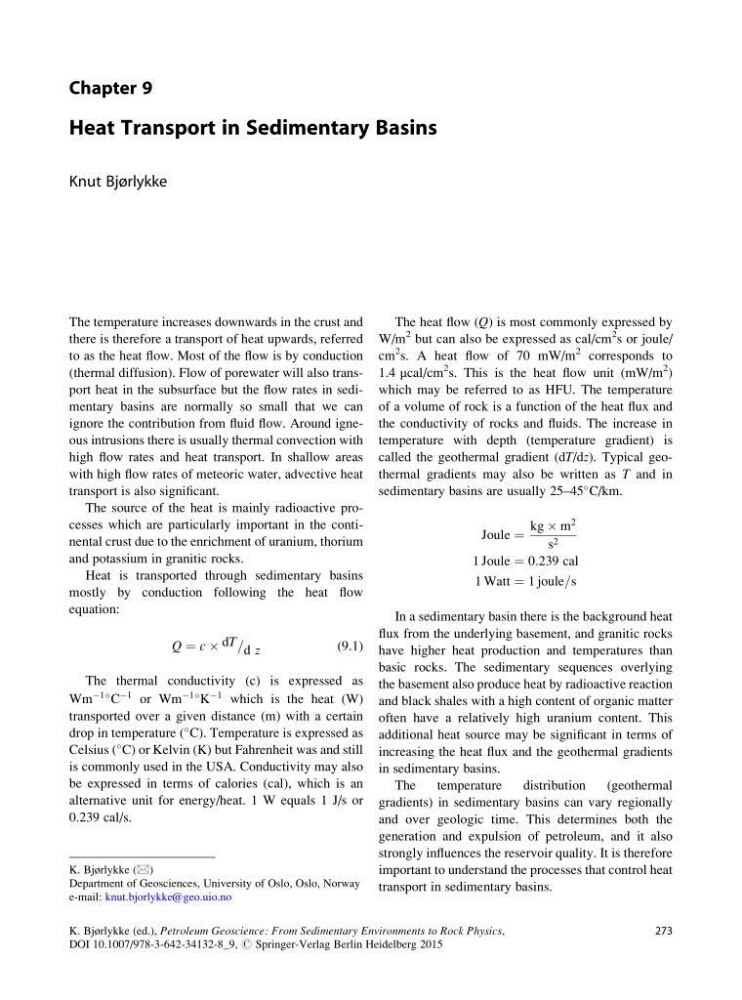
Chapter 9
Heat Transport in Sedimentary Basins
Knut Bjørlykke
The temperature increases downwards in the crust and
there is therefore a transport of heat upwards, referred
to as the heat flow. Most of the flow is by conduction
(thermal diffusion). Flow of porewater will also transport heat in the subsurface but the flow rates in sedimentary basins are normally so small that we can
ignore the contribution from fluid flow. Around igneous intrusions there is usually thermal convection with
high flow rates and heat transport. In shallow areas
with high flow rates of meteoric water, advective heat
transport is also significant.
The source of the heat is mainly radioactive processes which are particularly important in the continental crust due to the enrichment of uranium, thorium
and potassium in granitic rocks.
Heat is transported through sedimentary basins
mostly by conduction following the heat flow
equation:
Q ¼ c  dT = d z
(9.1)
The thermal conductivity (c) is expressed as
Wm
À1 C
À1 or Wm
À1 K
À1 which is the heat (W)
transported over a given distance (m) with a certain
drop in temperature (
C). Temperature is expressed as
Celsius (
C) or Kelvin (K) but Fahrenheit was and still
is commonly used in the USA. Conductivity may also
be expressed in terms of calories (cal), which is an
alternative unit for energy/heat. 1 W equals 1 J/s or
0.239 cal/s.
The heat flow (Q) is most commonly expressed by
W/m
2 but can also be expressed as cal/cm
2 s or joule/
cm
2 s. A heat flow of 70 mW/m
2 corresponds to
1.4 μcal/cm
2 s. This is the heat flow unit (mW/m
2 )
which may be referred to as HFU. The temperature
of a volume of rock is a function of the heat flux and
the conductivity of rocks and fluids. The increase in
temperature with depth (temperature gradient) is
called the geothermal gradient (dT/dz). Typical geothermal gradients may also be written as T and in
sedimentary basins are usually 25–45
C/km.
Joule ¼
kg  m
2
s 2
1 Joule ¼ 0:239 cal
1 Watt ¼ 1 joule=s
In a sedimentary basin there is the background heat
flux from the underlying basement, and granitic rocks
have higher heat production and temperatures than
basic rocks. The sedimentary sequences overlying
the basement also produce heat by radioactive reaction
and black shales with a high content of organic matter
often have a relatively high uranium content. This
additional heat source may be significant in terms of
increasing the heat flux and the geothermal gradients
in sedimentary basins.
The
temperature
distribution
(geothermal
gradients) in sedimentary basins can vary regionally
and over geologic time. This determines both the
generation and expulsion of petroleum, and it also
strongly influences the reservoir quality. It is therefore
important to understand the processes that control heat
transport in sedimentary basins.
K. Bjørlykke (*)
Department of Geosciences, University of Oslo, Oslo, Norway
e-mail: knut.bjorlykke@geo.uio.no
K. Bjørlykke (ed.), Petroleum Geoscience: From Sedimentary Environments to Rock Physics,
DOI 10.1007/978-3-642-34132-8_9, # Springer-Verlag Berlin Heidelberg 2015
273
Heat Transport in Sedimentary Basins
Knut Bjørlykke
The temperature increases downwards in the crust and
there is therefore a transport of heat upwards, referred
to as the heat flow. Most of the flow is by conduction
(thermal diffusion). Flow of porewater will also transport heat in the subsurface but the flow rates in sedimentary basins are normally so small that we can
ignore the contribution from fluid flow. Around igneous intrusions there is usually thermal convection with
high flow rates and heat transport. In shallow areas
with high flow rates of meteoric water, advective heat
transport is also significant.
The source of the heat is mainly radioactive processes which are particularly important in the continental crust due to the enrichment of uranium, thorium
and potassium in granitic rocks.
Heat is transported through sedimentary basins
mostly by conduction following the heat flow
equation:
Q ¼ c  dT = d z
(9.1)
The thermal conductivity (c) is expressed as
Wm
À1 C
À1 or Wm
À1 K
À1 which is the heat (W)
transported over a given distance (m) with a certain
drop in temperature (
C). Temperature is expressed as
Celsius (
C) or Kelvin (K) but Fahrenheit was and still
is commonly used in the USA. Conductivity may also
be expressed in terms of calories (cal), which is an
alternative unit for energy/heat. 1 W equals 1 J/s or
0.239 cal/s.
The heat flow (Q) is most commonly expressed by
W/m
2 but can also be expressed as cal/cm
2 s or joule/
cm
2 s. A heat flow of 70 mW/m
2 corresponds to
1.4 μcal/cm
2 s. This is the heat flow unit (mW/m
2 )
which may be referred to as HFU. The temperature
of a volume of rock is a function of the heat flux and
the conductivity of rocks and fluids. The increase in
temperature with depth (temperature gradient) is
called the geothermal gradient (dT/dz). Typical geothermal gradients may also be written as T and in
sedimentary basins are usually 25–45
C/km.
Joule ¼
kg  m
2
s 2
1 Joule ¼ 0:239 cal
1 Watt ¼ 1 joule=s
In a sedimentary basin there is the background heat
flux from the underlying basement, and granitic rocks
have higher heat production and temperatures than
basic rocks. The sedimentary sequences overlying
the basement also produce heat by radioactive reaction
and black shales with a high content of organic matter
often have a relatively high uranium content. This
additional heat source may be significant in terms of
increasing the heat flux and the geothermal gradients
in sedimentary basins.
The
temperature
distribution
(geothermal
gradients) in sedimentary basins can vary regionally
and over geologic time. This determines both the
generation and expulsion of petroleum, and it also
strongly influences the reservoir quality. It is therefore
important to understand the processes that control heat
transport in sedimentary basins.
K. Bjørlykke (*)
Department of Geosciences, University of Oslo, Oslo, Norway
e-mail: knut.bjorlykke@geo.uio.no
K. Bjørlykke (ed.), Petroleum Geoscience: From Sedimentary Environments to Rock Physics,
DOI 10.1007/978-3-642-34132-8_9, # Springer-Verlag Berlin Heidelberg 2015
273