

low, but relative to the seafloor the porewater is in
most cases sinking.
Meteoric water fluxes along aquifers into sedimentary basins are many orders of magnitude faster than in
compaction-driven flow; in some cases the downwards
flow of cool meteoric water from mountains into sedimentary basins may cause a significant reduction in
the geothermal gradients.
9.2
Heat Transported by Conduction
and by Fluid Flow (Advection)
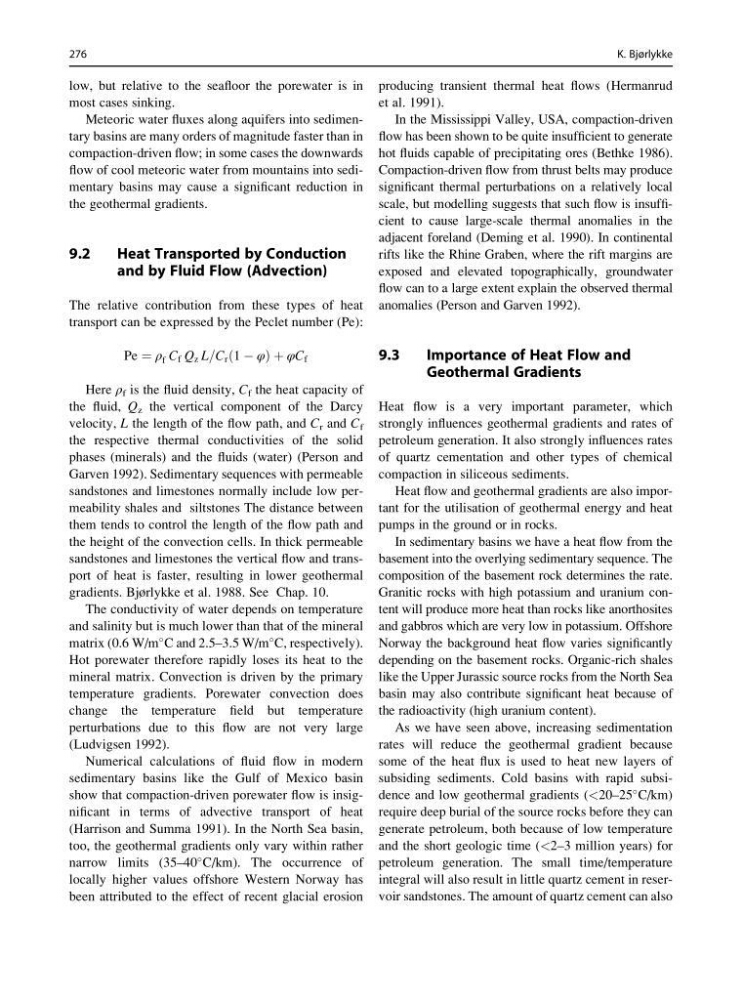
The relative contribution from these types of heat
transport can be expressed by the Peclet number (Pe):
Pe ¼ ρ f C f Q z L=C r 1 À φ
ð
ÞþφC f
Here ρ f is the fluid density, C f the heat capacity of
the fluid, Q z the vertical component of the Darcy
velocity, L the length of the flow path, and C r and C f
the respective thermal conductivities of the solid
phases (minerals) and the fluids (water) (Person and
Garven 1992). Sedimentary sequences with permeable
sandstones and limestones normally include low permeability shales and siltstones The distance between
them tends to control the length of the flow path and
the height of the convection cells. In thick permeable
sandstones and limestones the vertical flow and transport of heat is faster, resulting in lower geothermal
gradients. Bjørlykke et al. 1988. See Chap. 10.
The conductivity of water depends on temperature
and salinity but is much lower than that of the mineral
matrix (0.6 W/m
C and 2.5–3.5 W/m
C, respectively).
Hot porewater therefore rapidly loses its heat to the
mineral matrix. Convection is driven by the primary
temperature gradients. Porewater convection does
change the temperature field but temperature
perturbations due to this flow are not very large
(Ludvigsen 1992).
Numerical calculations of fluid flow in modern
sedimentary basins like the Gulf of Mexico basin
show that compaction-driven porewater flow is insignificant in terms of advective transport of heat
(Harrison and Summa 1991). In the North Sea basin,
too, the geothermal gradients only vary within rather
narrow limits (35–40
C/km). The occurrence of
locally higher values offshore Western Norway has
been attributed to the effect of recent glacial erosion
producing transient thermal heat flows (Hermanrud
et al. 1991).
In the Mississippi Valley, USA, compaction-driven
flow has been shown to be quite insufficient to generate
hot fluids capable of precipitating ores (Bethke 1986).
Compaction-driven flow from thrust belts may produce
significant thermal perturbations on a relatively local
scale, but modelling suggests that such flow is insufficient to cause large-scale thermal anomalies in the
adjacent foreland (Deming et al. 1990). In continental
rifts like the Rhine Graben, where the rift margins are
exposed and elevated topographically, groundwater
flow can to a large extent explain the observed thermal
anomalies (Person and Garven 1992).
9.3
Importance of Heat Flow and
Geothermal Gradients
Heat flow is a very important parameter, which
strongly influences geothermal gradients and rates of
petroleum generation. It also strongly influences rates
of quartz cementation and other types of chemical
compaction in siliceous sediments.
Heat flow and geothermal gradients are also important for the utilisation of geothermal energy and heat
pumps in the ground or in rocks.
In sedimentary basins we have a heat flow from the
basement into the overlying sedimentary sequence. The
composition of the basement rock determines the rate.
Granitic rocks with high potassium and uranium content will produce more heat than rocks like anorthosites
and gabbros which are very low in potassium. Offshore
Norway the background heat flow varies significantly
depending on the basement rocks. Organic-rich shales
like the Upper Jurassic source rocks from the North Sea
basin may also contribute significant heat because of
the radioactivity (high uranium content).
As we have seen above, increasing sedimentation
rates will reduce the geothermal gradient because
some of the heat flux is used to heat new layers of
subsiding sediments. Cold basins with rapid subsidence and low geothermal gradients (<20–25
C/km)
require deep burial of the source rocks before they can
generate petroleum, both because of low temperature
and the short geologic time (<2–3 million years) for
petroleum generation. The small time/temperature
integral will also result in little quartz cement in reservoir sandstones. The amount of quartz cement can also
276
K. Bjørlykke
most cases sinking.
Meteoric water fluxes along aquifers into sedimentary basins are many orders of magnitude faster than in
compaction-driven flow; in some cases the downwards
flow of cool meteoric water from mountains into sedimentary basins may cause a significant reduction in
the geothermal gradients.
9.2
Heat Transported by Conduction
and by Fluid Flow (Advection)
The relative contribution from these types of heat
transport can be expressed by the Peclet number (Pe):
Pe ¼ ρ f C f Q z L=C r 1 À φ
ð
ÞþφC f
Here ρ f is the fluid density, C f the heat capacity of
the fluid, Q z the vertical component of the Darcy
velocity, L the length of the flow path, and C r and C f
the respective thermal conductivities of the solid
phases (minerals) and the fluids (water) (Person and
Garven 1992). Sedimentary sequences with permeable
sandstones and limestones normally include low permeability shales and siltstones The distance between
them tends to control the length of the flow path and
the height of the convection cells. In thick permeable
sandstones and limestones the vertical flow and transport of heat is faster, resulting in lower geothermal
gradients. Bjørlykke et al. 1988. See Chap. 10.
The conductivity of water depends on temperature
and salinity but is much lower than that of the mineral
matrix (0.6 W/m
C and 2.5–3.5 W/m
C, respectively).
Hot porewater therefore rapidly loses its heat to the
mineral matrix. Convection is driven by the primary
temperature gradients. Porewater convection does
change the temperature field but temperature
perturbations due to this flow are not very large
(Ludvigsen 1992).
Numerical calculations of fluid flow in modern
sedimentary basins like the Gulf of Mexico basin
show that compaction-driven porewater flow is insignificant in terms of advective transport of heat
(Harrison and Summa 1991). In the North Sea basin,
too, the geothermal gradients only vary within rather
narrow limits (35–40
C/km). The occurrence of
locally higher values offshore Western Norway has
been attributed to the effect of recent glacial erosion
producing transient thermal heat flows (Hermanrud
et al. 1991).
In the Mississippi Valley, USA, compaction-driven
flow has been shown to be quite insufficient to generate
hot fluids capable of precipitating ores (Bethke 1986).
Compaction-driven flow from thrust belts may produce
significant thermal perturbations on a relatively local
scale, but modelling suggests that such flow is insufficient to cause large-scale thermal anomalies in the
adjacent foreland (Deming et al. 1990). In continental
rifts like the Rhine Graben, where the rift margins are
exposed and elevated topographically, groundwater
flow can to a large extent explain the observed thermal
anomalies (Person and Garven 1992).
9.3
Importance of Heat Flow and
Geothermal Gradients
Heat flow is a very important parameter, which
strongly influences geothermal gradients and rates of
petroleum generation. It also strongly influences rates
of quartz cementation and other types of chemical
compaction in siliceous sediments.
Heat flow and geothermal gradients are also important for the utilisation of geothermal energy and heat
pumps in the ground or in rocks.
In sedimentary basins we have a heat flow from the
basement into the overlying sedimentary sequence. The
composition of the basement rock determines the rate.
Granitic rocks with high potassium and uranium content will produce more heat than rocks like anorthosites
and gabbros which are very low in potassium. Offshore
Norway the background heat flow varies significantly
depending on the basement rocks. Organic-rich shales
like the Upper Jurassic source rocks from the North Sea
basin may also contribute significant heat because of
the radioactivity (high uranium content).
As we have seen above, increasing sedimentation
rates will reduce the geothermal gradient because
some of the heat flux is used to heat new layers of
subsiding sediments. Cold basins with rapid subsidence and low geothermal gradients (<20–25
C/km)
require deep burial of the source rocks before they can
generate petroleum, both because of low temperature
and the short geologic time (<2–3 million years) for
petroleum generation. The small time/temperature
integral will also result in little quartz cement in reservoir sandstones. The amount of quartz cement can also
276
K. Bjørlykke