

part of a delta out into the pro-delta muds. Relatively
thin transgressive sandstones may be deposited on the
delta top, and are useful for correlation. This is
because the relief on land may be very low so that a
few metres sea level rise causes a large transgression.
Transgressions will then result in a wide shelf with
little clastic supply, causing deposition of carbonates.
Thin calcareous sediments and limestones may therefore also be relatively close to time lines. Limestones
typically have rather high velocities and so we find
strong reflectors. On the delta slope, however, fluvial
sediments and marine delta front sand may prograde
into a marine basin over considerable geological time,
depending on the depth of the basin and the sediment
supply. The seismic reflections will follow the surface
from delta front sand to delta slope, where we have
sand and mud (shale) beds lying parallel with the
slope. Even though we can often follow the reflector
a little further into the basin, it will be less marked
there because there is less contrast in lithology and
hence in acoustic impedance. Different types of clay
may however also produce differences in seismic
response and particularly smectitic clays are
characterised by low density and velocity.
The shifting of sedimentation input from one part
of the delta to another through channel switching
(distributary abandonment as part of delta-lobe
shifting), also contributes to the formation of
lithological contrasts on the delta slope. Progradation
of new delta lobes results in deposition of sheets of
sand over mud near time-stratigraphic boundaries. The
inactive delta lobes will be compacted and often
develop a thin carbonate or transgressive sandstone
layer, while sedimentation takes place in the active
lobe. The small unconformities produced in this way
also tend to produce lithological contrasts which may
be recorded on the seismic record.
Seismic sections through prograding deltas provide
information about the water depth, the rate of sediment
input and the wave energy in the basin.
8.2
Different Types of Seismic
Signatures
A stratigraphic unit which is composed of a conformable bedding series, genetically linked together at the
top and bottom by unconformities, is called a depositional sequence. A depositional sequence is thus a
package of sediments deposited during a definite
period of time, defined by unconformities above and
below.
The unconformities may be due to a break in sedimentation due to relative changes in sea level or other
causes such as changes in sediment supply.
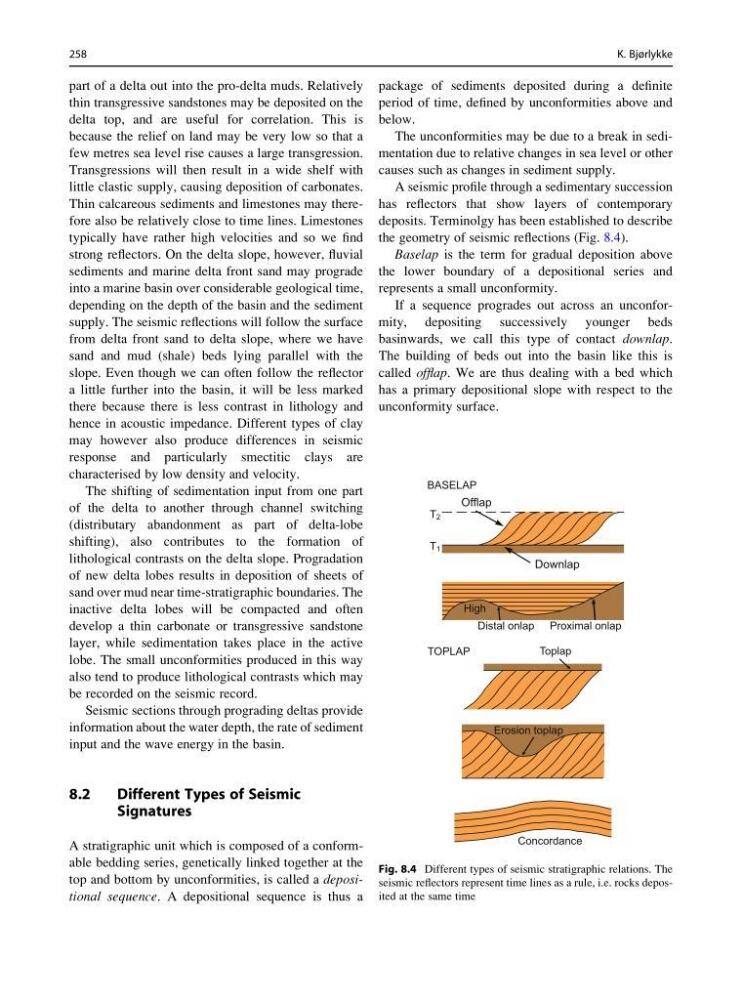
A seismic profile through a sedimentary succession
has reflectors that show layers of contemporary
deposits. Terminolgy has been established to describe
the geometry of seismic reflections (Fig. 8.4).
Baselap is the term for gradual deposition above
the lower boundary of a depositional series and
represents a small unconformity.
If a sequence progrades out across an unconformity, depositing successively younger beds
basinwards, we call this type of contact downlap.
The building of beds out into the basin like this is
called offlap. We are thus dealing with a bed which
has a primary depositional slope with respect to the
unconformity surface.
BASELAP
TOPLAP
Offlap
Downlap
High
Distal onlap Proximal onlap
Toplap
Concordance
T 2
T 1
Erosion toplap
Fig. 8.4 Different types of seismic stratigraphic relations. The
seismic reflectors represent time lines as a rule, i.e. rocks deposited at the same time
258
K. Bjørlykke
thin transgressive sandstones may be deposited on the
delta top, and are useful for correlation. This is
because the relief on land may be very low so that a
few metres sea level rise causes a large transgression.
Transgressions will then result in a wide shelf with
little clastic supply, causing deposition of carbonates.
Thin calcareous sediments and limestones may therefore also be relatively close to time lines. Limestones
typically have rather high velocities and so we find
strong reflectors. On the delta slope, however, fluvial
sediments and marine delta front sand may prograde
into a marine basin over considerable geological time,
depending on the depth of the basin and the sediment
supply. The seismic reflections will follow the surface
from delta front sand to delta slope, where we have
sand and mud (shale) beds lying parallel with the
slope. Even though we can often follow the reflector
a little further into the basin, it will be less marked
there because there is less contrast in lithology and
hence in acoustic impedance. Different types of clay
may however also produce differences in seismic
response and particularly smectitic clays are
characterised by low density and velocity.
The shifting of sedimentation input from one part
of the delta to another through channel switching
(distributary abandonment as part of delta-lobe
shifting), also contributes to the formation of
lithological contrasts on the delta slope. Progradation
of new delta lobes results in deposition of sheets of
sand over mud near time-stratigraphic boundaries. The
inactive delta lobes will be compacted and often
develop a thin carbonate or transgressive sandstone
layer, while sedimentation takes place in the active
lobe. The small unconformities produced in this way
also tend to produce lithological contrasts which may
be recorded on the seismic record.
Seismic sections through prograding deltas provide
information about the water depth, the rate of sediment
input and the wave energy in the basin.
8.2
Different Types of Seismic
Signatures
A stratigraphic unit which is composed of a conformable bedding series, genetically linked together at the
top and bottom by unconformities, is called a depositional sequence. A depositional sequence is thus a
package of sediments deposited during a definite
period of time, defined by unconformities above and
below.
The unconformities may be due to a break in sedimentation due to relative changes in sea level or other
causes such as changes in sediment supply.
A seismic profile through a sedimentary succession
has reflectors that show layers of contemporary
deposits. Terminolgy has been established to describe
the geometry of seismic reflections (Fig. 8.4).
Baselap is the term for gradual deposition above
the lower boundary of a depositional series and
represents a small unconformity.
If a sequence progrades out across an unconformity, depositing successively younger beds
basinwards, we call this type of contact downlap.
The building of beds out into the basin like this is
called offlap. We are thus dealing with a bed which
has a primary depositional slope with respect to the
unconformity surface.
BASELAP
TOPLAP
Offlap
Downlap
High
Distal onlap Proximal onlap
Toplap
Concordance
T 2
T 1
Erosion toplap
Fig. 8.4 Different types of seismic stratigraphic relations. The
seismic reflectors represent time lines as a rule, i.e. rocks deposited at the same time
258
K. Bjørlykke