

Onlap is the term for primarily almost horizontal
beds against a sloping unconformity which may be a
submarine or a subarial slope. It occurs most commonly as a result of sedimentation gradually burying
an unconformity during a transgression onto a land
surface that provides the unconformity (Fig. 8.5). We
call this proximal onlap or coastal onlap. If sedimentation covers a positive relief structure in the basin, for
example a horst or a salt dome, we get distal onlap
(Fig. 8.4).
Toplap is the contact between the seismic reflectors
and an upper unconformity. An erosion surface will
truncate the reflections sharply, forming an erosional
truncation (erosional toplap).
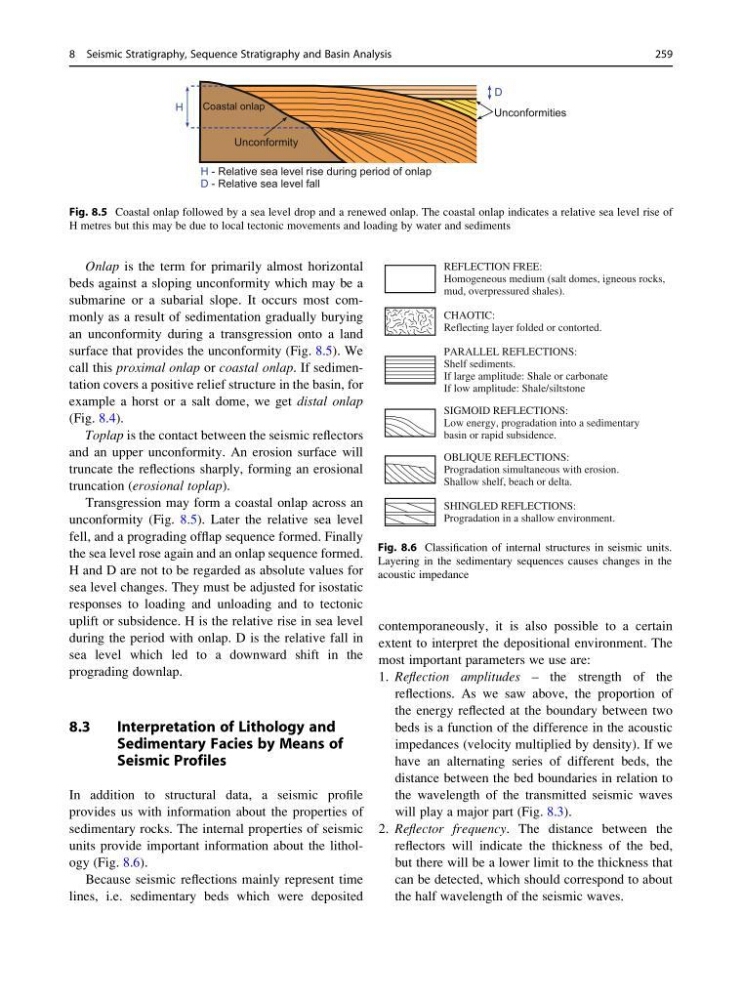
Transgression may form a coastal onlap across an
unconformity (Fig. 8.5). Later the relative sea level
fell, and a prograding offlap sequence formed. Finally
the sea level rose again and an onlap sequence formed.
H and D are not to be regarded as absolute values for
sea level changes. They must be adjusted for isostatic
responses to loading and unloading and to tectonic
uplift or subsidence. H is the relative rise in sea level
during the period with onlap. D is the relative fall in
sea level which led to a downward shift in the
prograding downlap.
8.3
Interpretation of Lithology and
Sedimentary Facies by Means of
Seismic Profiles
In addition to structural data, a seismic profile
provides us with information about the properties of
sedimentary rocks. The internal properties of seismic
units provide important information about the lithology (Fig. 8.6).
Because seismic reflections mainly represent time
lines, i.e. sedimentary beds which were deposited
contemporaneously, it is also possible to a certain
extent to interpret the depositional environment. The
most important parameters we use are:
1. Reflection amplitudes – the strength of the
reflections. As we saw above, the proportion of
the energy reflected at the boundary between two
beds is a function of the difference in the acoustic
impedances (velocity multiplied by density). If we
have an alternating series of different beds, the
distance between the bed boundaries in relation to
the wavelength of the transmitted seismic waves
will play a major part (Fig. 8.3).
2. Reflector frequency. The distance between the
reflectors will indicate the thickness of the bed,
but there will be a lower limit to the thickness that
can be detected, which should correspond to about
the half wavelength of the seismic waves.
H
D
Unconformities
Unconformity
Coastal onlap
H - Relative sea level rise during period of onlap
D - Relative sea level fall
Fig. 8.5 Coastal onlap followed by a sea level drop and a renewed onlap. The coastal onlap indicates a relative sea level rise of
H metres but this may be due to local tectonic movements and loading by water and sediments
REFLECTION FREE:
Homogeneous medium (salt domes, igneous rocks,
mud, overpressured shales).
CHAOTIC:
Reflecting layer folded or contorted.
PARALLEL REFLECTIONS:
Shelf sediments.
If large amplitude: Shale or carbonate
If low amplitude: Shale/siltstone
SIGMOID REFLECTIONS:
Low energy, progradation into a sedimentary
basin or rapid subsidence.
OBLIQUE REFLECTIONS:
Progradation simultaneous with erosion.
Shallow shelf, beach or delta.
SHINGLED REFLECTIONS:
Progradation in a shallow environment.
Fig. 8.6 Classification of internal structures in seismic units.
Layering in the sedimentary sequences causes changes in the
acoustic impedance
8 Seismic Stratigraphy, Sequence Stratigraphy and Basin Analysis
259
beds against a sloping unconformity which may be a
submarine or a subarial slope. It occurs most commonly as a result of sedimentation gradually burying
an unconformity during a transgression onto a land
surface that provides the unconformity (Fig. 8.5). We
call this proximal onlap or coastal onlap. If sedimentation covers a positive relief structure in the basin, for
example a horst or a salt dome, we get distal onlap
(Fig. 8.4).
Toplap is the contact between the seismic reflectors
and an upper unconformity. An erosion surface will
truncate the reflections sharply, forming an erosional
truncation (erosional toplap).
Transgression may form a coastal onlap across an
unconformity (Fig. 8.5). Later the relative sea level
fell, and a prograding offlap sequence formed. Finally
the sea level rose again and an onlap sequence formed.
H and D are not to be regarded as absolute values for
sea level changes. They must be adjusted for isostatic
responses to loading and unloading and to tectonic
uplift or subsidence. H is the relative rise in sea level
during the period with onlap. D is the relative fall in
sea level which led to a downward shift in the
prograding downlap.
8.3
Interpretation of Lithology and
Sedimentary Facies by Means of
Seismic Profiles
In addition to structural data, a seismic profile
provides us with information about the properties of
sedimentary rocks. The internal properties of seismic
units provide important information about the lithology (Fig. 8.6).
Because seismic reflections mainly represent time
lines, i.e. sedimentary beds which were deposited
contemporaneously, it is also possible to a certain
extent to interpret the depositional environment. The
most important parameters we use are:
1. Reflection amplitudes – the strength of the
reflections. As we saw above, the proportion of
the energy reflected at the boundary between two
beds is a function of the difference in the acoustic
impedances (velocity multiplied by density). If we
have an alternating series of different beds, the
distance between the bed boundaries in relation to
the wavelength of the transmitted seismic waves
will play a major part (Fig. 8.3).
2. Reflector frequency. The distance between the
reflectors will indicate the thickness of the bed,
but there will be a lower limit to the thickness that
can be detected, which should correspond to about
the half wavelength of the seismic waves.
H
D
Unconformities
Unconformity
Coastal onlap
H - Relative sea level rise during period of onlap
D - Relative sea level fall
Fig. 8.5 Coastal onlap followed by a sea level drop and a renewed onlap. The coastal onlap indicates a relative sea level rise of
H metres but this may be due to local tectonic movements and loading by water and sediments
REFLECTION FREE:
Homogeneous medium (salt domes, igneous rocks,
mud, overpressured shales).
CHAOTIC:
Reflecting layer folded or contorted.
PARALLEL REFLECTIONS:
Shelf sediments.
If large amplitude: Shale or carbonate
If low amplitude: Shale/siltstone
SIGMOID REFLECTIONS:
Low energy, progradation into a sedimentary
basin or rapid subsidence.
OBLIQUE REFLECTIONS:
Progradation simultaneous with erosion.
Shallow shelf, beach or delta.
SHINGLED REFLECTIONS:
Progradation in a shallow environment.
Fig. 8.6 Classification of internal structures in seismic units.
Layering in the sedimentary sequences causes changes in the
acoustic impedance
8 Seismic Stratigraphy, Sequence Stratigraphy and Basin Analysis
259