

Condensed sections have a large regional extent,
and show an expanding time span from coastal to
basinal areas (Fig. 7.12). They are particularly well
developed at the maximum flooding surface and help
to identify this horizon. Thus, condensed sections represent important levels of correlation within sedimentary basins. They are also applicable to recognition of
global transgressive-regressive cycles.
7.9.6 Sequence Types
During development of the sequence boundary the
relative sea level fall is of varying magnitude. The
sea level fall can continue to a position below the
shelf-slope break, or stop on the shelf. According to
these developments, two types of sequences are
distinguished.
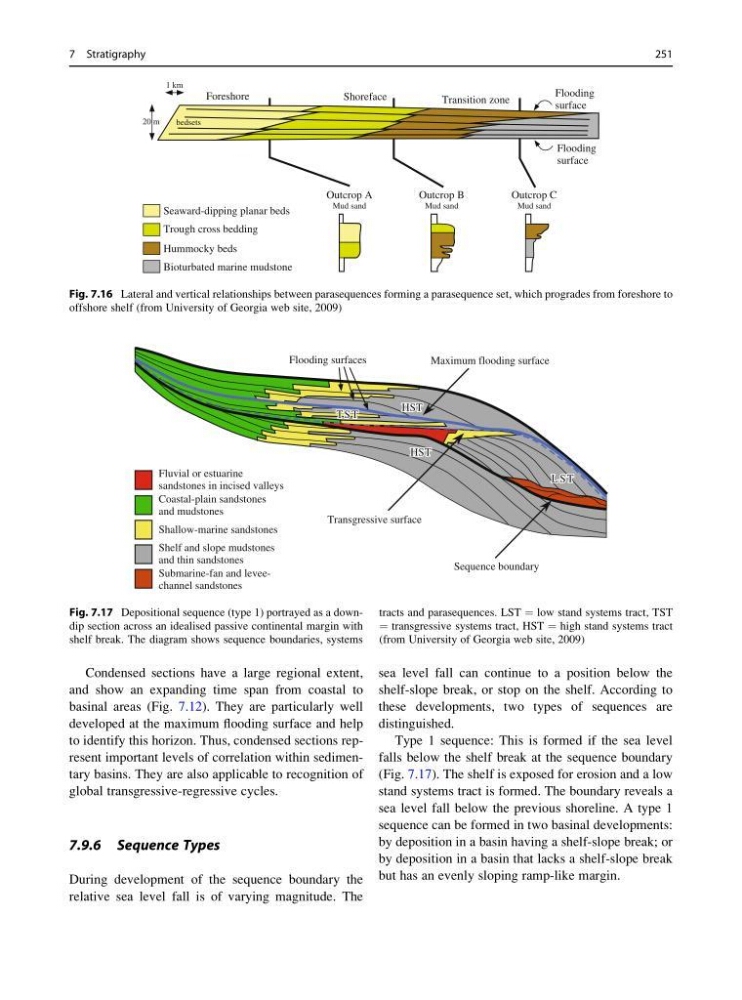
Type 1 sequence: This is formed if the sea level
falls below the shelf break at the sequence boundary
(Fig. 7.17). The shelf is exposed for erosion and a low
stand systems tract is formed. The boundary reveals a
sea level fall below the previous shoreline. A type 1
sequence can be formed in two basinal developments:
by deposition in a basin having a shelf-slope break; or
by deposition in a basin that lacks a shelf-slope break
but has an evenly sloping ramp-like margin.
Outcrop A
Mud sand
Outcrop B
Mud sand
Outcrop C
Mud sand
Foreshore
Shoreface
Transition zone
Flooding
surface
Flooding
surface
Seaward-dipping planar beds
Trough cross bedding
Hummocky beds
Bioturbated marine mudstone
bedsets
1 km
20 m
Fig. 7.16 Lateral and vertical relationships between parasequences forming a parasequence set, which progrades from foreshore to
offshore shelf (from University of Georgia web site, 2009)
Fluvial or estuarine
sandstones in incised valleys
Coastal-plain sandstones
and mudstones
Shallow-marine sandstones
Shelf and slope mudstones
and thin sandstones
Submarine-fan and leveechannel sandstones
Transgressive surface
Sequence boundary
Maximum flooding surface
Flooding surfaces
H
H HS S ST T T
T T T S S S T
T T
H H HS S ST T T
L
L L S S ST T T
Fig. 7.17 Depositional sequence (type 1) portrayed as a downdip section across an idealised passive continental margin with
shelf break. The diagram shows sequence boundaries, systems
tracts and parasequences. LST ¼ low stand systems tract, TST
¼ transgressive systems tract, HST ¼ high stand systems tract
(from University of Georgia web site, 2009)
7 Stratigraphy
251
and show an expanding time span from coastal to
basinal areas (Fig. 7.12). They are particularly well
developed at the maximum flooding surface and help
to identify this horizon. Thus, condensed sections represent important levels of correlation within sedimentary basins. They are also applicable to recognition of
global transgressive-regressive cycles.
7.9.6 Sequence Types
During development of the sequence boundary the
relative sea level fall is of varying magnitude. The
sea level fall can continue to a position below the
shelf-slope break, or stop on the shelf. According to
these developments, two types of sequences are
distinguished.
Type 1 sequence: This is formed if the sea level
falls below the shelf break at the sequence boundary
(Fig. 7.17). The shelf is exposed for erosion and a low
stand systems tract is formed. The boundary reveals a
sea level fall below the previous shoreline. A type 1
sequence can be formed in two basinal developments:
by deposition in a basin having a shelf-slope break; or
by deposition in a basin that lacks a shelf-slope break
but has an evenly sloping ramp-like margin.
Outcrop A
Mud sand
Outcrop B
Mud sand
Outcrop C
Mud sand
Foreshore
Shoreface
Transition zone
Flooding
surface
Flooding
surface
Seaward-dipping planar beds
Trough cross bedding
Hummocky beds
Bioturbated marine mudstone
bedsets
1 km
20 m
Fig. 7.16 Lateral and vertical relationships between parasequences forming a parasequence set, which progrades from foreshore to
offshore shelf (from University of Georgia web site, 2009)
Fluvial or estuarine
sandstones in incised valleys
Coastal-plain sandstones
and mudstones
Shallow-marine sandstones
Shelf and slope mudstones
and thin sandstones
Submarine-fan and leveechannel sandstones
Transgressive surface
Sequence boundary
Maximum flooding surface
Flooding surfaces
H
H HS S ST T T
T T T S S S T
T T
H H HS S ST T T
L
L L S S ST T T
Fig. 7.17 Depositional sequence (type 1) portrayed as a downdip section across an idealised passive continental margin with
shelf break. The diagram shows sequence boundaries, systems
tracts and parasequences. LST ¼ low stand systems tract, TST
¼ transgressive systems tract, HST ¼ high stand systems tract
(from University of Georgia web site, 2009)
7 Stratigraphy
251