

conformity. This can be recognised as a change in
lithology and facies. The sediments between two
unconformities or their correlative maximum regressive surface have been called a transgressive-regressive (T-R) sequence.
7.9.2 Accommodation Space
Local accommodation space for sediments represents
simply the water depth in the depositional area. A
global factor influencing the accommodation space is
the eustatic sea level stand which is defined by a
combination of several factors. One of these is the
volume of the ocean basins, which is believed to be
mainly controlled by the rate of seafloor spreading.
Young lithosphere is warm and buoyant, therefore it
will rise and decrease the volume of the world ocean.
On the contrary, old lithosphere is colder and denser,
and sinks. Another factor contributing to ocean volume changes is the sedimentation rate.
The volume of water in the ocean basins is also a
primary factor influencing eustatic sea level changes.
Continental
and
mountain
glaciations
and
deglaciations decrease and increase, respectively, the
volume of ocean water. These developments are
exemplified by the well-documented regressions and
transgressions accompanying Quaternary glacial and
interglacial periods (Fig. 7.13). Other factors
influencing the volume of oceanic waters are the
expansion of water with increasing temperature and
the amount of continental groundwater and surface
water.
Tectonic movements result in transgressions and
regressions of local to regional nature. These
movements are driven by factors that affect how continental lithosphere floats on the asthenosphere, which
is controlled by three main mechanisms: (1) Stretching
of continental lithosphere resulting in replacement of
continental lithosphere by denser and thinner
astenosphere which sinks. (2) During stretching, continental lithosphere is heated, becomes less dense and
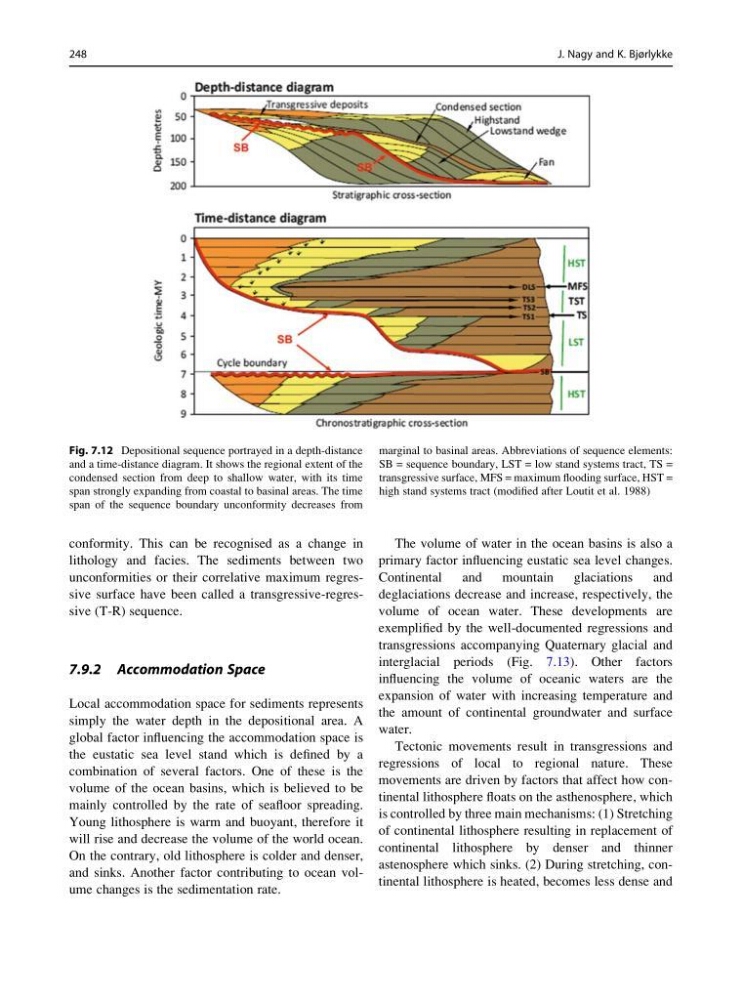
Fig. 7.12 Depositional sequence portrayed in a depth-distance
and a time-distance diagram. It shows the regional extent of the
condensed section from deep to shallow water, with its time
span strongly expanding from coastal to basinal areas. The time
span of the sequence boundary unconformity decreases from
marginal to basinal areas. Abbreviations of sequence elements:
SB = sequence boundary, LST = low stand systems tract, TS =
transgressive surface, MFS = maximum flooding surface, HST =
high stand systems tract (modified after Loutit et al. 1988)
248
J. Nagy and K. Bjørlykke
lithology and facies. The sediments between two
unconformities or their correlative maximum regressive surface have been called a transgressive-regressive (T-R) sequence.
7.9.2 Accommodation Space
Local accommodation space for sediments represents
simply the water depth in the depositional area. A
global factor influencing the accommodation space is
the eustatic sea level stand which is defined by a
combination of several factors. One of these is the
volume of the ocean basins, which is believed to be
mainly controlled by the rate of seafloor spreading.
Young lithosphere is warm and buoyant, therefore it
will rise and decrease the volume of the world ocean.
On the contrary, old lithosphere is colder and denser,
and sinks. Another factor contributing to ocean volume changes is the sedimentation rate.
The volume of water in the ocean basins is also a
primary factor influencing eustatic sea level changes.
Continental
and
mountain
glaciations
and
deglaciations decrease and increase, respectively, the
volume of ocean water. These developments are
exemplified by the well-documented regressions and
transgressions accompanying Quaternary glacial and
interglacial periods (Fig. 7.13). Other factors
influencing the volume of oceanic waters are the
expansion of water with increasing temperature and
the amount of continental groundwater and surface
water.
Tectonic movements result in transgressions and
regressions of local to regional nature. These
movements are driven by factors that affect how continental lithosphere floats on the asthenosphere, which
is controlled by three main mechanisms: (1) Stretching
of continental lithosphere resulting in replacement of
continental lithosphere by denser and thinner
astenosphere which sinks. (2) During stretching, continental lithosphere is heated, becomes less dense and
Fig. 7.12 Depositional sequence portrayed in a depth-distance
and a time-distance diagram. It shows the regional extent of the
condensed section from deep to shallow water, with its time
span strongly expanding from coastal to basinal areas. The time
span of the sequence boundary unconformity decreases from
marginal to basinal areas. Abbreviations of sequence elements:
SB = sequence boundary, LST = low stand systems tract, TS =
transgressive surface, MFS = maximum flooding surface, HST =
high stand systems tract (modified after Loutit et al. 1988)
248
J. Nagy and K. Bjørlykke