

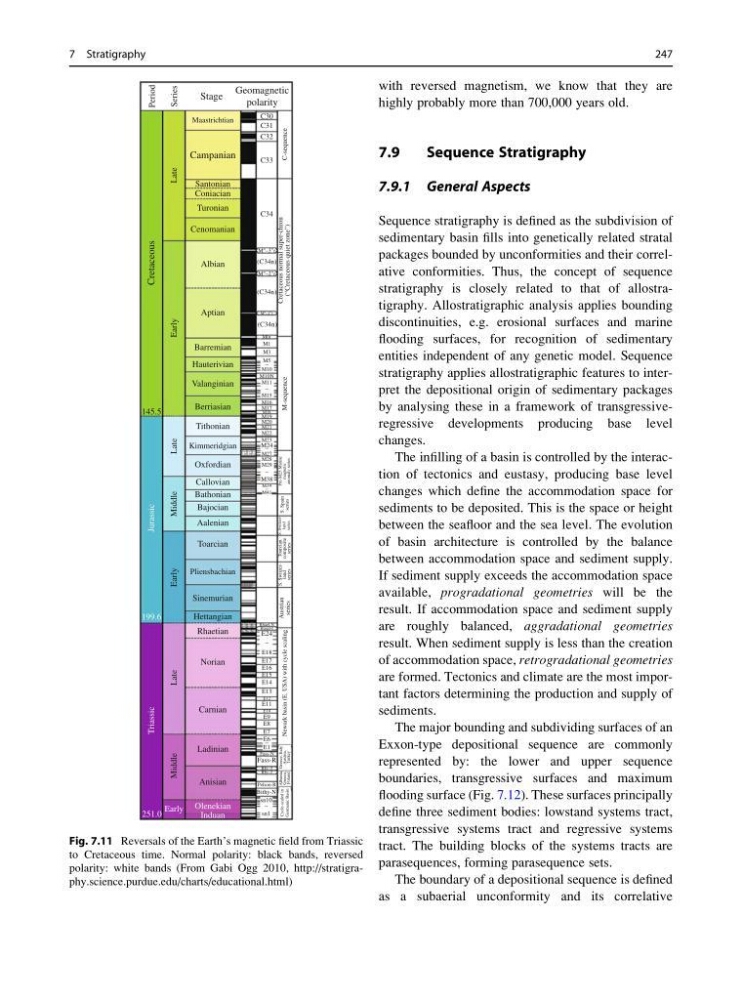
with reversed magnetism, we know that they are
highly probably more than 700,000 years old.
7.9
Sequence Stratigraphy
7.9.1 General Aspects
Sequence stratigraphy is defined as the subdivision of
sedimentary basin fills into genetically related stratal
packages bounded by unconformities and their correlative conformities. Thus, the concept of sequence
stratigraphy is closely related to that of allostratigraphy. Allostratigraphic analysis applies bounding
discontinuities, e.g. erosional surfaces and marine
flooding surfaces, for recognition of sedimentary
entities independent of any genetic model. Sequence
stratigraphy applies allostratigraphic features to interpret the depositional origin of sedimentary packages
by analysing these in a framework of transgressiveregressive developments producing base level
changes.
The infilling of a basin is controlled by the interaction of tectonics and eustasy, producing base level
changes which define the accommodation space for
sediments to be deposited. This is the space or height
between the seafloor and the sea level. The evolution
of basin architecture is controlled by the balance
between accommodation space and sediment supply.
If sediment supply exceeds the accommodation space
available, progradational geometries will be the
result. If accommodation space and sediment supply
are roughly balanced, aggradational geometries
result. When sediment supply is less than the creation
of accommodation space, retrogradational geometries
are formed. Tectonics and climate are the most important factors determining the production and supply of
sediments.
The major bounding and subdividing surfaces of an
Exxon-type depositional sequence are commonly
represented by: the lower and upper sequence
boundaries, transgressive surfaces and maximum
flooding surface (Fig. 7.12). These surfaces principally
define three sediment bodies: lowstand systems tract,
transgressive systems tract and regressive systems
tract. The building blocks of the systems tracts are
parasequences, forming parasequence sets.
The boundary of a depositional sequence is defined
as a subaerial unconformity and its correlative
Campanian
Stage
Geomagnetic
polarity
Santonian
Coniacian
Turonian
Cenomanian
Albian
Aptian
Barremian
Hauterivian
Valanginian
Berriasian
Tithonian
145.5
199.6
Oxfordian
Callovian
Bathonian
Bajocian
Aalenian
Toarcian
Sinemurian
Hettangian
Rhaetian
Norian
Carnian
Ladinian
Middle
Triassic
Late
Early
Middle
Late
Early
Cretaceous
Late
Series
Period
Jurassic
Anisian
Early
251.0
Olenekian
Induan
Pliensbachian
Kimmeridgian
Maastrichtian
C30
C31
C32
C33
C34
M″–3”r
M″–2”r
M″–1”r
M0r
(C34n)
(C34n)
(C34n)
M1
M3
M5
M10
M10N
M11
M15
M16
M17
M19
M20
M22
M23
M24
M27
M28
M29
M38
M39
M41
Rhael-N
Basal-I
E24
E18
E17
E16
E15
E14
E13
E11
E9
E8
E7
E6
E1
Fass-N
IIIy–3
IIIy–2
Pelson-R
Bithy-N
sn10
sn1
Cycle-scaled in
Germanic Basin
Albania,
Greece,
Poland
Greece, Italy
Austria,
Turkey
Newark basin (E. USA) with cycle scaling
Austrian
series
S. Switzerland
series
Toarcian
composite
series
S. Spain
series
Pre-M25 Marine
magnetic
anomaly series
M-sequence
Cretaceous normal super-chron
(“Cretaceous quiet zone”)
C-sequence
S. Switzerland
series
–
Fass-R
–
E12
E10
–
M18
M21
–
–
–
–
–
Fig. 7.11 Reversals of the Earth’s magnetic field from Triassic
to Cretaceous time. Normal polarity: black bands, reversed
polarity: white bands (From Gabi Ogg 2010, http://stratigraphy.science.purdue.edu/charts/educational.html)
7 Stratigraphy
247
highly probably more than 700,000 years old.
7.9
Sequence Stratigraphy
7.9.1 General Aspects
Sequence stratigraphy is defined as the subdivision of
sedimentary basin fills into genetically related stratal
packages bounded by unconformities and their correlative conformities. Thus, the concept of sequence
stratigraphy is closely related to that of allostratigraphy. Allostratigraphic analysis applies bounding
discontinuities, e.g. erosional surfaces and marine
flooding surfaces, for recognition of sedimentary
entities independent of any genetic model. Sequence
stratigraphy applies allostratigraphic features to interpret the depositional origin of sedimentary packages
by analysing these in a framework of transgressiveregressive developments producing base level
changes.
The infilling of a basin is controlled by the interaction of tectonics and eustasy, producing base level
changes which define the accommodation space for
sediments to be deposited. This is the space or height
between the seafloor and the sea level. The evolution
of basin architecture is controlled by the balance
between accommodation space and sediment supply.
If sediment supply exceeds the accommodation space
available, progradational geometries will be the
result. If accommodation space and sediment supply
are roughly balanced, aggradational geometries
result. When sediment supply is less than the creation
of accommodation space, retrogradational geometries
are formed. Tectonics and climate are the most important factors determining the production and supply of
sediments.
The major bounding and subdividing surfaces of an
Exxon-type depositional sequence are commonly
represented by: the lower and upper sequence
boundaries, transgressive surfaces and maximum
flooding surface (Fig. 7.12). These surfaces principally
define three sediment bodies: lowstand systems tract,
transgressive systems tract and regressive systems
tract. The building blocks of the systems tracts are
parasequences, forming parasequence sets.
The boundary of a depositional sequence is defined
as a subaerial unconformity and its correlative
Campanian
Stage
Geomagnetic
polarity
Santonian
Coniacian
Turonian
Cenomanian
Albian
Aptian
Barremian
Hauterivian
Valanginian
Berriasian
Tithonian
145.5
199.6
Oxfordian
Callovian
Bathonian
Bajocian
Aalenian
Toarcian
Sinemurian
Hettangian
Rhaetian
Norian
Carnian
Ladinian
Middle
Triassic
Late
Early
Middle
Late
Early
Cretaceous
Late
Series
Period
Jurassic
Anisian
Early
251.0
Olenekian
Induan
Pliensbachian
Kimmeridgian
Maastrichtian
C30
C31
C32
C33
C34
M″–3”r
M″–2”r
M″–1”r
M0r
(C34n)
(C34n)
(C34n)
M1
M3
M5
M10
M10N
M11
M15
M16
M17
M19
M20
M22
M23
M24
M27
M28
M29
M38
M39
M41
Rhael-N
Basal-I
E24
E18
E17
E16
E15
E14
E13
E11
E9
E8
E7
E6
E1
Fass-N
IIIy–3
IIIy–2
Pelson-R
Bithy-N
sn10
sn1
Cycle-scaled in
Germanic Basin
Albania,
Greece,
Poland
Greece, Italy
Austria,
Turkey
Newark basin (E. USA) with cycle scaling
Austrian
series
S. Switzerland
series
Toarcian
composite
series
S. Spain
series
Pre-M25 Marine
magnetic
anomaly series
M-sequence
Cretaceous normal super-chron
(“Cretaceous quiet zone”)
C-sequence
S. Switzerland
series
–
Fass-R
–
E12
E10
–
M18
M21
–
–
–
–
–
Fig. 7.11 Reversals of the Earth’s magnetic field from Triassic
to Cretaceous time. Normal polarity: black bands, reversed
polarity: white bands (From Gabi Ogg 2010, http://stratigraphy.science.purdue.edu/charts/educational.html)
7 Stratigraphy
247