

organs of terrestrial plants, but are dispersed principally as plankton (by air or water).
It is obvious that the pelagic group contains
microfossils with particularly high stratigraphic applicability, owing to their relative independence of
facies, e.g. planktonic foraminifera, calcareous nannoplankton, dinoflagellates and the nektonic conodonts.
Benthic biota usually have less stratigraphic potential,
although they are also commonly used for this purpose, particularly in marginal marine deposits where
planktonic biota are rare. On the other hand, benthic
forms are commonly excellent facies indicators, e.g.
benthic foraminifera and ostracods.
7.3.2.2 Environmental Distribution
The life habitat of biota is of prime importance both
for stratigraphical purposes and biofacies analysis. In
non-marine subaquatic environments important fossil
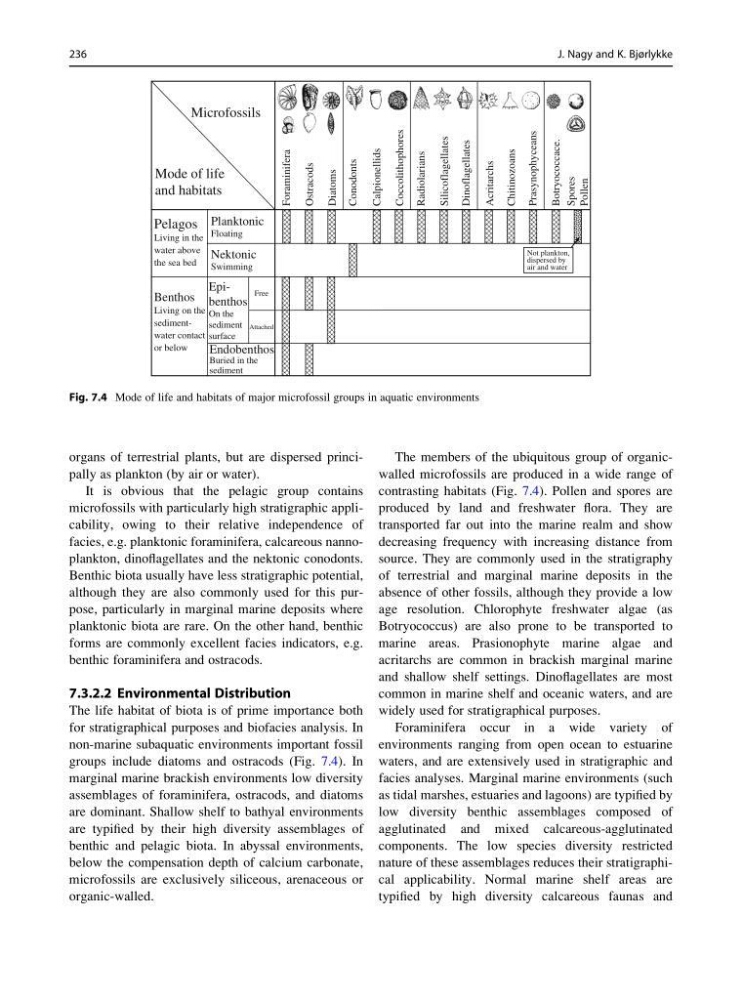
groups include diatoms and ostracods (Fig. 7.4). In
marginal marine brackish environments low diversity
assemblages of foraminifera, ostracods, and diatoms
are dominant. Shallow shelf to bathyal environments
are typified by their high diversity assemblages of
benthic and pelagic biota. In abyssal environments,
below the compensation depth of calcium carbonate,
microfossils are exclusively siliceous, arenaceous or
organic-walled.
The members of the ubiquitous group of organicwalled microfossils are produced in a wide range of
contrasting habitats (Fig. 7.4). Pollen and spores are
produced by land and freshwater flora. They are
transported far out into the marine realm and show
decreasing frequency with increasing distance from
source. They are commonly used in the stratigraphy
of terrestrial and marginal marine deposits in the
absence of other fossils, although they provide a low
age resolution. Chlorophyte freshwater algae (as
Botryococcus) are also prone to be transported to
marine areas. Prasionophyte marine algae and
acritarchs are common in brackish marginal marine
and shallow shelf settings. Dinoflagellates are most
common in marine shelf and oceanic waters, and are
widely used for stratigraphical purposes.
Foraminifera occur in a wide variety of
environments ranging from open ocean to estuarine
waters, and are extensively used in stratigraphic and
facies analyses. Marginal marine environments (such
as tidal marshes, estuaries and lagoons) are typified by
low diversity benthic assemblages composed of
agglutinated and mixed calcareous-agglutinated
components. The low species diversity restricted
nature of these assemblages reduces their stratigraphical applicability. Normal marine shelf areas are
typified by high diversity calcareous faunas and
Foraminifera
Ostracods
Diatoms
Conodonts
Calpionellids
Coccolithophores
Radiolarians
Silicoflagellates
Dinoflagellates
Acritarchs
Chitinozoans
Prasynophyceans
Botryococcace.
Spores
Pollen
Microfossils
Mode of life
and habitats
Pelagos
Living in the
water above
the sea bed
Benthos
Living on the
sedimentwater contact
or below
Planktonic
Floating
Nektonic
Swimming
Epibenthos
On the
sediment
surface
Endobenthos
Buried in the
sediment
Attached
Free
Not plankton,
dispersed by
air and water
Fig. 7.4 Mode of life and habitats of major microfossil groups in aquatic environments
236
J. Nagy and K. Bjørlykke
It is obvious that the pelagic group contains
microfossils with particularly high stratigraphic applicability, owing to their relative independence of
facies, e.g. planktonic foraminifera, calcareous nannoplankton, dinoflagellates and the nektonic conodonts.
Benthic biota usually have less stratigraphic potential,
although they are also commonly used for this purpose, particularly in marginal marine deposits where
planktonic biota are rare. On the other hand, benthic
forms are commonly excellent facies indicators, e.g.
benthic foraminifera and ostracods.
7.3.2.2 Environmental Distribution
The life habitat of biota is of prime importance both
for stratigraphical purposes and biofacies analysis. In
non-marine subaquatic environments important fossil
groups include diatoms and ostracods (Fig. 7.4). In
marginal marine brackish environments low diversity
assemblages of foraminifera, ostracods, and diatoms
are dominant. Shallow shelf to bathyal environments
are typified by their high diversity assemblages of
benthic and pelagic biota. In abyssal environments,
below the compensation depth of calcium carbonate,
microfossils are exclusively siliceous, arenaceous or
organic-walled.
The members of the ubiquitous group of organicwalled microfossils are produced in a wide range of
contrasting habitats (Fig. 7.4). Pollen and spores are
produced by land and freshwater flora. They are
transported far out into the marine realm and show
decreasing frequency with increasing distance from
source. They are commonly used in the stratigraphy
of terrestrial and marginal marine deposits in the
absence of other fossils, although they provide a low
age resolution. Chlorophyte freshwater algae (as
Botryococcus) are also prone to be transported to
marine areas. Prasionophyte marine algae and
acritarchs are common in brackish marginal marine
and shallow shelf settings. Dinoflagellates are most
common in marine shelf and oceanic waters, and are
widely used for stratigraphical purposes.
Foraminifera occur in a wide variety of
environments ranging from open ocean to estuarine
waters, and are extensively used in stratigraphic and
facies analyses. Marginal marine environments (such
as tidal marshes, estuaries and lagoons) are typified by
low diversity benthic assemblages composed of
agglutinated and mixed calcareous-agglutinated
components. The low species diversity restricted
nature of these assemblages reduces their stratigraphical applicability. Normal marine shelf areas are
typified by high diversity calcareous faunas and
Foraminifera
Ostracods
Diatoms
Conodonts
Calpionellids
Coccolithophores
Radiolarians
Silicoflagellates
Dinoflagellates
Acritarchs
Chitinozoans
Prasynophyceans
Botryococcace.
Spores
Pollen
Microfossils
Mode of life
and habitats
Pelagos
Living in the
water above
the sea bed
Benthos
Living on the
sedimentwater contact
or below
Planktonic
Floating
Nektonic
Swimming
Epibenthos
On the
sediment
surface
Endobenthos
Buried in the
sediment
Attached
Free
Not plankton,
dispersed by
air and water
Fig. 7.4 Mode of life and habitats of major microfossil groups in aquatic environments
236
J. Nagy and K. Bjørlykke