

(6) Presence of many distinct morphological features,
increasing the precision level of taxon identification.
7.3.2.1 Mode of Life
The mode of life (ethology) of organisms is crucial for
the regional distribution of their fossil remains. Living
and fossil biota can be arranged into two ethological
groups (Fig. 7.4). Pelagic organisms live freely in the
water column and comprise the planktonic forms (passively floating) and nektonic forms (actively swimming). The benthos comprises bottom dwelling
organisms belonging to epibenthos (living at the
sediment/water interface), and endobenthos (living
buried in the sediment). Epibenthic forms are freely
moving or are attached to firm surfaces. Foraminifera
as a group reveal the widest environmental range by
being represented in all the ethological categories
except nektonic. Ostracods and diatoms also have a
relatively wide range as they occur both in the benthic
and pelagic habitats. Conodonts are regarded to have a
nektonic origin. Acritarchs, dinoflagellates, calcareous
nannoplankton, radiolarians and several minor groups
are exclusively planktonic. Spores and pollen occupy a
special position because they are the reproductive
Periods
Micro-fossils
Ostracods
(Extant)
Quaternary
Tertiary
Cretaceous
Jurassic
Triassic
Permian
Carboniferous
Devonian
Silurian
Ordovician
Palaeozoic
Mesozoic
Cenozoic
Cambrian
Precambrian
?
Eras
Tasmanitids
Acritarchs
Chitinozoa
Dinoflagellates
Conodonts
Radiolaria
Diatoms
Silicoflagellates
Ebridians
Skeletal
calc algae
Ostracods
Foraminifera
Bryozoa
Calcareous
nannoplankton
Calpionellids
Organic-walled
Siliceous
Calcareous
Phosphatic
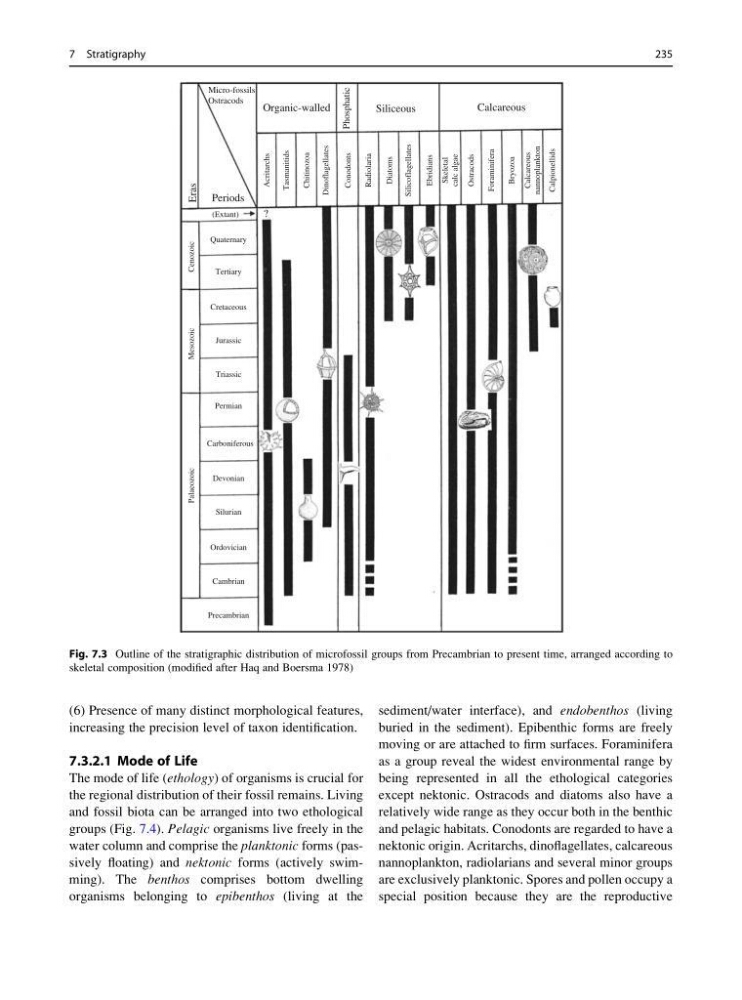
Fig. 7.3 Outline of the stratigraphic distribution of microfossil groups from Precambrian to present time, arranged according to
skeletal composition (modified after Haq and Boersma 1978)
7 Stratigraphy
235
increasing the precision level of taxon identification.
7.3.2.1 Mode of Life
The mode of life (ethology) of organisms is crucial for
the regional distribution of their fossil remains. Living
and fossil biota can be arranged into two ethological
groups (Fig. 7.4). Pelagic organisms live freely in the
water column and comprise the planktonic forms (passively floating) and nektonic forms (actively swimming). The benthos comprises bottom dwelling
organisms belonging to epibenthos (living at the
sediment/water interface), and endobenthos (living
buried in the sediment). Epibenthic forms are freely
moving or are attached to firm surfaces. Foraminifera
as a group reveal the widest environmental range by
being represented in all the ethological categories
except nektonic. Ostracods and diatoms also have a
relatively wide range as they occur both in the benthic
and pelagic habitats. Conodonts are regarded to have a
nektonic origin. Acritarchs, dinoflagellates, calcareous
nannoplankton, radiolarians and several minor groups
are exclusively planktonic. Spores and pollen occupy a
special position because they are the reproductive
Periods
Micro-fossils
Ostracods
(Extant)
Quaternary
Tertiary
Cretaceous
Jurassic
Triassic
Permian
Carboniferous
Devonian
Silurian
Ordovician
Palaeozoic
Mesozoic
Cenozoic
Cambrian
Precambrian
?
Eras
Tasmanitids
Acritarchs
Chitinozoa
Dinoflagellates
Conodonts
Radiolaria
Diatoms
Silicoflagellates
Ebridians
Skeletal
calc algae
Ostracods
Foraminifera
Bryozoa
Calcareous
nannoplankton
Calpionellids
Organic-walled
Siliceous
Calcareous
Phosphatic
Fig. 7.3 Outline of the stratigraphic distribution of microfossil groups from Precambrian to present time, arranged according to
skeletal composition (modified after Haq and Boersma 1978)
7 Stratigraphy
235