

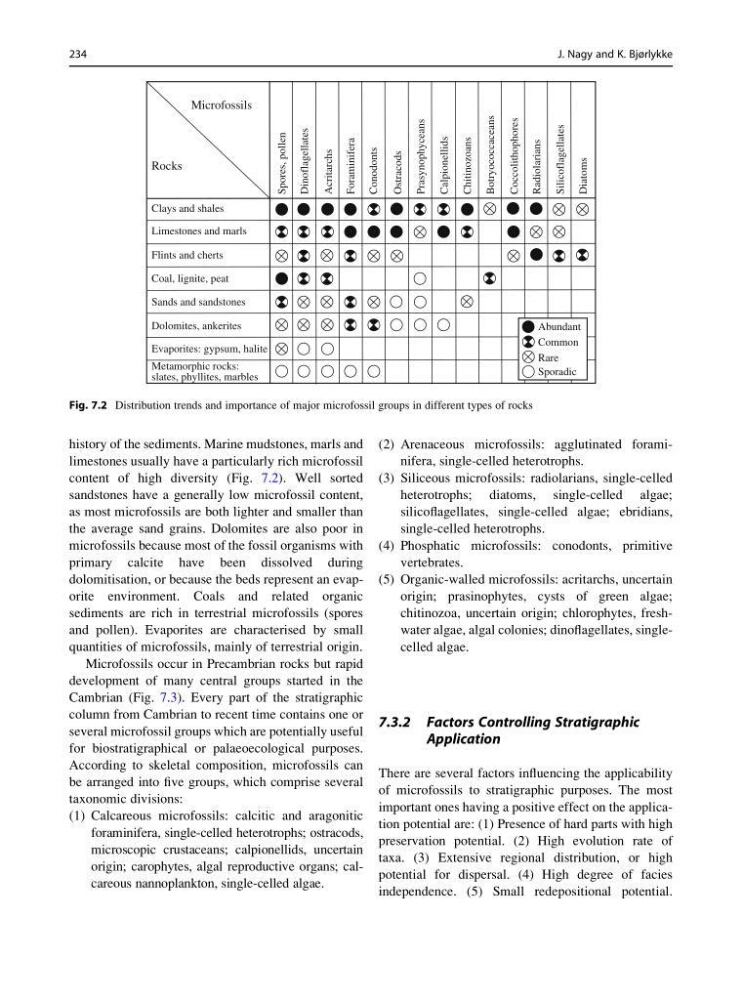
history of the sediments. Marine mudstones, marls and
limestones usually have a particularly rich microfossil
content of high diversity (Fig. 7.2). Well sorted
sandstones have a generally low microfossil content,
as most microfossils are both lighter and smaller than
the average sand grains. Dolomites are also poor in
microfossils because most of the fossil organisms with
primary calcite have been dissolved during
dolomitisation, or because the beds represent an evaporite environment. Coals and related organic
sediments are rich in terrestrial microfossils (spores
and pollen). Evaporites are characterised by small
quantities of microfossils, mainly of terrestrial origin.
Microfossils occur in Precambrian rocks but rapid
development of many central groups started in the
Cambrian (Fig. 7.3). Every part of the stratigraphic
column from Cambrian to recent time contains one or
several microfossil groups which are potentially useful
for biostratigraphical or palaeoecological purposes.
According to skeletal composition, microfossils can
be arranged into five groups, which comprise several
taxonomic divisions:
(1) Calcareous microfossils: calcitic and aragonitic
foraminifera, single-celled heterotrophs; ostracods,
microscopic crustaceans; calpionellids, uncertain
origin; carophytes, algal reproductive organs; calcareous nannoplankton, single-celled algae.
(2) Arenaceous microfossils: agglutinated foraminifera, single-celled heterotrophs.
(3) Siliceous microfossils: radiolarians, single-celled
heterotrophs; diatoms, single-celled algae;
silicoflagellates, single-celled algae; ebridians,
single-celled heterotrophs.
(4) Phosphatic microfossils: conodonts, primitive
vertebrates.
(5) Organic-walled microfossils: acritarchs, uncertain
origin; prasinophytes, cysts of green algae;
chitinozoa, uncertain origin; chlorophytes, freshwater algae, algal colonies; dinoflagellates, singlecelled algae.
7.3.2 Factors Controlling Stratigraphic
Application
There are several factors influencing the applicability
of microfossils to stratigraphic purposes. The most
important ones having a positive effect on the application potential are: (1) Presence of hard parts with high
preservation potential. (2) High evolution rate of
taxa. (3) Extensive regional distribution, or high
potential for dispersal. (4) High degree of facies
independence. (5) Small redepositional potential.
Spores, pollen
Dinoflagellates
Acritarchs
Conodonts
Foraminifera
Ostracods
Calpionellids
Chitinozoans
Botryococcaceans
Coccolithophores
Radiolarians
Silicoflagellates
Microfossils
Rocks
Clays and shales
Prasynophyceans
Diatoms
Limestones and marls
Metamorphic rocks:
slates, phyllites, marbles
Flints and cherts
Coal, lignite, peat
Sands and sandstones
Dolomites, ankerites
Evaporites: gypsum, halite
Abundant
Common
Rare
Sporadic
Fig. 7.2 Distribution trends and importance of major microfossil groups in different types of rocks
234
J. Nagy and K. Bjørlykke
limestones usually have a particularly rich microfossil
content of high diversity (Fig. 7.2). Well sorted
sandstones have a generally low microfossil content,
as most microfossils are both lighter and smaller than
the average sand grains. Dolomites are also poor in
microfossils because most of the fossil organisms with
primary calcite have been dissolved during
dolomitisation, or because the beds represent an evaporite environment. Coals and related organic
sediments are rich in terrestrial microfossils (spores
and pollen). Evaporites are characterised by small
quantities of microfossils, mainly of terrestrial origin.
Microfossils occur in Precambrian rocks but rapid
development of many central groups started in the
Cambrian (Fig. 7.3). Every part of the stratigraphic
column from Cambrian to recent time contains one or
several microfossil groups which are potentially useful
for biostratigraphical or palaeoecological purposes.
According to skeletal composition, microfossils can
be arranged into five groups, which comprise several
taxonomic divisions:
(1) Calcareous microfossils: calcitic and aragonitic
foraminifera, single-celled heterotrophs; ostracods,
microscopic crustaceans; calpionellids, uncertain
origin; carophytes, algal reproductive organs; calcareous nannoplankton, single-celled algae.
(2) Arenaceous microfossils: agglutinated foraminifera, single-celled heterotrophs.
(3) Siliceous microfossils: radiolarians, single-celled
heterotrophs; diatoms, single-celled algae;
silicoflagellates, single-celled algae; ebridians,
single-celled heterotrophs.
(4) Phosphatic microfossils: conodonts, primitive
vertebrates.
(5) Organic-walled microfossils: acritarchs, uncertain
origin; prasinophytes, cysts of green algae;
chitinozoa, uncertain origin; chlorophytes, freshwater algae, algal colonies; dinoflagellates, singlecelled algae.
7.3.2 Factors Controlling Stratigraphic
Application
There are several factors influencing the applicability
of microfossils to stratigraphic purposes. The most
important ones having a positive effect on the application potential are: (1) Presence of hard parts with high
preservation potential. (2) High evolution rate of
taxa. (3) Extensive regional distribution, or high
potential for dispersal. (4) High degree of facies
independence. (5) Small redepositional potential.
Spores, pollen
Dinoflagellates
Acritarchs
Conodonts
Foraminifera
Ostracods
Calpionellids
Chitinozoans
Botryococcaceans
Coccolithophores
Radiolarians
Silicoflagellates
Microfossils
Rocks
Clays and shales
Prasynophyceans
Diatoms
Limestones and marls
Metamorphic rocks:
slates, phyllites, marbles
Flints and cherts
Coal, lignite, peat
Sands and sandstones
Dolomites, ankerites
Evaporites: gypsum, halite
Abundant
Common
Rare
Sporadic
Fig. 7.2 Distribution trends and importance of major microfossil groups in different types of rocks
234
J. Nagy and K. Bjørlykke