

7.3
Biostratigraphy
Biostratigraphy is based on the fossils in sedimentary
rocks. Its tasks are to group strata into units
characterized by fossil content, and apply these to
date and correlate sedimentary successions. Biostratigraphy has made it possible to correlate sedimentary
rocks on a global scale, and forms the foundation for
global stratigraphic classification of sedimentary
successions in combination with radiometric and
other age dating methods. The biostratigraphic application of fossils is based on the fact that during the
course of geological time, biological evolution took
place whereby some species died out and new ones
appeared. Any particular species will therefore be
represented only in sediments deposited within a limited time span, and can be used to recognise this time
span or part of it.
7.3.1 Nature of the Fossil Record
7.3.1.1 Fields of Application
Industrial application of biostratigraphy is mainly
based on microfossils, owing to the fact that these
microscopic remains commonly occur in large
amounts, and can be extracted easily both from drill
cuttings, sidewall cores as well as conventional cores.
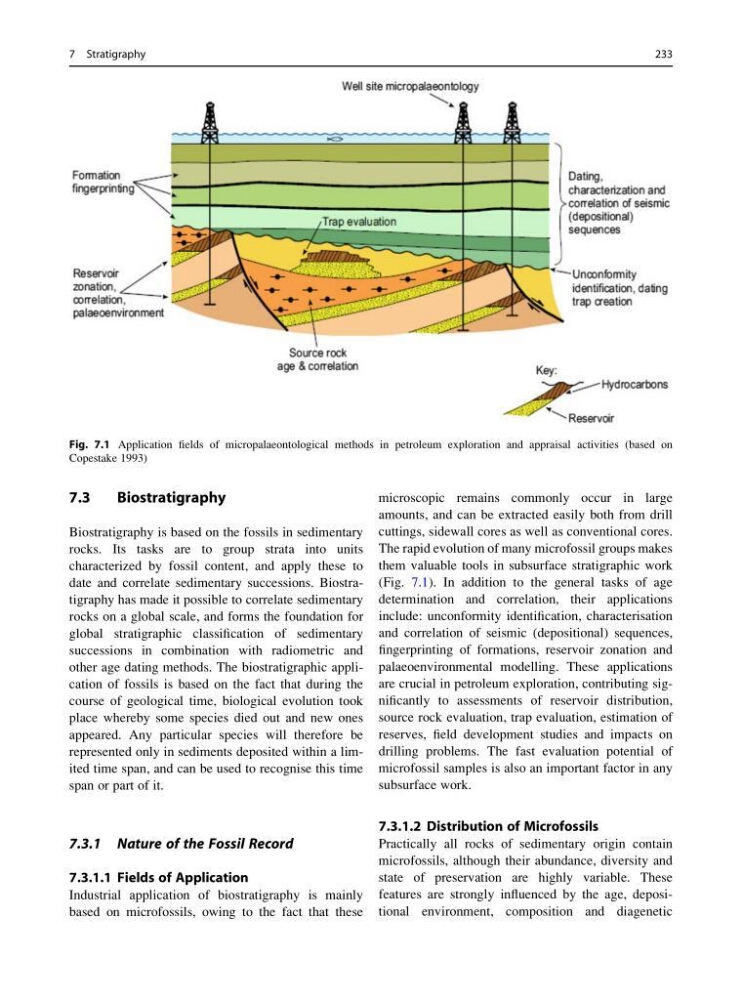
The rapid evolution of many microfossil groups makes
them valuable tools in subsurface stratigraphic work
(Fig. 7.1). In addition to the general tasks of age
determination and correlation, their applications
include: unconformity identification, characterisation
and correlation of seismic (depositional) sequences,
fingerprinting of formations, reservoir zonation and
palaeoenvironmental modelling. These applications
are crucial in petroleum exploration, contributing significantly to assessments of reservoir distribution,
source rock evaluation, trap evaluation, estimation of
reserves, field development studies and impacts on
drilling problems. The fast evaluation potential of
microfossil samples is also an important factor in any
subsurface work.
7.3.1.2 Distribution of Microfossils
Practically all rocks of sedimentary origin contain
microfossils, although their abundance, diversity and
state of preservation are highly variable. These
features are strongly influenced by the age, depositional environment, composition and diagenetic
Fig. 7.1 Application fields of micropalaeontological methods in petroleum exploration and appraisal activities (based on
Copestake 1993)
7 Stratigraphy
233
Biostratigraphy
Biostratigraphy is based on the fossils in sedimentary
rocks. Its tasks are to group strata into units
characterized by fossil content, and apply these to
date and correlate sedimentary successions. Biostratigraphy has made it possible to correlate sedimentary
rocks on a global scale, and forms the foundation for
global stratigraphic classification of sedimentary
successions in combination with radiometric and
other age dating methods. The biostratigraphic application of fossils is based on the fact that during the
course of geological time, biological evolution took
place whereby some species died out and new ones
appeared. Any particular species will therefore be
represented only in sediments deposited within a limited time span, and can be used to recognise this time
span or part of it.
7.3.1 Nature of the Fossil Record
7.3.1.1 Fields of Application
Industrial application of biostratigraphy is mainly
based on microfossils, owing to the fact that these
microscopic remains commonly occur in large
amounts, and can be extracted easily both from drill
cuttings, sidewall cores as well as conventional cores.
The rapid evolution of many microfossil groups makes
them valuable tools in subsurface stratigraphic work
(Fig. 7.1). In addition to the general tasks of age
determination and correlation, their applications
include: unconformity identification, characterisation
and correlation of seismic (depositional) sequences,
fingerprinting of formations, reservoir zonation and
palaeoenvironmental modelling. These applications
are crucial in petroleum exploration, contributing significantly to assessments of reservoir distribution,
source rock evaluation, trap evaluation, estimation of
reserves, field development studies and impacts on
drilling problems. The fast evaluation potential of
microfossil samples is also an important factor in any
subsurface work.
7.3.1.2 Distribution of Microfossils
Practically all rocks of sedimentary origin contain
microfossils, although their abundance, diversity and
state of preservation are highly variable. These
features are strongly influenced by the age, depositional environment, composition and diagenetic
Fig. 7.1 Application fields of micropalaeontological methods in petroleum exploration and appraisal activities (based on
Copestake 1993)
7 Stratigraphy
233