

increasing frequency of planktonic species toward the
shelf break.
The foraminiferal planktonic component reaches its
maximum in bathyal areas. These shelf and bathyal
assemblages form an excellent basis for age determination and stratigraphic correlation. The amount of
calcareous benthic and planktonic foraminifera
decreases downslope through the lysocline and they
disappear below the compensation depth of calcium
carbonate. Below this level the sea bed is populated by
agglutinated species, usually of a cosmopolitan nature,
which provide an adequate basis for stratigraphic and
environmental application.
The environmental distribution of the various
microfossil groups in the North Sea basin Mesozoic
and Cenozoic succession is well known owing to the
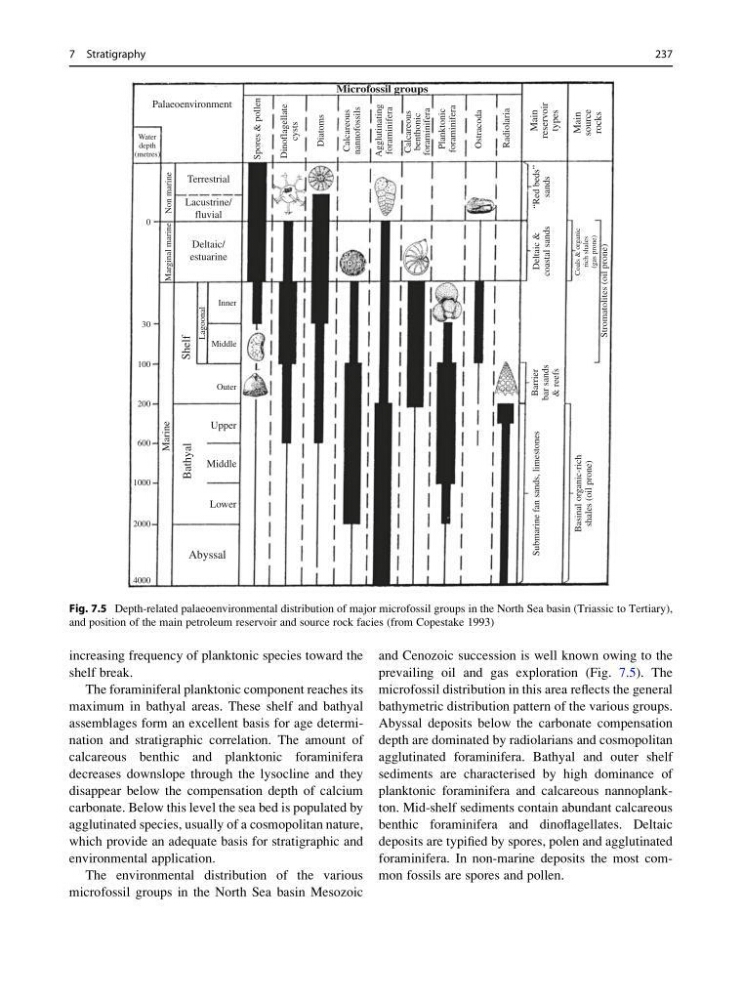
prevailing oil and gas exploration (Fig. 7.5). The
microfossil distribution in this area reflects the general
bathymetric distribution pattern of the various groups.
Abyssal deposits below the carbonate compensation
depth are dominated by radiolarians and cosmopolitan
agglutinated foraminifera. Bathyal and outer shelf
sediments are characterised by high dominance of
planktonic foraminifera and calcareous nannoplankton. Mid-shelf sediments contain abundant calcareous
benthic foraminifera and dinoflagellates. Deltaic
deposits are typified by spores, polen and agglutinated
foraminifera. In non-marine deposits the most common fossils are spores and pollen.
Palaeoenvironment
Microfossil groups
Spores & pollen
Dinoflagellate
cysts
Diatoms
Calcareous
nannofossils
Agglutinating
foraminifera
Calcareous
benthonic
foraminifera
Planktonic
foraminifera
Ostracoda
Radiolaria
Main
reservoir
types
“Red beds”
sands
Deltaic &
coastal sands
Stromatolites (oil prone)
Coals & organic
rich shales
(gas prone)
Barrier
bar sands
& reefs
Submarine fan sands, limestones
Basinal organic-rich
shales (oil prone)
Main
source
rocks
Terrestrial
Non marine
Marginal marine
Lacustrine/
fluvial
0
30
100
200
600
1000
2000
4000
Deltaic/
estuarine
Inner
Middle
Outer
Upper
Middle
Abyssal
Lower
Bathyal
Marine
Lagoonal
Shelf
Water
depth
(metres)
Fig. 7.5 Depth-related palaeoenvironmental distribution of major microfossil groups in the North Sea basin (Triassic to Tertiary),
and position of the main petroleum reservoir and source rock facies (from Copestake 1993)
7 Stratigraphy
237
shelf break.
The foraminiferal planktonic component reaches its
maximum in bathyal areas. These shelf and bathyal
assemblages form an excellent basis for age determination and stratigraphic correlation. The amount of
calcareous benthic and planktonic foraminifera
decreases downslope through the lysocline and they
disappear below the compensation depth of calcium
carbonate. Below this level the sea bed is populated by
agglutinated species, usually of a cosmopolitan nature,
which provide an adequate basis for stratigraphic and
environmental application.
The environmental distribution of the various
microfossil groups in the North Sea basin Mesozoic
and Cenozoic succession is well known owing to the
prevailing oil and gas exploration (Fig. 7.5). The
microfossil distribution in this area reflects the general
bathymetric distribution pattern of the various groups.
Abyssal deposits below the carbonate compensation
depth are dominated by radiolarians and cosmopolitan
agglutinated foraminifera. Bathyal and outer shelf
sediments are characterised by high dominance of
planktonic foraminifera and calcareous nannoplankton. Mid-shelf sediments contain abundant calcareous
benthic foraminifera and dinoflagellates. Deltaic
deposits are typified by spores, polen and agglutinated
foraminifera. In non-marine deposits the most common fossils are spores and pollen.
Palaeoenvironment
Microfossil groups
Spores & pollen
Dinoflagellate
cysts
Diatoms
Calcareous
nannofossils
Agglutinating
foraminifera
Calcareous
benthonic
foraminifera
Planktonic
foraminifera
Ostracoda
Radiolaria
Main
reservoir
types
“Red beds”
sands
Deltaic &
coastal sands
Stromatolites (oil prone)
Coals & organic
rich shales
(gas prone)
Barrier
bar sands
& reefs
Submarine fan sands, limestones
Basinal organic-rich
shales (oil prone)
Main
source
rocks
Terrestrial
Non marine
Marginal marine
Lacustrine/
fluvial
0
30
100
200
600
1000
2000
4000
Deltaic/
estuarine
Inner
Middle
Outer
Upper
Middle
Abyssal
Lower
Bathyal
Marine
Lagoonal
Shelf
Water
depth
(metres)
Fig. 7.5 Depth-related palaeoenvironmental distribution of major microfossil groups in the North Sea basin (Triassic to Tertiary),
and position of the main petroleum reservoir and source rock facies (from Copestake 1993)
7 Stratigraphy
237