

salts, and are hence the last to precipitate. If the salt
concentration increases with evaporation, this is the
sequence of salt deposition. During periods with
greater circulation and supply of normal seawater the
salt concentration will fall, and there will be cyclic salt
deposition and solution. Chlorides (NaCl, KCl) will
dissolve in moisture from the air unless the humidity is
very low.
Periods of increased evaporation and hence high
salt concentration may alternate with influxes of seawater with a more normal salt concentration, producing cycles representing changes in salinity. These are
called evaporite cycles. In many evaporite basins the
salt concentration has been sufficiently high for gypsum to be precipitated, but not high enough for
chlorides (see Fig. 6.7).
The stability of the various salts during evaporation can be determined experimentally, or estimated
through physical chemistry calculations. However, it
is clear that certain metastable mineral phases can
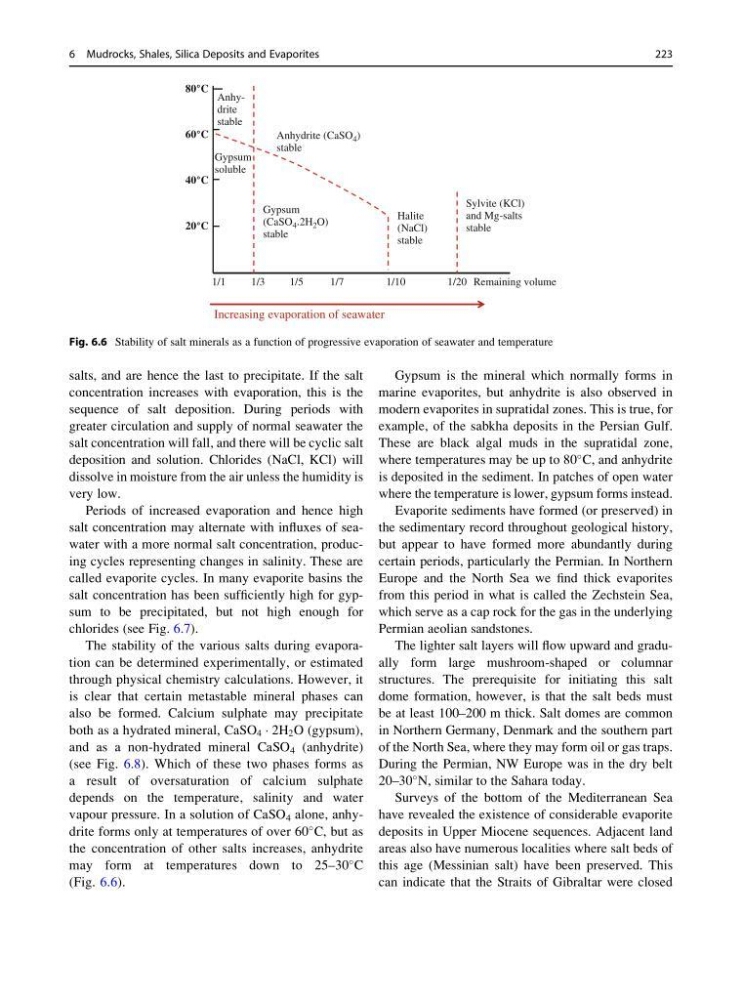
also be formed. Calcium sulphate may precipitate
both as a hydrated mineral, CaSO 4 Á 2H 2 O (gypsum),
and as a non-hydrated mineral CaSO 4 (anhydrite)
(see Fig. 6.8). Which of these two phases forms as
a result of oversaturation of calcium sulphate
depends on the temperature, salinity and water
vapour pressure. In a solution of CaSO 4 alone, anhydrite forms only at temperatures of over 60
C, but as
the concentration of other salts increases, anhydrite
may form at temperatures down to 25–30
C
(Fig. 6.6).
Gypsum is the mineral which normally forms in
marine evaporites, but anhydrite is also observed in
modern evaporites in supratidal zones. This is true, for
example, of the sabkha deposits in the Persian Gulf.
These are black algal muds in the supratidal zone,
where temperatures may be up to 80
C, and anhydrite
is deposited in the sediment. In patches of open water
where the temperature is lower, gypsum forms instead.
Evaporite sediments have formed (or preserved) in
the sedimentary record throughout geological history,
but appear to have formed more abundantly during
certain periods, particularly the Permian. In Northern
Europe and the North Sea we find thick evaporites
from this period in what is called the Zechstein Sea,
which serve as a cap rock for the gas in the underlying
Permian aeolian sandstones.
The lighter salt layers will flow upward and gradually form large mushroom-shaped or columnar
structures. The prerequisite for initiating this salt
dome formation, however, is that the salt beds must
be at least 100–200 m thick. Salt domes are common
in Northern Germany, Denmark and the southern part
of the North Sea, where they may form oil or gas traps.
During the Permian, NW Europe was in the dry belt
20–30
N, similar to the Sahara today.
Surveys of the bottom of the Mediterranean Sea
have revealed the existence of considerable evaporite
deposits in Upper Miocene sequences. Adjacent land
areas also have numerous localities where salt beds of
this age (Messinian salt) have been preserved. This
can indicate that the Straits of Gibraltar were closed
80 ˚ C
60 ˚ C
40 ˚ C
20 ˚ C
1/1
1/3
1/5
1/7
1/10
1/20 Remaining volume
Gypsum
soluble
Anhydrite
stable
Gypsum
(CaSO 4 .2H 2 O)
stable
Halite
(NaCl)
stable
Sylvite (KCl)
and Mg-salts
stable
Increasing evaporation of seawater
Anhydrite (CaSO 4 )
stable
Fig. 6.6 Stability of salt minerals as a function of progressive evaporation of seawater and temperature
6 Mudrocks, Shales, Silica Deposits and Evaporites
223
concentration increases with evaporation, this is the
sequence of salt deposition. During periods with
greater circulation and supply of normal seawater the
salt concentration will fall, and there will be cyclic salt
deposition and solution. Chlorides (NaCl, KCl) will
dissolve in moisture from the air unless the humidity is
very low.
Periods of increased evaporation and hence high
salt concentration may alternate with influxes of seawater with a more normal salt concentration, producing cycles representing changes in salinity. These are
called evaporite cycles. In many evaporite basins the
salt concentration has been sufficiently high for gypsum to be precipitated, but not high enough for
chlorides (see Fig. 6.7).
The stability of the various salts during evaporation can be determined experimentally, or estimated
through physical chemistry calculations. However, it
is clear that certain metastable mineral phases can
also be formed. Calcium sulphate may precipitate
both as a hydrated mineral, CaSO 4 Á 2H 2 O (gypsum),
and as a non-hydrated mineral CaSO 4 (anhydrite)
(see Fig. 6.8). Which of these two phases forms as
a result of oversaturation of calcium sulphate
depends on the temperature, salinity and water
vapour pressure. In a solution of CaSO 4 alone, anhydrite forms only at temperatures of over 60
C, but as
the concentration of other salts increases, anhydrite
may form at temperatures down to 25–30
C
(Fig. 6.6).
Gypsum is the mineral which normally forms in
marine evaporites, but anhydrite is also observed in
modern evaporites in supratidal zones. This is true, for
example, of the sabkha deposits in the Persian Gulf.
These are black algal muds in the supratidal zone,
where temperatures may be up to 80
C, and anhydrite
is deposited in the sediment. In patches of open water
where the temperature is lower, gypsum forms instead.
Evaporite sediments have formed (or preserved) in
the sedimentary record throughout geological history,
but appear to have formed more abundantly during
certain periods, particularly the Permian. In Northern
Europe and the North Sea we find thick evaporites
from this period in what is called the Zechstein Sea,
which serve as a cap rock for the gas in the underlying
Permian aeolian sandstones.
The lighter salt layers will flow upward and gradually form large mushroom-shaped or columnar
structures. The prerequisite for initiating this salt
dome formation, however, is that the salt beds must
be at least 100–200 m thick. Salt domes are common
in Northern Germany, Denmark and the southern part
of the North Sea, where they may form oil or gas traps.
During the Permian, NW Europe was in the dry belt
20–30
N, similar to the Sahara today.
Surveys of the bottom of the Mediterranean Sea
have revealed the existence of considerable evaporite
deposits in Upper Miocene sequences. Adjacent land
areas also have numerous localities where salt beds of
this age (Messinian salt) have been preserved. This
can indicate that the Straits of Gibraltar were closed
80 ˚ C
60 ˚ C
40 ˚ C
20 ˚ C
1/1
1/3
1/5
1/7
1/10
1/20 Remaining volume
Gypsum
soluble
Anhydrite
stable
Gypsum
(CaSO 4 .2H 2 O)
stable
Halite
(NaCl)
stable
Sylvite (KCl)
and Mg-salts
stable
Increasing evaporation of seawater
Anhydrite (CaSO 4 )
stable
Fig. 6.6 Stability of salt minerals as a function of progressive evaporation of seawater and temperature
6 Mudrocks, Shales, Silica Deposits and Evaporites
223