

for large parts of the Tertiary and that the Mediterranean Sea was a vast desert inland sea 2,000–3,000 m
below sea level at that time.
6.5
The Sabkha Model
“Sabkha” is the Arabic term for the large flat areas
around the Persian Gulf. This area extends from the
tidal zone, forming an 8–10 km wide belt with a very
low seaward gradient of only about 0.4 m/km. The
sabkha flats were created by carbonate sediments
infilling lagoons, chiefly during the Holocene. For
the last 4,000 years there has been a gradual regression
in the area. The climate is very dry (30–100 mm
annual precipitation), but this is nevertheless sufficient
to cause groundwater from surrounding areas to flow
out to the sea. The groundwater flow is extremely
slow, only a few centimetres a year, but is nevertheless
responsible for the diagenetic environment containing
porewater of continental origin. During storms and
high tides, marine water floods the sabkha. Some
runs off, some evaporates and some filters down into
the sediment and mixes with the groundwater. Relatively large amounts of gypsum are then formed. The
remainder of the water is highly enriched in magnesium, and dolomite is formed. Evaporation will
increase the salt concentration of the porewater, and
if it is intense enough, chlorides (halite) are
precipitated in addition to gypsum. However, halites
will dissolve easily the next time salt water flows in
over the sabkha. Moisture in the air will also help to
dissolve halite on the surface, so that it is not preserved
in the bedding series.
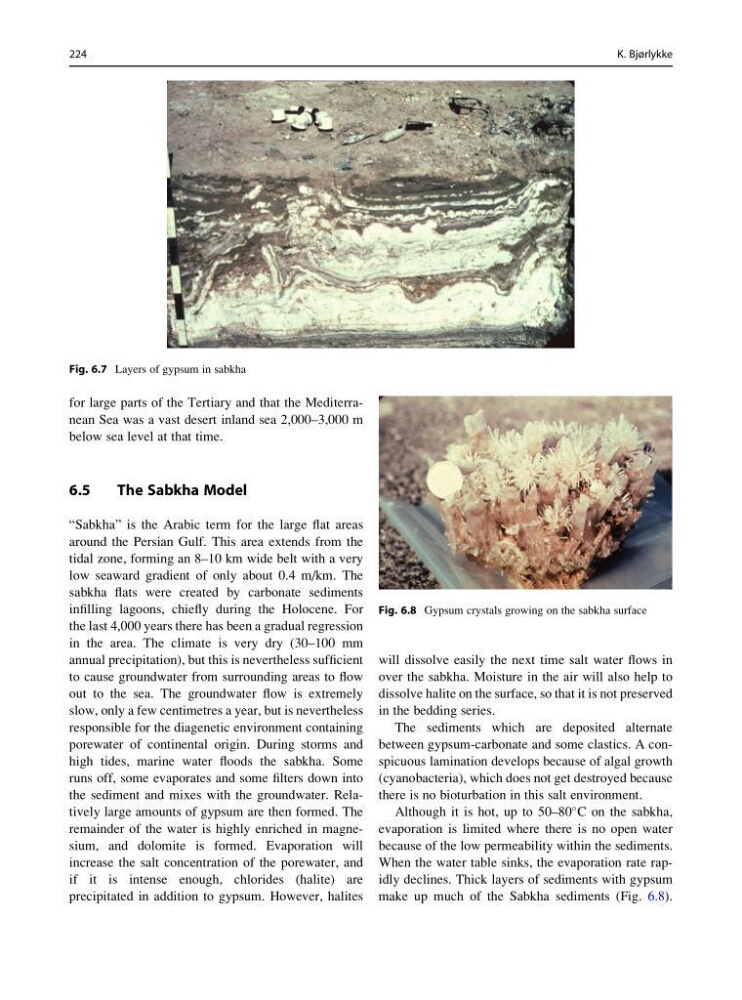
The sediments which are deposited alternate
between gypsum-carbonate and some clastics. A conspicuous lamination develops because of algal growth
(cyanobacteria), which does not get destroyed because
there is no bioturbation in this salt environment.
Although it is hot, up to 50–80
C on the sabkha,
evaporation is limited where there is no open water
because of the low permeability within the sediments.
When the water table sinks, the evaporation rate rapidly declines. Thick layers of sediments with gypsum
make up much of the Sabkha sediments (Fig. 6.8).
Fig. 6.7 Layers of gypsum in sabkha
Fig. 6.8 Gypsum crystals growing on the sabkha surface
224
K. Bjørlykke
below sea level at that time.
6.5
The Sabkha Model
“Sabkha” is the Arabic term for the large flat areas
around the Persian Gulf. This area extends from the
tidal zone, forming an 8–10 km wide belt with a very
low seaward gradient of only about 0.4 m/km. The
sabkha flats were created by carbonate sediments
infilling lagoons, chiefly during the Holocene. For
the last 4,000 years there has been a gradual regression
in the area. The climate is very dry (30–100 mm
annual precipitation), but this is nevertheless sufficient
to cause groundwater from surrounding areas to flow
out to the sea. The groundwater flow is extremely
slow, only a few centimetres a year, but is nevertheless
responsible for the diagenetic environment containing
porewater of continental origin. During storms and
high tides, marine water floods the sabkha. Some
runs off, some evaporates and some filters down into
the sediment and mixes with the groundwater. Relatively large amounts of gypsum are then formed. The
remainder of the water is highly enriched in magnesium, and dolomite is formed. Evaporation will
increase the salt concentration of the porewater, and
if it is intense enough, chlorides (halite) are
precipitated in addition to gypsum. However, halites
will dissolve easily the next time salt water flows in
over the sabkha. Moisture in the air will also help to
dissolve halite on the surface, so that it is not preserved
in the bedding series.
The sediments which are deposited alternate
between gypsum-carbonate and some clastics. A conspicuous lamination develops because of algal growth
(cyanobacteria), which does not get destroyed because
there is no bioturbation in this salt environment.
Although it is hot, up to 50–80
C on the sabkha,
evaporation is limited where there is no open water
because of the low permeability within the sediments.
When the water table sinks, the evaporation rate rapidly declines. Thick layers of sediments with gypsum
make up much of the Sabkha sediments (Fig. 6.8).
Fig. 6.7 Layers of gypsum in sabkha
Fig. 6.8 Gypsum crystals growing on the sabkha surface
224
K. Bjørlykke