

of Precambrian chert, and since silica must also have
been added to the oceans, we must assume that the
ocean was saturated with respect to silica, and that
there may have been inorganic precipitation of silica.
Silica deposits may also be formed in lakes by
freshwater diatoms. In lakes along the rift systems of
East Africa, there are thick deposits of diatomite
which are exploited for use in insulating materials. A
great deal of CO 2 is taken from the lake water by
diatoms and other algae for photosynthesis, and the
water therefore becomes strongly basic (pH 9–10).
This increases the solubility of silica, thus increasing
the corrosion of silicate minerals. Examples of this are
found, for instance, at Lake Turkana in Kenya. Volcanic rocks and water from hot springs are also important sources of silica.
Chemical precipitation of silica may also take place
in evaporite basins, and in ephemeral lakes which dry
up between rainy seasons.
6.4
Evaporites
Evaporites consist of minerals which have crystallised
out through evaporation of water. This can happen in
many ways:
1. Evaporation of seawater in completely or partly
cut-off marine basins.
2. In lakes which have little or no outlet and a high
evaporation rate.
3. Through evaporation of seasonal precipitation
which collects in topographical depressions without outlets (playas).
4. In soil profiles or sandy sediments, through evaporation of groundwater.
5. In arctic areas, the sublimation of ice and the freezing of seawater to ice both increase the salt concentration of sea water, and evaporite minerals such as
gypsum may be precipitated.
6. Through solution and precipitation of salts from
older evaporite deposits.
The formation of evaporites is therefore not an
unambiguous indication of a high temperature, but
most evaporite deposits (salt) form in the climatically
dry belts about 20–30
from the equator. Evaporites
contain a number of salt minerals which are too soluble to be precipitated in normal marine or continental
environments. The most important are:
Chlorides
Sulphates
Alkaline carbonates
Ca-Mg carbonates
Borates
Nitrates
Silica deposits
Iron deposits
6.4.1 Marine Evaporite Environments
Although the salt content of seawater varies somewhat
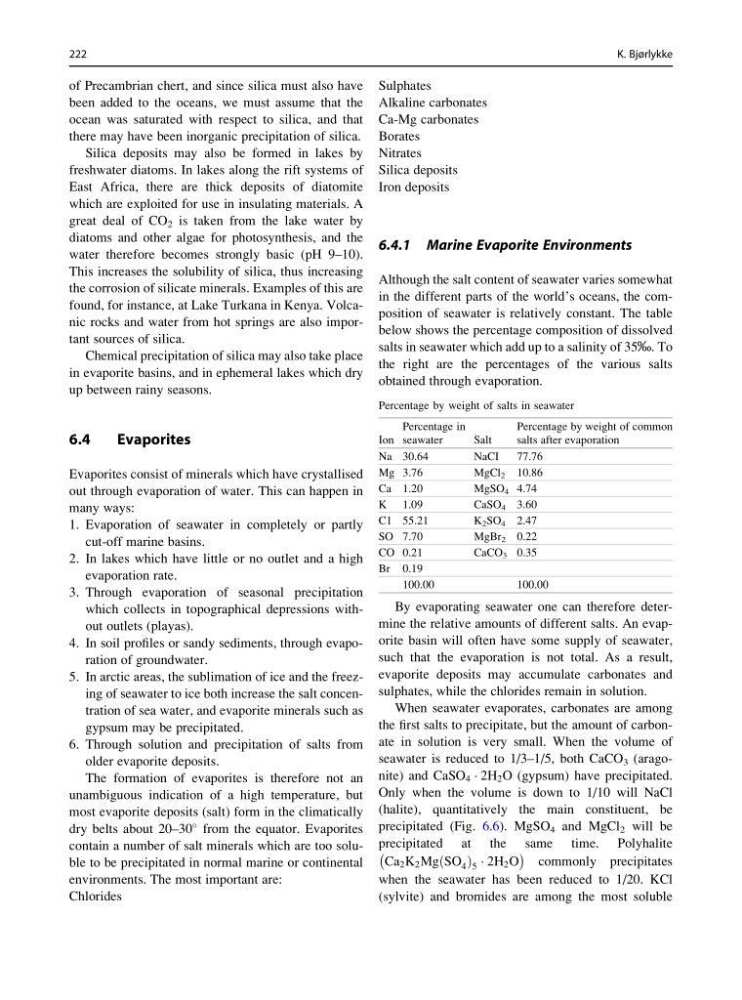
in the different parts of the world’s oceans, the composition of seawater is relatively constant. The table
below shows the percentage composition of dissolved
salts in seawater which add up to a salinity of 35‰. To
the right are the percentages of the various salts
obtained through evaporation.
Percentage by weight of salts in seawater
Ion
Percentage in
seawater
Salt
Percentage by weight of common
salts after evaporation
Na 30.64
NaCI
77.76
Mg 3.76
MgCl 2 10.86
Ca 1.20
MgSO 4 4.74
K 1.09
CaSO 4 3.60
C1 55.21
K 2 SO 4 2.47
SO 7.70
MgBr 2 0.22
CO 0.21
CaCO 3 0.35
Br 0.19
100.00
100.00
By evaporating seawater one can therefore determine the relative amounts of different salts. An evaporite basin will often have some supply of seawater,
such that the evaporation is not total. As a result,
evaporite deposits may accumulate carbonates and
sulphates, while the chlorides remain in solution.
When seawater evaporates, carbonates are among
the first salts to precipitate, but the amount of carbonate in solution is very small. When the volume of
seawater is reduced to 1/3–1/5, both CaCO 3 (aragonite) and CaSO 4 Á 2H 2 O (gypsum) have precipitated.
Only when the volume is down to 1/10 will NaCl
(halite), quantitatively the main constituent, be
precipitated (Fig. 6.6). MgSO 4 and MgCl 2 will be
precipitated at the same time. Polyhalite
Ca 2 K 2 MgðSO 4 Þ 5 Á 2H 2 O
À
Á
commonly precipitates
when the seawater has been reduced to 1/20. KCl
(sylvite) and bromides are among the most soluble
222
K. Bjørlykke
been added to the oceans, we must assume that the
ocean was saturated with respect to silica, and that
there may have been inorganic precipitation of silica.
Silica deposits may also be formed in lakes by
freshwater diatoms. In lakes along the rift systems of
East Africa, there are thick deposits of diatomite
which are exploited for use in insulating materials. A
great deal of CO 2 is taken from the lake water by
diatoms and other algae for photosynthesis, and the
water therefore becomes strongly basic (pH 9–10).
This increases the solubility of silica, thus increasing
the corrosion of silicate minerals. Examples of this are
found, for instance, at Lake Turkana in Kenya. Volcanic rocks and water from hot springs are also important sources of silica.
Chemical precipitation of silica may also take place
in evaporite basins, and in ephemeral lakes which dry
up between rainy seasons.
6.4
Evaporites
Evaporites consist of minerals which have crystallised
out through evaporation of water. This can happen in
many ways:
1. Evaporation of seawater in completely or partly
cut-off marine basins.
2. In lakes which have little or no outlet and a high
evaporation rate.
3. Through evaporation of seasonal precipitation
which collects in topographical depressions without outlets (playas).
4. In soil profiles or sandy sediments, through evaporation of groundwater.
5. In arctic areas, the sublimation of ice and the freezing of seawater to ice both increase the salt concentration of sea water, and evaporite minerals such as
gypsum may be precipitated.
6. Through solution and precipitation of salts from
older evaporite deposits.
The formation of evaporites is therefore not an
unambiguous indication of a high temperature, but
most evaporite deposits (salt) form in the climatically
dry belts about 20–30
from the equator. Evaporites
contain a number of salt minerals which are too soluble to be precipitated in normal marine or continental
environments. The most important are:
Chlorides
Sulphates
Alkaline carbonates
Ca-Mg carbonates
Borates
Nitrates
Silica deposits
Iron deposits
6.4.1 Marine Evaporite Environments
Although the salt content of seawater varies somewhat
in the different parts of the world’s oceans, the composition of seawater is relatively constant. The table
below shows the percentage composition of dissolved
salts in seawater which add up to a salinity of 35‰. To
the right are the percentages of the various salts
obtained through evaporation.
Percentage by weight of salts in seawater
Ion
Percentage in
seawater
Salt
Percentage by weight of common
salts after evaporation
Na 30.64
NaCI
77.76
Mg 3.76
MgCl 2 10.86
Ca 1.20
MgSO 4 4.74
K 1.09
CaSO 4 3.60
C1 55.21
K 2 SO 4 2.47
SO 7.70
MgBr 2 0.22
CO 0.21
CaCO 3 0.35
Br 0.19
100.00
100.00
By evaporating seawater one can therefore determine the relative amounts of different salts. An evaporite basin will often have some supply of seawater,
such that the evaporation is not total. As a result,
evaporite deposits may accumulate carbonates and
sulphates, while the chlorides remain in solution.
When seawater evaporates, carbonates are among
the first salts to precipitate, but the amount of carbonate in solution is very small. When the volume of
seawater is reduced to 1/3–1/5, both CaCO 3 (aragonite) and CaSO 4 Á 2H 2 O (gypsum) have precipitated.
Only when the volume is down to 1/10 will NaCl
(halite), quantitatively the main constituent, be
precipitated (Fig. 6.6). MgSO 4 and MgCl 2 will be
precipitated at the same time. Polyhalite
Ca 2 K 2 MgðSO 4 Þ 5 Á 2H 2 O
À
Á
commonly precipitates
when the seawater has been reduced to 1/20. KCl
(sylvite) and bromides are among the most soluble
222
K. Bjørlykke