

still opal A. When altered to opal CT most of the
primary structures are gone.
When opal A and opal CT dissolve, the water
becomes oversaturated with respect to quartz which
then begins to crystallise at a large number of points
(nucleii). It thus forms microcrystalline quartz, known
as “chert”. The dark colouration is due to organic
material. In Europe, flint is the best known variety of
chert which is abundant as concretions in the Upper
Cretaceous Chalk. Cherts are formed of silica which
has been finely distributed in the sediment, largely as
sponges and radiolaria often concentrated along special horizons. Because small particles with a large
specific surface are highly unstable, they will dissolve
and silica will be precipitated in nodules which are
massive structures with a small specific surface and in
consequence thermodynamically more stable.
Novaculite is more or less synonymous with light,
laminated chert which contains less organic material.
Porcellanite is a term applied to more contaminated
silica (chert) which has the appearance of unglazed
porcelain. Laminated chert is very common in
Palaeozoic and Mesozoic sequences immediately
above oceanic seafloor (ophiolites) near spreading
ridges, sourced from water circulating through the
basalts. This chert may be white, grey or dark,
depending on the content of organic matter or traces
of iron, magnesium etc.
Chert containing oxidised iron has a reddish
colouration and is called jasper. Jasper may form on
the seafloor near the spreading ridges. When water
circulates through the spreading ridges it carries
away iron which then oxidises in the seawater and
produces the red colour. When mixed with silica
which is precipitated mostly by organisms, chert is
formed. Jasper is found on top of obducted ocean
floor basalts in nappes of Ordovician age in western
Norway.
Chert has also been found during ocean drilling,
overlying present ocean floor of Cretaceous or Tertiary age. Although all amorphous silica has been
converted to quartz, it is often possible in chert to
detect the remains of organic particles, e.g. radiolaria,
especially in Palaeozoic chert deposits. Younger silica
deposits are chiefly precipitated by diatoms. In areas
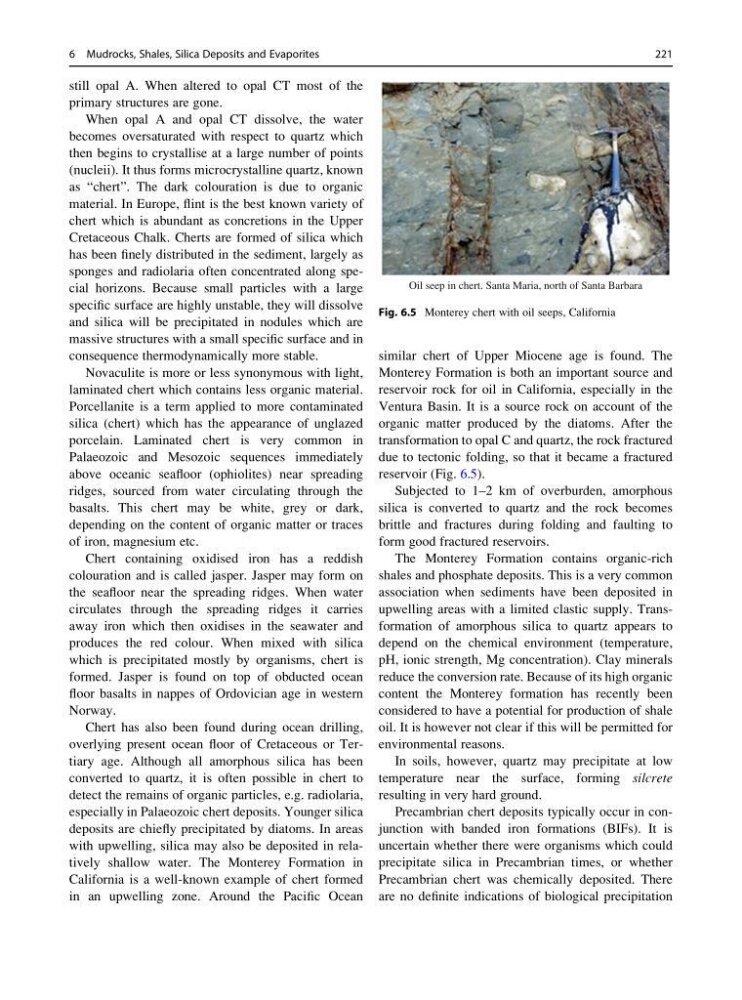
with upwelling, silica may also be deposited in relatively shallow water. The Monterey Formation in
California is a well-known example of chert formed
in an upwelling zone. Around the Pacific Ocean
similar chert of Upper Miocene age is found. The
Monterey Formation is both an important source and
reservoir rock for oil in California, especially in the
Ventura Basin. It is a source rock on account of the
organic matter produced by the diatoms. After the
transformation to opal C and quartz, the rock fractured
due to tectonic folding, so that it became a fractured
reservoir (Fig. 6.5).
Subjected to 1–2 km of overburden, amorphous
silica is converted to quartz and the rock becomes
brittle and fractures during folding and faulting to
form good fractured reservoirs.
The Monterey Formation contains organic-rich
shales and phosphate deposits. This is a very common
association when sediments have been deposited in
upwelling areas with a limited clastic supply. Transformation of amorphous silica to quartz appears to
depend on the chemical environment (temperature,
pH, ionic strength, Mg concentration). Clay minerals
reduce the conversion rate. Because of its high organic
content the Monterey formation has recently been
considered to have a potential for production of shale
oil. It is however not clear if this will be permitted for
environmental reasons.
In soils, however, quartz may precipitate at low
temperature near the surface, forming silcrete
resulting in very hard ground.
Precambrian chert deposits typically occur in conjunction with banded iron formations (BIFs). It is
uncertain whether there were organisms which could
precipitate silica in Precambrian times, or whether
Precambrian chert was chemically deposited. There
are no definite indications of biological precipitation
Oil seep in chert. Santa Maria, north of Santa Barbara
Fig. 6.5 Monterey chert with oil seeps, California
6 Mudrocks, Shales, Silica Deposits and Evaporites
221
primary structures are gone.
When opal A and opal CT dissolve, the water
becomes oversaturated with respect to quartz which
then begins to crystallise at a large number of points
(nucleii). It thus forms microcrystalline quartz, known
as “chert”. The dark colouration is due to organic
material. In Europe, flint is the best known variety of
chert which is abundant as concretions in the Upper
Cretaceous Chalk. Cherts are formed of silica which
has been finely distributed in the sediment, largely as
sponges and radiolaria often concentrated along special horizons. Because small particles with a large
specific surface are highly unstable, they will dissolve
and silica will be precipitated in nodules which are
massive structures with a small specific surface and in
consequence thermodynamically more stable.
Novaculite is more or less synonymous with light,
laminated chert which contains less organic material.
Porcellanite is a term applied to more contaminated
silica (chert) which has the appearance of unglazed
porcelain. Laminated chert is very common in
Palaeozoic and Mesozoic sequences immediately
above oceanic seafloor (ophiolites) near spreading
ridges, sourced from water circulating through the
basalts. This chert may be white, grey or dark,
depending on the content of organic matter or traces
of iron, magnesium etc.
Chert containing oxidised iron has a reddish
colouration and is called jasper. Jasper may form on
the seafloor near the spreading ridges. When water
circulates through the spreading ridges it carries
away iron which then oxidises in the seawater and
produces the red colour. When mixed with silica
which is precipitated mostly by organisms, chert is
formed. Jasper is found on top of obducted ocean
floor basalts in nappes of Ordovician age in western
Norway.
Chert has also been found during ocean drilling,
overlying present ocean floor of Cretaceous or Tertiary age. Although all amorphous silica has been
converted to quartz, it is often possible in chert to
detect the remains of organic particles, e.g. radiolaria,
especially in Palaeozoic chert deposits. Younger silica
deposits are chiefly precipitated by diatoms. In areas
with upwelling, silica may also be deposited in relatively shallow water. The Monterey Formation in
California is a well-known example of chert formed
in an upwelling zone. Around the Pacific Ocean
similar chert of Upper Miocene age is found. The
Monterey Formation is both an important source and
reservoir rock for oil in California, especially in the
Ventura Basin. It is a source rock on account of the
organic matter produced by the diatoms. After the
transformation to opal C and quartz, the rock fractured
due to tectonic folding, so that it became a fractured
reservoir (Fig. 6.5).
Subjected to 1–2 km of overburden, amorphous
silica is converted to quartz and the rock becomes
brittle and fractures during folding and faulting to
form good fractured reservoirs.
The Monterey Formation contains organic-rich
shales and phosphate deposits. This is a very common
association when sediments have been deposited in
upwelling areas with a limited clastic supply. Transformation of amorphous silica to quartz appears to
depend on the chemical environment (temperature,
pH, ionic strength, Mg concentration). Clay minerals
reduce the conversion rate. Because of its high organic
content the Monterey formation has recently been
considered to have a potential for production of shale
oil. It is however not clear if this will be permitted for
environmental reasons.
In soils, however, quartz may precipitate at low
temperature near the surface, forming silcrete
resulting in very hard ground.
Precambrian chert deposits typically occur in conjunction with banded iron formations (BIFs). It is
uncertain whether there were organisms which could
precipitate silica in Precambrian times, or whether
Precambrian chert was chemically deposited. There
are no definite indications of biological precipitation
Oil seep in chert. Santa Maria, north of Santa Barbara
Fig. 6.5 Monterey chert with oil seeps, California
6 Mudrocks, Shales, Silica Deposits and Evaporites
221