

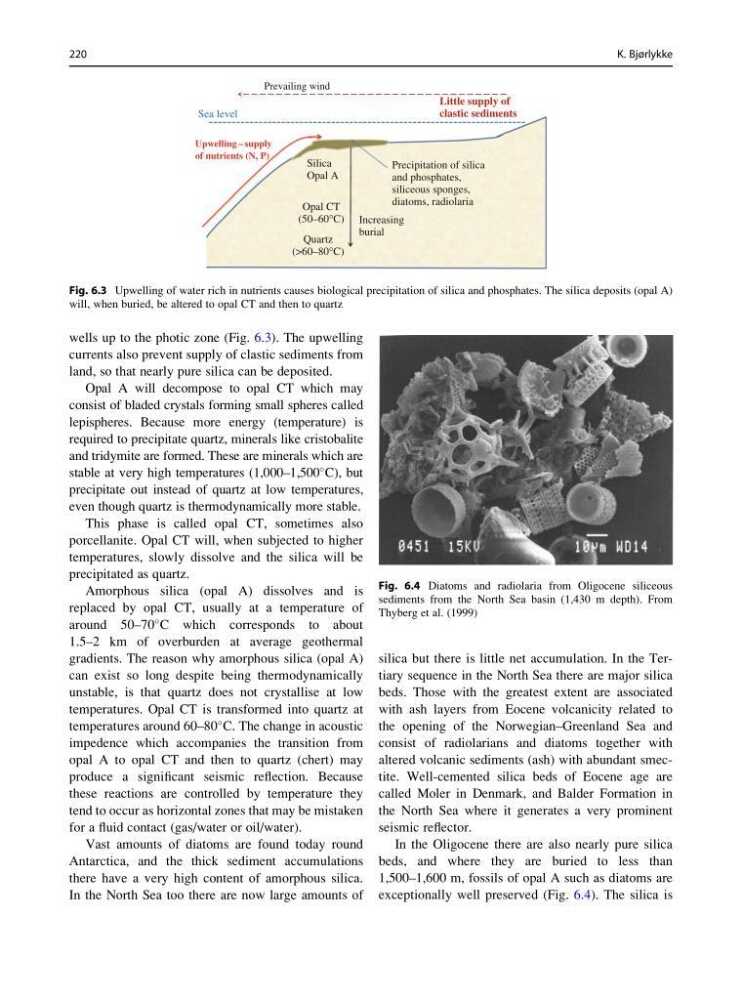
wells up to the photic zone (Fig. 6.3). The upwelling
currents also prevent supply of clastic sediments from
land, so that nearly pure silica can be deposited.
Opal A will decompose to opal CT which may
consist of bladed crystals forming small spheres called
lepispheres. Because more energy (temperature) is
required to precipitate quartz, minerals like cristobalite
and tridymite are formed. These are minerals which are
stable at very high temperatures (1,000–1,500
C), but
precipitate out instead of quartz at low temperatures,
even though quartz is thermodynamically more stable.
This phase is called opal CT, sometimes also
porcellanite. Opal CT will, when subjected to higher
temperatures, slowly dissolve and the silica will be
precipitated as quartz.
Amorphous silica (opal A) dissolves and is
replaced by opal CT, usually at a temperature of
around 50–70
C which corresponds to about
1.5–2 km of overburden at average geothermal
gradients. The reason why amorphous silica (opal A)
can exist so long despite being thermodynamically
unstable, is that quartz does not crystallise at low
temperatures. Opal CT is transformed into quartz at
temperatures around 60–80
C. The change in acoustic
impedence which accompanies the transition from
opal A to opal CT and then to quartz (chert) may
produce a significant seismic reflection. Because
these reactions are controlled by temperature they
tend to occur as horizontal zones that may be mistaken
for a fluid contact (gas/water or oil/water).
Vast amounts of diatoms are found today round
Antarctica, and the thick sediment accumulations
there have a very high content of amorphous silica.
In the North Sea too there are now large amounts of
silica but there is little net accumulation. In the Tertiary sequence in the North Sea there are major silica
beds. Those with the greatest extent are associated
with ash layers from Eocene volcanicity related to
the opening of the Norwegian–Greenland Sea and
consist of radiolarians and diatoms together with
altered volcanic sediments (ash) with abundant smectite. Well-cemented silica beds of Eocene age are
called Moler in Denmark, and Balder Formation in
the North Sea where it generates a very prominent
seismic reflector.
In the Oligocene there are also nearly pure silica
beds, and where they are buried to less than
1,500–1,600 m, fossils of opal A such as diatoms are
exceptionally well preserved (Fig. 6.4). The silica is
Prevailing wind
Little supply of
clastic sediments
Upwelling – supply
of nutrients (N, P)
Sea level
Precipitation of silica
and phosphates,
siliceous sponges,
diatoms, radiolaria
Silica
Opal A
Opal CT
(50–60°C)
Quartz
(>60–80°C)
Increasing
burial
Fig. 6.3 Upwelling of water rich in nutrients causes biological precipitation of silica and phosphates. The silica deposits (opal A)
will, when buried, be altered to opal CT and then to quartz
Fig. 6.4 Diatoms and radiolaria from Oligocene siliceous
sediments from the North Sea basin (1,430 m depth). From
Thyberg et al. (1999)
220
K. Bjørlykke
currents also prevent supply of clastic sediments from
land, so that nearly pure silica can be deposited.
Opal A will decompose to opal CT which may
consist of bladed crystals forming small spheres called
lepispheres. Because more energy (temperature) is
required to precipitate quartz, minerals like cristobalite
and tridymite are formed. These are minerals which are
stable at very high temperatures (1,000–1,500
C), but
precipitate out instead of quartz at low temperatures,
even though quartz is thermodynamically more stable.
This phase is called opal CT, sometimes also
porcellanite. Opal CT will, when subjected to higher
temperatures, slowly dissolve and the silica will be
precipitated as quartz.
Amorphous silica (opal A) dissolves and is
replaced by opal CT, usually at a temperature of
around 50–70
C which corresponds to about
1.5–2 km of overburden at average geothermal
gradients. The reason why amorphous silica (opal A)
can exist so long despite being thermodynamically
unstable, is that quartz does not crystallise at low
temperatures. Opal CT is transformed into quartz at
temperatures around 60–80
C. The change in acoustic
impedence which accompanies the transition from
opal A to opal CT and then to quartz (chert) may
produce a significant seismic reflection. Because
these reactions are controlled by temperature they
tend to occur as horizontal zones that may be mistaken
for a fluid contact (gas/water or oil/water).
Vast amounts of diatoms are found today round
Antarctica, and the thick sediment accumulations
there have a very high content of amorphous silica.
In the North Sea too there are now large amounts of
silica but there is little net accumulation. In the Tertiary sequence in the North Sea there are major silica
beds. Those with the greatest extent are associated
with ash layers from Eocene volcanicity related to
the opening of the Norwegian–Greenland Sea and
consist of radiolarians and diatoms together with
altered volcanic sediments (ash) with abundant smectite. Well-cemented silica beds of Eocene age are
called Moler in Denmark, and Balder Formation in
the North Sea where it generates a very prominent
seismic reflector.
In the Oligocene there are also nearly pure silica
beds, and where they are buried to less than
1,500–1,600 m, fossils of opal A such as diatoms are
exceptionally well preserved (Fig. 6.4). The silica is
Prevailing wind
Little supply of
clastic sediments
Upwelling – supply
of nutrients (N, P)
Sea level
Precipitation of silica
and phosphates,
siliceous sponges,
diatoms, radiolaria
Silica
Opal A
Opal CT
(50–60°C)
Quartz
(>60–80°C)
Increasing
burial
Fig. 6.3 Upwelling of water rich in nutrients causes biological precipitation of silica and phosphates. The silica deposits (opal A)
will, when buried, be altered to opal CT and then to quartz
Fig. 6.4 Diatoms and radiolaria from Oligocene siliceous
sediments from the North Sea basin (1,430 m depth). From
Thyberg et al. (1999)
220
K. Bjørlykke