

initially be very small, for example round ooids will
only have very limited areas of contact. As the overburden increases, the pressure per unit area at the
contact points will be very great. Pressure solution
will then occur at the contact points, so that the contact
area expands and the pressure per unit area decreases.
The distinction between grain-supported and mudsupported rocks is not simply a function of the ratio of
grains to mud, because carbonate grains have widely
different and often highly irregular shapes. Rocks
composed of spherical grains (e.g. ooids) may need a
grain content of about 60% to achieve grain support,
whereas rocks with highly irregular grain shapes may
form a self-supporting framework with a grain content
of only 20–25%.
Mudstones, wackestones and packstones would all
be poor reservoir rocks because of the carbonate
mud in the matrix. In the case of packstones the grains
form a grain-supported fabric but the matrix is still
carbonate mud. Grainstones represents well-sorted
carbonate deposits with good porosity and permeability,
which may serve as a good reservoir if cement
precipitation is not too advanced. This is the carbonate
equivalent of well-sorted siliceous sand. Boundstones
are rocks bound together by organisms (fossils) as in
reefs, and they may also have high porosity and
permeability.
Embry and Klovan (1971) extended the classification
of Dunham (1962) with different types of autochthonous
and allochthonous reef limestones (Fig. 5.60). The
autochthonous types are bafflestone that contains inplace stalked fossils that trapped sediment by baffling
the currents, bindstone that contains in-place large
lamellar or tabular fossils that encrust or bind loose
sediment together, and framestone that contains inplace large frame-builders forming the rigid framework
of the reef. The autochthonous types contain more than
10% particles larger than 2 mm; the matrix-supported
type is floatstone while the clast-supported is termed
rudstone.
5.7.10 Dolomitisation
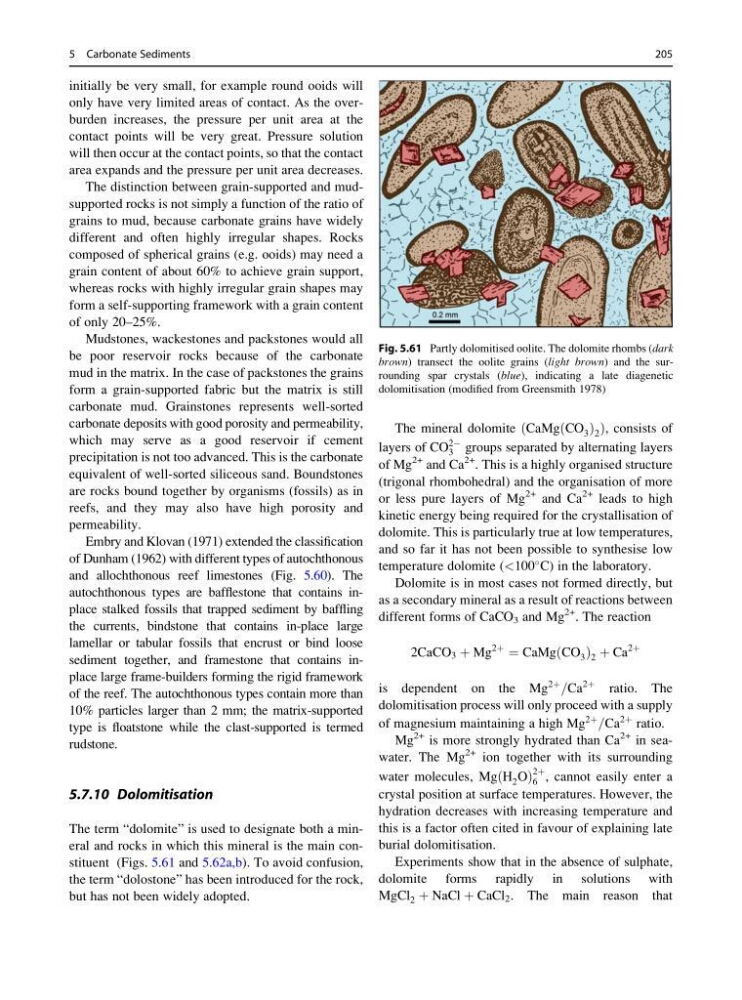
The term “dolomite” is used to designate both a mineral and rocks in which this mineral is the main constituent (Figs. 5.61 and 5.62a,b). To avoid confusion,
the term “dolostone” has been introduced for the rock,
but has not been widely adopted.
The mineral dolomite ðCaMgðCO 3 Þ 2 Þ, consists of
layers of CO
2À
3 groups separated by alternating layers
of Mg
2+ and Ca
2+ . This is a highly organised structure
(trigonal rhombohedral) and the organisation of more
or less pure layers of Mg
2+ and Ca
2+ leads to high
kinetic energy being required for the crystallisation of
dolomite. This is particularly true at low temperatures,
and so far it has not been possible to synthesise low
temperature dolomite (<100
C) in the laboratory.
Dolomite is in most cases not formed directly, but
as a secondary mineral as a result of reactions between
different forms of CaCO 3 and Mg
2+ . The reaction
2CaCO 3 þ Mg
2þ
¼ CaMgðCO 3 Þ 2 þ Ca
2þ
is dependent on the Mg
2þ
=Ca
2þ
ratio. The
dolomitisation process will only proceed with a supply
of magnesium maintaining a high Mg
2þ
=Ca
2þ ratio.
Mg
2+ is more strongly hydrated than Ca
2+ in seawater. The Mg
2+ ion together with its surrounding
water molecules, MgðH 2 OÞ
2þ
6 , cannot easily enter a
crystal position at surface temperatures. However, the
hydration decreases with increasing temperature and
this is a factor often cited in favour of explaining late
burial dolomitisation.
Experiments show that in the absence of sulphate,
dolomite forms rapidly in solutions with
MgCl 2 þ NaCl þ CaCl 2 . The main reason that
Fig. 5.61 Partly dolomitised oolite. The dolomite rhombs (dark
brown) transect the oolite grains (light brown) and the surrounding spar crystals (blue), indicating a late diagenetic
dolomitisation (modified from Greensmith 1978)
5 Carbonate Sediments
205
only have very limited areas of contact. As the overburden increases, the pressure per unit area at the
contact points will be very great. Pressure solution
will then occur at the contact points, so that the contact
area expands and the pressure per unit area decreases.
The distinction between grain-supported and mudsupported rocks is not simply a function of the ratio of
grains to mud, because carbonate grains have widely
different and often highly irregular shapes. Rocks
composed of spherical grains (e.g. ooids) may need a
grain content of about 60% to achieve grain support,
whereas rocks with highly irregular grain shapes may
form a self-supporting framework with a grain content
of only 20–25%.
Mudstones, wackestones and packstones would all
be poor reservoir rocks because of the carbonate
mud in the matrix. In the case of packstones the grains
form a grain-supported fabric but the matrix is still
carbonate mud. Grainstones represents well-sorted
carbonate deposits with good porosity and permeability,
which may serve as a good reservoir if cement
precipitation is not too advanced. This is the carbonate
equivalent of well-sorted siliceous sand. Boundstones
are rocks bound together by organisms (fossils) as in
reefs, and they may also have high porosity and
permeability.
Embry and Klovan (1971) extended the classification
of Dunham (1962) with different types of autochthonous
and allochthonous reef limestones (Fig. 5.60). The
autochthonous types are bafflestone that contains inplace stalked fossils that trapped sediment by baffling
the currents, bindstone that contains in-place large
lamellar or tabular fossils that encrust or bind loose
sediment together, and framestone that contains inplace large frame-builders forming the rigid framework
of the reef. The autochthonous types contain more than
10% particles larger than 2 mm; the matrix-supported
type is floatstone while the clast-supported is termed
rudstone.
5.7.10 Dolomitisation
The term “dolomite” is used to designate both a mineral and rocks in which this mineral is the main constituent (Figs. 5.61 and 5.62a,b). To avoid confusion,
the term “dolostone” has been introduced for the rock,
but has not been widely adopted.
The mineral dolomite ðCaMgðCO 3 Þ 2 Þ, consists of
layers of CO
2À
3 groups separated by alternating layers
of Mg
2+ and Ca
2+ . This is a highly organised structure
(trigonal rhombohedral) and the organisation of more
or less pure layers of Mg
2+ and Ca
2+ leads to high
kinetic energy being required for the crystallisation of
dolomite. This is particularly true at low temperatures,
and so far it has not been possible to synthesise low
temperature dolomite (<100
C) in the laboratory.
Dolomite is in most cases not formed directly, but
as a secondary mineral as a result of reactions between
different forms of CaCO 3 and Mg
2+ . The reaction
2CaCO 3 þ Mg
2þ
¼ CaMgðCO 3 Þ 2 þ Ca
2þ
is dependent on the Mg
2þ
=Ca
2þ
ratio. The
dolomitisation process will only proceed with a supply
of magnesium maintaining a high Mg
2þ
=Ca
2þ ratio.
Mg
2+ is more strongly hydrated than Ca
2+ in seawater. The Mg
2+ ion together with its surrounding
water molecules, MgðH 2 OÞ
2þ
6 , cannot easily enter a
crystal position at surface temperatures. However, the
hydration decreases with increasing temperature and
this is a factor often cited in favour of explaining late
burial dolomitisation.
Experiments show that in the absence of sulphate,
dolomite forms rapidly in solutions with
MgCl 2 þ NaCl þ CaCl 2 . The main reason that
Fig. 5.61 Partly dolomitised oolite. The dolomite rhombs (dark
brown) transect the oolite grains (light brown) and the surrounding spar crystals (blue), indicating a late diagenetic
dolomitisation (modified from Greensmith 1978)
5 Carbonate Sediments
205