

an initial pore space of about 40% between the grains
(or even more if the skeletal material shows irregular
growth forms). These sparry deposits are potential
reservoir rocks if they only become partly cemented
with calcite spar. The presence of petroleum may
retard the precipitation of carbonate cement.
5.7.9 Dunham (1962) Classification
Working for Shell Oil, Dunham (1962) developed a
classification which was more oriented to the needs of
the oil industry, and this simple classification has
become the most widely used today. His classification
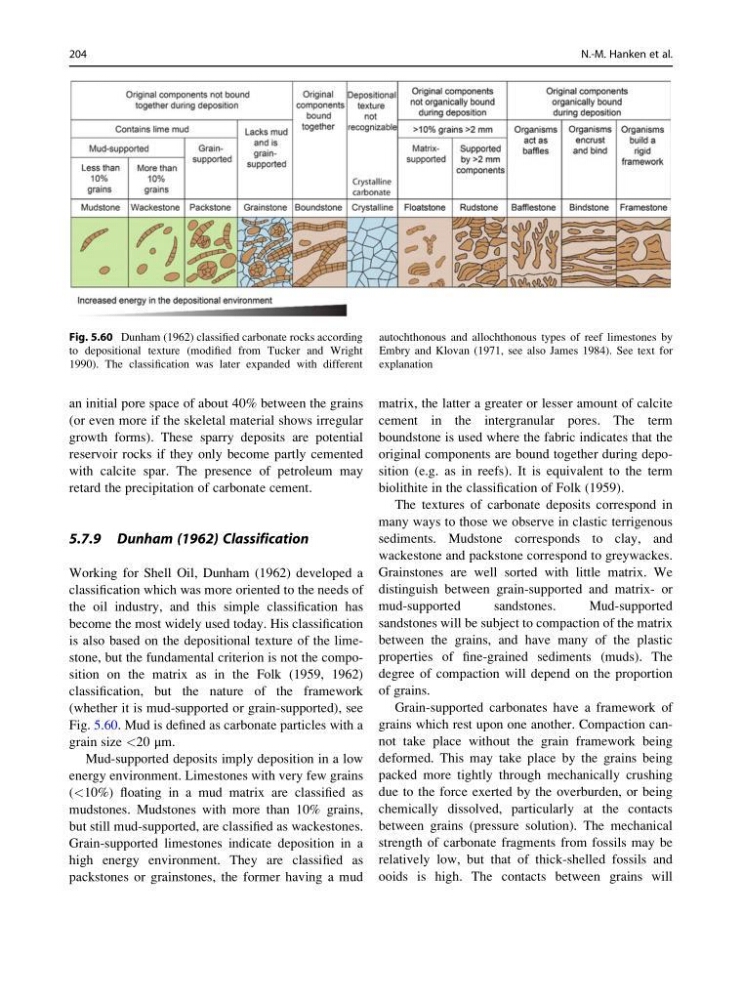
is also based on the depositional texture of the limestone, but the fundamental criterion is not the composition on the matrix as in the Folk (1959, 1962)
classification, but the nature of the framework
(whether it is mud-supported or grain-supported), see
Fig. 5.60. Mud is defined as carbonate particles with a
grain size <20 μm.
Mud-supported deposits imply deposition in a low
energy environment. Limestones with very few grains
(<10%) floating in a mud matrix are classified as
mudstones. Mudstones with more than 10% grains,
but still mud-supported, are classified as wackestones.
Grain-supported limestones indicate deposition in a
high energy environment. They are classified as
packstones or grainstones, the former having a mud
matrix, the latter a greater or lesser amount of calcite
cement in the intergranular pores. The term
boundstone is used where the fabric indicates that the
original components are bound together during deposition (e.g. as in reefs). It is equivalent to the term
biolithite in the classification of Folk (1959).
The textures of carbonate deposits correspond in
many ways to those we observe in clastic terrigenous
sediments. Mudstone corresponds to clay, and
wackestone and packstone correspond to greywackes.
Grainstones are well sorted with little matrix. We
distinguish between grain-supported and matrix- or
mud-supported
sandstones.
Mud-supported
sandstones will be subject to compaction of the matrix
between the grains, and have many of the plastic
properties of fine-grained sediments (muds). The
degree of compaction will depend on the proportion
of grains.
Grain-supported carbonates have a framework of
grains which rest upon one another. Compaction cannot take place without the grain framework being
deformed. This may take place by the grains being
packed more tightly through mechanically crushing
due to the force exerted by the overburden, or being
chemically dissolved, particularly at the contacts
between grains (pressure solution). The mechanical
strength of carbonate fragments from fossils may be
relatively low, but that of thick-shelled fossils and
ooids is high. The contacts between grains will
Fig. 5.60 Dunham (1962) classified carbonate rocks according
to depositional texture (modified from Tucker and Wright
1990). The classification was later expanded with different
autochthonous and allochthonous types of reef limestones by
Embry and Klovan (1971, see also James 1984). See text for
explanation
204
N.-M. Hanken et al.
(or even more if the skeletal material shows irregular
growth forms). These sparry deposits are potential
reservoir rocks if they only become partly cemented
with calcite spar. The presence of petroleum may
retard the precipitation of carbonate cement.
5.7.9 Dunham (1962) Classification
Working for Shell Oil, Dunham (1962) developed a
classification which was more oriented to the needs of
the oil industry, and this simple classification has
become the most widely used today. His classification
is also based on the depositional texture of the limestone, but the fundamental criterion is not the composition on the matrix as in the Folk (1959, 1962)
classification, but the nature of the framework
(whether it is mud-supported or grain-supported), see
Fig. 5.60. Mud is defined as carbonate particles with a
grain size <20 μm.
Mud-supported deposits imply deposition in a low
energy environment. Limestones with very few grains
(<10%) floating in a mud matrix are classified as
mudstones. Mudstones with more than 10% grains,
but still mud-supported, are classified as wackestones.
Grain-supported limestones indicate deposition in a
high energy environment. They are classified as
packstones or grainstones, the former having a mud
matrix, the latter a greater or lesser amount of calcite
cement in the intergranular pores. The term
boundstone is used where the fabric indicates that the
original components are bound together during deposition (e.g. as in reefs). It is equivalent to the term
biolithite in the classification of Folk (1959).
The textures of carbonate deposits correspond in
many ways to those we observe in clastic terrigenous
sediments. Mudstone corresponds to clay, and
wackestone and packstone correspond to greywackes.
Grainstones are well sorted with little matrix. We
distinguish between grain-supported and matrix- or
mud-supported
sandstones.
Mud-supported
sandstones will be subject to compaction of the matrix
between the grains, and have many of the plastic
properties of fine-grained sediments (muds). The
degree of compaction will depend on the proportion
of grains.
Grain-supported carbonates have a framework of
grains which rest upon one another. Compaction cannot take place without the grain framework being
deformed. This may take place by the grains being
packed more tightly through mechanically crushing
due to the force exerted by the overburden, or being
chemically dissolved, particularly at the contacts
between grains (pressure solution). The mechanical
strength of carbonate fragments from fossils may be
relatively low, but that of thick-shelled fossils and
ooids is high. The contacts between grains will
Fig. 5.60 Dunham (1962) classified carbonate rocks according
to depositional texture (modified from Tucker and Wright
1990). The classification was later expanded with different
autochthonous and allochthonous types of reef limestones by
Embry and Klovan (1971, see also James 1984). See text for
explanation
204
N.-M. Hanken et al.