

dolomite is not common in modern marine
environments is that the sulphate ion ðSO
2À
4 Þ is very
efficient at preventing dolomitisation. Consequently
dolomitisation takes place more easily when there
are few sulphate ions (Baker and Kastner 1981). For
this reason dolomite is formed in a number of lakes
and in brackish zones with mixing of salt- and freshwater (Dorag model). In a microbial sulphate reduction zone, the SO
2À
4 concentration will be lower and
ammonium NH 4
þ Þ
ð
can be formed by nitrate-reducing
bacteria. The sulphate is reduced to hydrogen sulphide
(H 2 S), which may react with dissolved reduced iron
(Fe
2+ ) to form metal sulphides such as pyrite (FeS 2 ).
NH 4
þ can replace Mg
2+ adsorbed on clay minerals. In
this way magnesium is liberated for dolomitisation.
5.7.10.1 Models
Dolomitisation means that CaCO 3 is dissolved and
dolomite precipitated. The conditions for this are:
1. That calcium carbonate becomes unstable, and that
the solution is supersaturated with respect to
dolomite.
2. That Mg
2+ is added to the solution so that
dolomitisation can continue.
3. That an inhibitor such as sulphate is absent or at
least in low concentration.
Solution of calcium carbonate takes place most
easily if we have aragonite at the outset. Fine-grained
carbonate mud has a large specific surface which
enables it to react more rapidly than massive
carbonate.
The dolomitisation process is accelerated if the
sediment concerned has a high permeability and a
high rate of percolating porewater containing magnesium, though if carbonate sediments already contain a
good deal of magnesium, dolomitisation will be able
to proceed without any addition of Mg
2+ . This
applies, for example, to carbonate sediments rich
in high-Mg calcite as in reefs. We often find thin
dolomite beds or finely divided dolomite in shales,
and this may be due to a supply of Mg
2+ from clay
minerals.
Seawater is a highly complex solution. We cannot
simply predict the way in which it will react from the
concentrations found through chemical analyses.
Some of the Mg
2+ and Ca
2+ is associated with Cl
À
through ion pairing, and must be excluded from
calculations regarding activities involving carbonates.
Theoretical
calculations
indicate
that
dolomitisation should occur when the Mg
2þ
=Ca
2þ
activity ratio is about 0.6. Although these figures are
somewhat uncertain, it is clear that seawater, in which
the Mg
2þ
=Ca
2þ ratio is 5.6, is oversaturated with
respect to dolomite. The fact that dolomite does not
form is ascribable to kinetic reasons, one probably
being the high SO
2À
4 concentration, and only when
the ratio is over about 7 will dolomitisation take
place in seawater. In freshwater the ion strength is
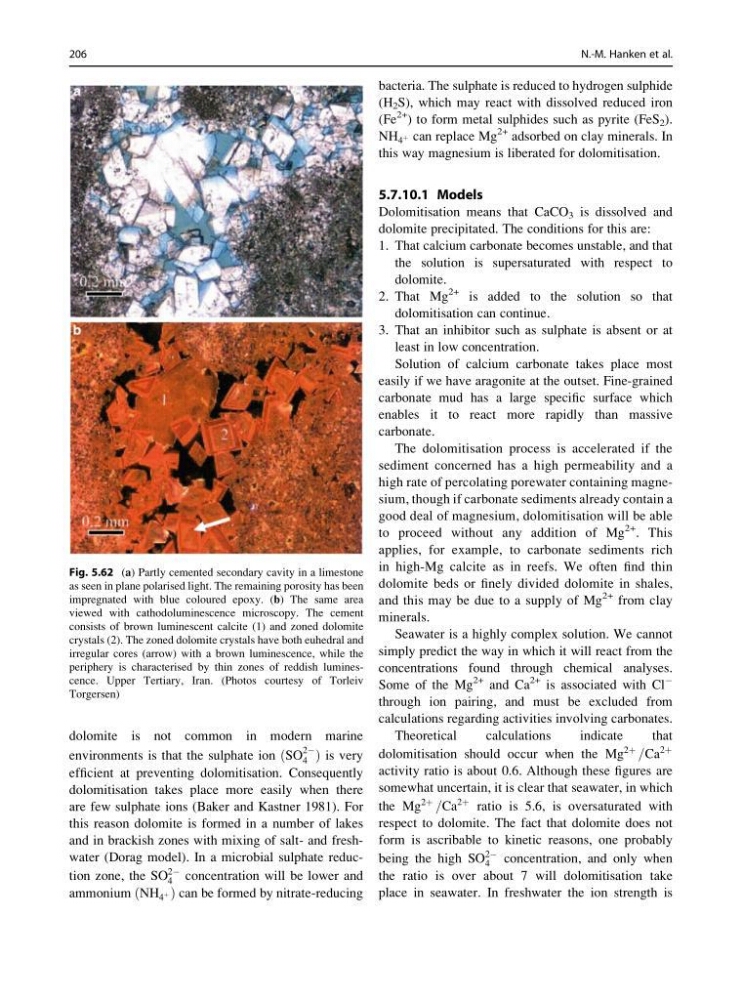
Fig. 5.62 (a) Partly cemented secondary cavity in a limestone
as seen in plane polarised light. The remaining porosity has been
impregnated with blue coloured epoxy. (b) The same area
viewed with cathodoluminescence microscopy. The cement
consists of brown luminescent calcite (1) and zoned dolomite
crystals (2). The zoned dolomite crystals have both euhedral and
irregular cores (arrow) with a brown luminescence, while the
periphery is characterised by thin zones of reddish luminescence. Upper Tertiary, Iran. (Photos courtesy of Torleiv
Torgersen)
206
N.-M. Hanken et al.
environments is that the sulphate ion ðSO
2À
4 Þ is very
efficient at preventing dolomitisation. Consequently
dolomitisation takes place more easily when there
are few sulphate ions (Baker and Kastner 1981). For
this reason dolomite is formed in a number of lakes
and in brackish zones with mixing of salt- and freshwater (Dorag model). In a microbial sulphate reduction zone, the SO
2À
4 concentration will be lower and
ammonium NH 4
þ Þ
ð
can be formed by nitrate-reducing
bacteria. The sulphate is reduced to hydrogen sulphide
(H 2 S), which may react with dissolved reduced iron
(Fe
2+ ) to form metal sulphides such as pyrite (FeS 2 ).
NH 4
þ can replace Mg
2+ adsorbed on clay minerals. In
this way magnesium is liberated for dolomitisation.
5.7.10.1 Models
Dolomitisation means that CaCO 3 is dissolved and
dolomite precipitated. The conditions for this are:
1. That calcium carbonate becomes unstable, and that
the solution is supersaturated with respect to
dolomite.
2. That Mg
2+ is added to the solution so that
dolomitisation can continue.
3. That an inhibitor such as sulphate is absent or at
least in low concentration.
Solution of calcium carbonate takes place most
easily if we have aragonite at the outset. Fine-grained
carbonate mud has a large specific surface which
enables it to react more rapidly than massive
carbonate.
The dolomitisation process is accelerated if the
sediment concerned has a high permeability and a
high rate of percolating porewater containing magnesium, though if carbonate sediments already contain a
good deal of magnesium, dolomitisation will be able
to proceed without any addition of Mg
2+ . This
applies, for example, to carbonate sediments rich
in high-Mg calcite as in reefs. We often find thin
dolomite beds or finely divided dolomite in shales,
and this may be due to a supply of Mg
2+ from clay
minerals.
Seawater is a highly complex solution. We cannot
simply predict the way in which it will react from the
concentrations found through chemical analyses.
Some of the Mg
2+ and Ca
2+ is associated with Cl
À
through ion pairing, and must be excluded from
calculations regarding activities involving carbonates.
Theoretical
calculations
indicate
that
dolomitisation should occur when the Mg
2þ
=Ca
2þ
activity ratio is about 0.6. Although these figures are
somewhat uncertain, it is clear that seawater, in which
the Mg
2þ
=Ca
2þ ratio is 5.6, is oversaturated with
respect to dolomite. The fact that dolomite does not
form is ascribable to kinetic reasons, one probably
being the high SO
2À
4 concentration, and only when
the ratio is over about 7 will dolomitisation take
place in seawater. In freshwater the ion strength is
Fig. 5.62 (a) Partly cemented secondary cavity in a limestone
as seen in plane polarised light. The remaining porosity has been
impregnated with blue coloured epoxy. (b) The same area
viewed with cathodoluminescence microscopy. The cement
consists of brown luminescent calcite (1) and zoned dolomite
crystals (2). The zoned dolomite crystals have both euhedral and
irregular cores (arrow) with a brown luminescence, while the
periphery is characterised by thin zones of reddish luminescence. Upper Tertiary, Iran. (Photos courtesy of Torleiv
Torgersen)
206
N.-M. Hanken et al.