

5.7.5.5 Reefs as Reservoir Rocks
The properties of reefs as reservoir rocks vary greatly
and depend very much on the type of reef building
organisms. These have varied through time and
depend also on the environment. The fossils determine
the initial mineralogical composition of the reef
structures and hence the burial diagenesis.
The coarse carbonate block deposits (talus) down
the slope in front of the reef (the fore-reef facies) and
bioclastic sand behind the reef experience less water
flow and tend to develop less marine cement. These
facies constitute better reservoir rocks in terms of
primary porosity.
Reefs are often surrounded by organic-rich terrigenous mud which may form a good source rock during
burial. The reefs themselves may be good hydrocarbon
traps, because they rise up from the seabed and thereby
constitute structures which may become sealed if the
reef drowns and is covered by terrigenous mud
(Fig. 5.56).
5.7.6 Burial Diagenesis
Early cementation by calcite cements reduces the primary porosity but the cement may strengthen the grain
framework and thus reduce compaction. Statistically,
however, porosity clearly decreases as a function of
burial depth (Schmoker and Halley 1982), although
the porosity/depth function varies greatly with the
lithology. The loss of porosity in carbonate sediments
is partly a result of mechanical compaction of the
carbonate mud and grains, just as in terrigenous mud
and sand, but with an important difference. Unlike
silicate reactions, carbonate reactions are relatively
fast even at low temperatures and chemical compaction is therefore important both at shallow depth and
low temperature, as well as at deeper burial depth and
higher temperature.
Aragonite and high-Mg calcite are metastable
minerals in the marine environment. They precipitate
because low-Mg calcite, which is the thermodynamically stable calcium carbonate phase, fails to precipitate. This is probably due to the poisoning (inhibiting)
effect of sulphate on calcite precipitation (Kastner
1984). During burial both aragonite and high-Mg calcite dissolve and are replaced by low-Mg calcite, but
we do not know how fast this reaction is in marine
sediments. This thermodynamic drive for dissolution
and compaction is almost independent of stress. The
dissolution of aragonite fossils or cements may cause
grain framework to collapse, whereas high-Mg calcite
is replaced by calcite that retains much of the original
texture so that the grain framework is conserved.
The solubility of carbonate grains is also a function
of effective stress and thus burial depth. Pressure
Incipient filling
of cavity
Complete cementation
of the mould
Dissolution and
formation of cavity
(mould)
Aragonite
Neomorphic calcite
Indistinet
primary
organic
lamination
Gradual dissolution
and precipitation
Sparry calcite
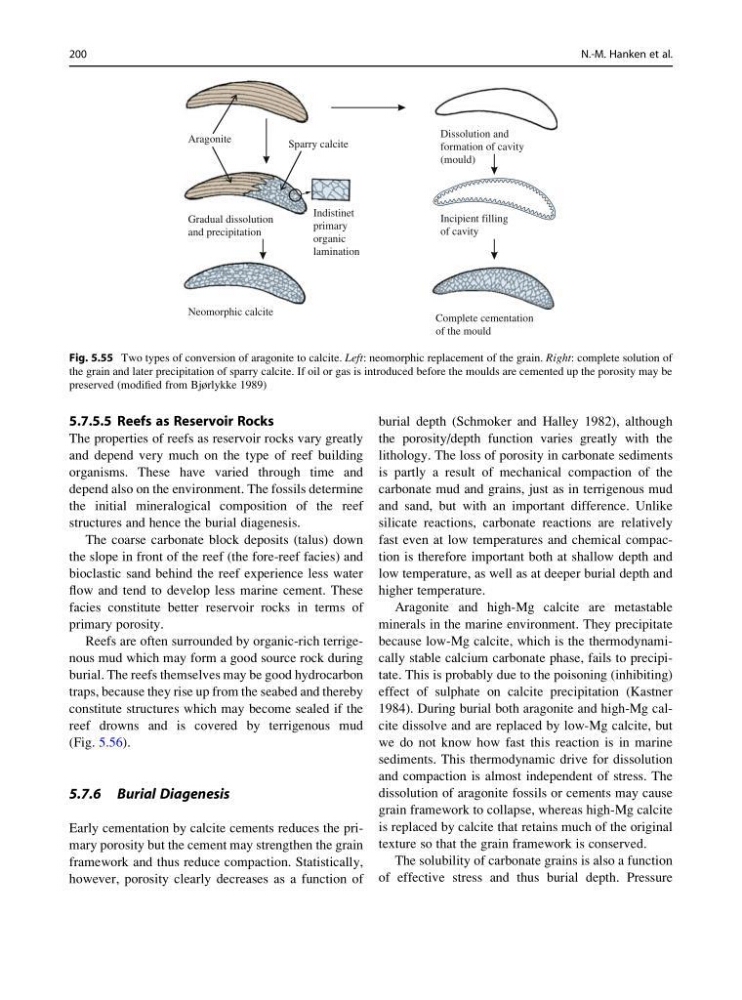
Fig. 5.55 Two types of conversion of aragonite to calcite. Left: neomorphic replacement of the grain. Right: complete solution of
the grain and later precipitation of sparry calcite. If oil or gas is introduced before the moulds are cemented up the porosity may be
preserved (modified from Bjørlykke 1989)
200
N.-M. Hanken et al.
The properties of reefs as reservoir rocks vary greatly
and depend very much on the type of reef building
organisms. These have varied through time and
depend also on the environment. The fossils determine
the initial mineralogical composition of the reef
structures and hence the burial diagenesis.
The coarse carbonate block deposits (talus) down
the slope in front of the reef (the fore-reef facies) and
bioclastic sand behind the reef experience less water
flow and tend to develop less marine cement. These
facies constitute better reservoir rocks in terms of
primary porosity.
Reefs are often surrounded by organic-rich terrigenous mud which may form a good source rock during
burial. The reefs themselves may be good hydrocarbon
traps, because they rise up from the seabed and thereby
constitute structures which may become sealed if the
reef drowns and is covered by terrigenous mud
(Fig. 5.56).
5.7.6 Burial Diagenesis
Early cementation by calcite cements reduces the primary porosity but the cement may strengthen the grain
framework and thus reduce compaction. Statistically,
however, porosity clearly decreases as a function of
burial depth (Schmoker and Halley 1982), although
the porosity/depth function varies greatly with the
lithology. The loss of porosity in carbonate sediments
is partly a result of mechanical compaction of the
carbonate mud and grains, just as in terrigenous mud
and sand, but with an important difference. Unlike
silicate reactions, carbonate reactions are relatively
fast even at low temperatures and chemical compaction is therefore important both at shallow depth and
low temperature, as well as at deeper burial depth and
higher temperature.
Aragonite and high-Mg calcite are metastable
minerals in the marine environment. They precipitate
because low-Mg calcite, which is the thermodynamically stable calcium carbonate phase, fails to precipitate. This is probably due to the poisoning (inhibiting)
effect of sulphate on calcite precipitation (Kastner
1984). During burial both aragonite and high-Mg calcite dissolve and are replaced by low-Mg calcite, but
we do not know how fast this reaction is in marine
sediments. This thermodynamic drive for dissolution
and compaction is almost independent of stress. The
dissolution of aragonite fossils or cements may cause
grain framework to collapse, whereas high-Mg calcite
is replaced by calcite that retains much of the original
texture so that the grain framework is conserved.
The solubility of carbonate grains is also a function
of effective stress and thus burial depth. Pressure
Incipient filling
of cavity
Complete cementation
of the mould
Dissolution and
formation of cavity
(mould)
Aragonite
Neomorphic calcite
Indistinet
primary
organic
lamination
Gradual dissolution
and precipitation
Sparry calcite
Fig. 5.55 Two types of conversion of aragonite to calcite. Left: neomorphic replacement of the grain. Right: complete solution of
the grain and later precipitation of sparry calcite. If oil or gas is introduced before the moulds are cemented up the porosity may be
preserved (modified from Bjørlykke 1989)
200
N.-M. Hanken et al.