

5.7.5.2 Beach Rock
The tidal zone on sandy beaches in tropical areas is
commonly cemented by aragonite or less commonly
by high-Mg calcite to produce “beach rock”. On modern
beaches the lithified zone may be about 0.5 m in thickness containing embedded bottles or other artifacts
indicating that cementation has been very rapid by geological standards. Cementation takes place in situ
beneath a thin sediment cover and is due to a combination of high flux of water due to wave action and rise in
ionic concentration due to evaporation of seawater as it
drains through the beach at low tide.
5.7.5.3 Hardground
A combination of dissolution and precipitation of carbonate sediments close to the seabed may produce a
well-cemented surface called a “hardground”. This
can be recognised by evidence of borings and/or
encrustations of hard bottom faunal elements such as
calcareous algae, sponges, corals, serpulids, crinoids
and oysters. Hard grounds are best developed in areas
of slow sedimentation and high current activity. Long
exposure on the seafloor can also lead to impregnation
with minerals such as iron hydroxides, phosphorite
and glauconite.
5.7.5.4 Cementation in Modern Reefs
Modern reefs have a very high porosity, made up of
everything from small cavities to large caverns. It was
previously believed that this primary porosity was
preserved in older reefs. Boring and blasting into
modern reefs, however, has revealed that the primary
porosity is rapidly reduced because the hollows are
rapidly filled up with fossil fragments and lime mud,
and/or become more or less cemented by early marine
cement. Reefs can therefore only make good reservoir
rocks if secondary porosity develops through the dissolution of fossils or cement. This may happen by the
reef being exposed above sea level to groundwater
percolation and also by flow beneath the seabed of
meteoric water from land. Aragonite or high-Mg calcite will then dissolve particularly easily and low-Mg
calcite will precipitate. This diagenetic process may
not significantly increase the overall porosity, but
merely redistribute it.
Marine cementation commences early in reefs. The
parts most exposed to waves, where water flux is
greatest, will undergo rapid marine cementation. In
the interior and landward parts there are less marine
cement and more secondary porosity due to subaerial
exposure and freshwater flushing. Skeletal material of
primary aragonite may dissolve as calcite precipitates
in the open framework porosity. Thus the porosity to a
large extent becomes mouldic due to dissolution of
many of the reef-building organisms.
Early cementation of aragonite or high-Mg calcite
reduces porosity but the cementation produces a
mechanically much stronger rock. The potential for
preserving the remaining porosity is therefore higher
than in uncemented carbonate sand. Furthermore,
pressure solution may be reduced because the cement
increases the contact area which reduces the stress per
grain contact.
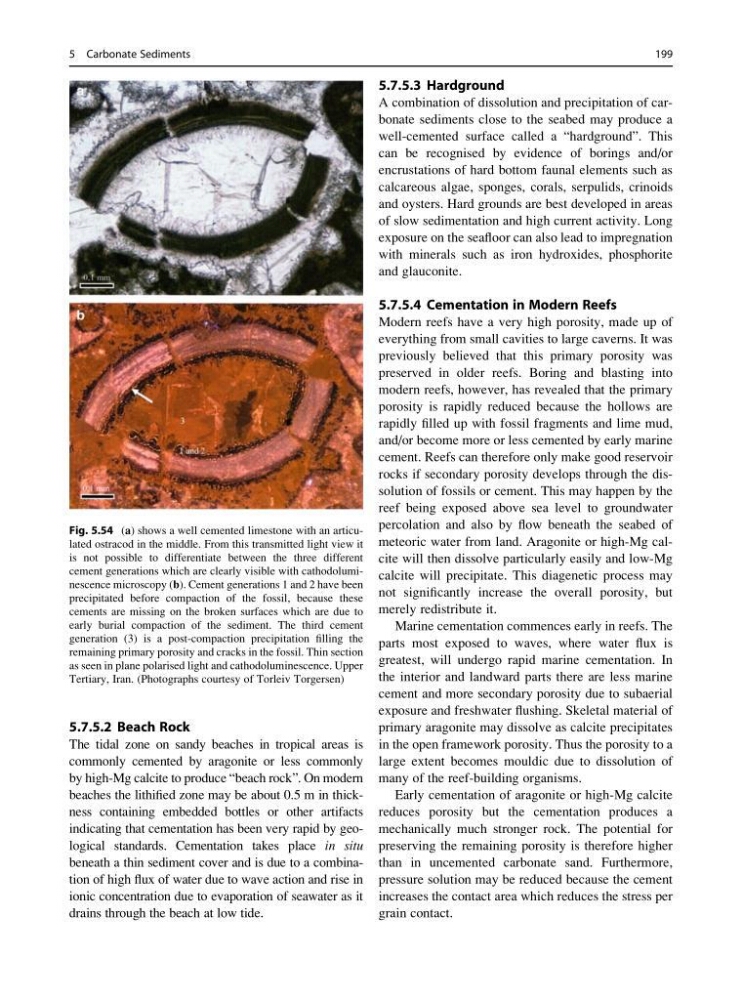
Fig. 5.54 (a) shows a well cemented limestone with an articulated ostracod in the middle. From this transmitted light view it
is not possible to differentiate between the three different
cement generations which are clearly visible with cathodoluminescence microscopy (b). Cement generations 1 and 2 have been
precipitated before compaction of the fossil, because these
cements are missing on the broken surfaces which are due to
early burial compaction of the sediment. The third cement
generation (3) is a post-compaction precipitation filling the
remaining primary porosity and cracks in the fossil. Thin section
as seen in plane polarised light and cathodoluminescence. Upper
Tertiary, Iran. (Photographs courtesy of Torleiv Torgersen)
5 Carbonate Sediments
199
The tidal zone on sandy beaches in tropical areas is
commonly cemented by aragonite or less commonly
by high-Mg calcite to produce “beach rock”. On modern
beaches the lithified zone may be about 0.5 m in thickness containing embedded bottles or other artifacts
indicating that cementation has been very rapid by geological standards. Cementation takes place in situ
beneath a thin sediment cover and is due to a combination of high flux of water due to wave action and rise in
ionic concentration due to evaporation of seawater as it
drains through the beach at low tide.
5.7.5.3 Hardground
A combination of dissolution and precipitation of carbonate sediments close to the seabed may produce a
well-cemented surface called a “hardground”. This
can be recognised by evidence of borings and/or
encrustations of hard bottom faunal elements such as
calcareous algae, sponges, corals, serpulids, crinoids
and oysters. Hard grounds are best developed in areas
of slow sedimentation and high current activity. Long
exposure on the seafloor can also lead to impregnation
with minerals such as iron hydroxides, phosphorite
and glauconite.
5.7.5.4 Cementation in Modern Reefs
Modern reefs have a very high porosity, made up of
everything from small cavities to large caverns. It was
previously believed that this primary porosity was
preserved in older reefs. Boring and blasting into
modern reefs, however, has revealed that the primary
porosity is rapidly reduced because the hollows are
rapidly filled up with fossil fragments and lime mud,
and/or become more or less cemented by early marine
cement. Reefs can therefore only make good reservoir
rocks if secondary porosity develops through the dissolution of fossils or cement. This may happen by the
reef being exposed above sea level to groundwater
percolation and also by flow beneath the seabed of
meteoric water from land. Aragonite or high-Mg calcite will then dissolve particularly easily and low-Mg
calcite will precipitate. This diagenetic process may
not significantly increase the overall porosity, but
merely redistribute it.
Marine cementation commences early in reefs. The
parts most exposed to waves, where water flux is
greatest, will undergo rapid marine cementation. In
the interior and landward parts there are less marine
cement and more secondary porosity due to subaerial
exposure and freshwater flushing. Skeletal material of
primary aragonite may dissolve as calcite precipitates
in the open framework porosity. Thus the porosity to a
large extent becomes mouldic due to dissolution of
many of the reef-building organisms.
Early cementation of aragonite or high-Mg calcite
reduces porosity but the cementation produces a
mechanically much stronger rock. The potential for
preserving the remaining porosity is therefore higher
than in uncemented carbonate sand. Furthermore,
pressure solution may be reduced because the cement
increases the contact area which reduces the stress per
grain contact.
Fig. 5.54 (a) shows a well cemented limestone with an articulated ostracod in the middle. From this transmitted light view it
is not possible to differentiate between the three different
cement generations which are clearly visible with cathodoluminescence microscopy (b). Cement generations 1 and 2 have been
precipitated before compaction of the fossil, because these
cements are missing on the broken surfaces which are due to
early burial compaction of the sediment. The third cement
generation (3) is a post-compaction precipitation filling the
remaining primary porosity and cracks in the fossil. Thin section
as seen in plane polarised light and cathodoluminescence. Upper
Tertiary, Iran. (Photographs courtesy of Torleiv Torgersen)
5 Carbonate Sediments
199