

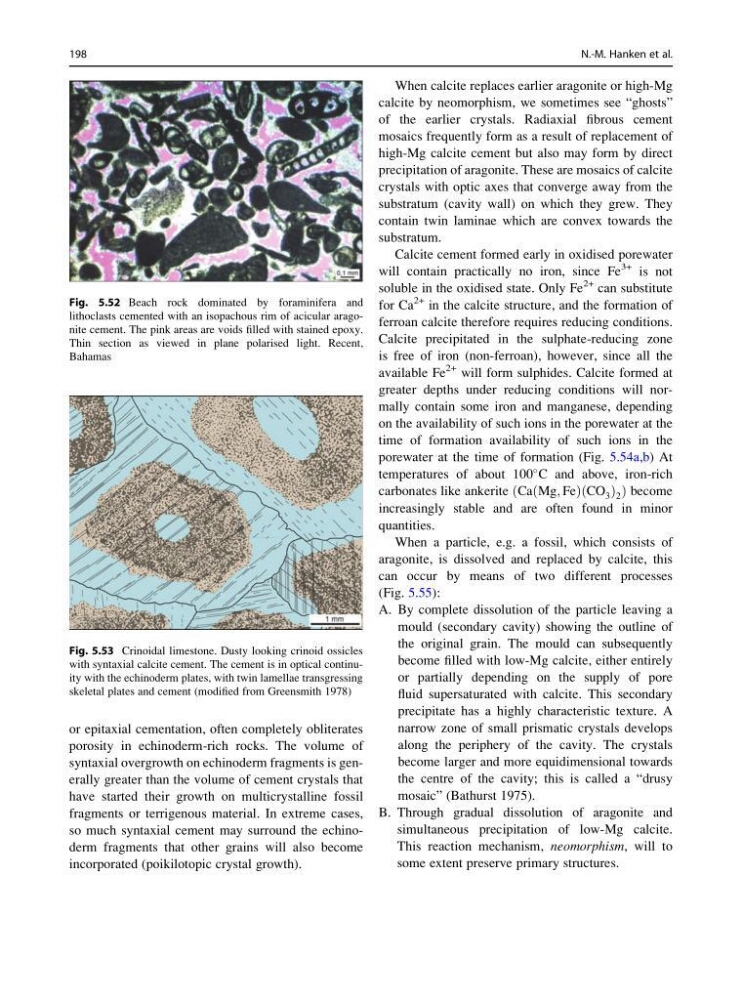
or epitaxial cementation, often completely obliterates
porosity in echinoderm-rich rocks. The volume of
syntaxial overgrowth on echinoderm fragments is generally greater than the volume of cement crystals that
have started their growth on multicrystalline fossil
fragments or terrigenous material. In extreme cases,
so much syntaxial cement may surround the echinoderm fragments that other grains will also become
incorporated (poikilotopic crystal growth).
When calcite replaces earlier aragonite or high-Mg
calcite by neomorphism, we sometimes see “ghosts”
of the earlier crystals. Radiaxial fibrous cement
mosaics frequently form as a result of replacement of
high-Mg calcite cement but also may form by direct
precipitation of aragonite. These are mosaics of calcite
crystals with optic axes that converge away from the
substratum (cavity wall) on which they grew. They
contain twin laminae which are convex towards the
substratum.
Calcite cement formed early in oxidised porewater
will contain practically no iron, since Fe
3+ is not
soluble in the oxidised state. Only Fe
2+ can substitute
for Ca
2+ in the calcite structure, and the formation of
ferroan calcite therefore requires reducing conditions.
Calcite precipitated in the sulphate-reducing zone
is free of iron (non-ferroan), however, since all the
available Fe
2+ will form sulphides. Calcite formed at
greater depths under reducing conditions will normally contain some iron and manganese, depending
on the availability of such ions in the porewater at the
time of formation availability of such ions in the
porewater at the time of formation (Fig. 5.54a,b) At
temperatures of about 100
C and above, iron-rich
carbonates like ankerite ðCaðMg; FeÞðCO 3 Þ 2 Þ become
increasingly stable and are often found in minor
quantities.
When a particle, e.g. a fossil, which consists of
aragonite, is dissolved and replaced by calcite, this
can occur by means of two different processes
(Fig. 5.55):
A. By complete dissolution of the particle leaving a
mould (secondary cavity) showing the outline of
the original grain. The mould can subsequently
become filled with low-Mg calcite, either entirely
or partially depending on the supply of pore
fluid supersaturated with calcite. This secondary
precipitate has a highly characteristic texture. A
narrow zone of small prismatic crystals develops
along the periphery of the cavity. The crystals
become larger and more equidimensional towards
the centre of the cavity; this is called a “drusy
mosaic” (Bathurst 1975).
B. Through gradual dissolution of aragonite and
simultaneous precipitation of low-Mg calcite.
This reaction mechanism, neomorphism, will to
some extent preserve primary structures.
Fig. 5.53 Crinoidal limestone. Dusty looking crinoid ossicles
with syntaxial calcite cement. The cement is in optical continuity with the echinoderm plates, with twin lamellae transgressing
skeletal plates and cement (modified from Greensmith 1978)
Fig. 5.52 Beach rock dominated by foraminifera and
lithoclasts cemented with an isopachous rim of acicular aragonite cement. The pink areas are voids filled with stained epoxy.
Thin section as viewed in plane polarised light. Recent,
Bahamas
198
N.-M. Hanken et al.
porosity in echinoderm-rich rocks. The volume of
syntaxial overgrowth on echinoderm fragments is generally greater than the volume of cement crystals that
have started their growth on multicrystalline fossil
fragments or terrigenous material. In extreme cases,
so much syntaxial cement may surround the echinoderm fragments that other grains will also become
incorporated (poikilotopic crystal growth).
When calcite replaces earlier aragonite or high-Mg
calcite by neomorphism, we sometimes see “ghosts”
of the earlier crystals. Radiaxial fibrous cement
mosaics frequently form as a result of replacement of
high-Mg calcite cement but also may form by direct
precipitation of aragonite. These are mosaics of calcite
crystals with optic axes that converge away from the
substratum (cavity wall) on which they grew. They
contain twin laminae which are convex towards the
substratum.
Calcite cement formed early in oxidised porewater
will contain practically no iron, since Fe
3+ is not
soluble in the oxidised state. Only Fe
2+ can substitute
for Ca
2+ in the calcite structure, and the formation of
ferroan calcite therefore requires reducing conditions.
Calcite precipitated in the sulphate-reducing zone
is free of iron (non-ferroan), however, since all the
available Fe
2+ will form sulphides. Calcite formed at
greater depths under reducing conditions will normally contain some iron and manganese, depending
on the availability of such ions in the porewater at the
time of formation availability of such ions in the
porewater at the time of formation (Fig. 5.54a,b) At
temperatures of about 100
C and above, iron-rich
carbonates like ankerite ðCaðMg; FeÞðCO 3 Þ 2 Þ become
increasingly stable and are often found in minor
quantities.
When a particle, e.g. a fossil, which consists of
aragonite, is dissolved and replaced by calcite, this
can occur by means of two different processes
(Fig. 5.55):
A. By complete dissolution of the particle leaving a
mould (secondary cavity) showing the outline of
the original grain. The mould can subsequently
become filled with low-Mg calcite, either entirely
or partially depending on the supply of pore
fluid supersaturated with calcite. This secondary
precipitate has a highly characteristic texture. A
narrow zone of small prismatic crystals develops
along the periphery of the cavity. The crystals
become larger and more equidimensional towards
the centre of the cavity; this is called a “drusy
mosaic” (Bathurst 1975).
B. Through gradual dissolution of aragonite and
simultaneous precipitation of low-Mg calcite.
This reaction mechanism, neomorphism, will to
some extent preserve primary structures.
Fig. 5.53 Crinoidal limestone. Dusty looking crinoid ossicles
with syntaxial calcite cement. The cement is in optical continuity with the echinoderm plates, with twin lamellae transgressing
skeletal plates and cement (modified from Greensmith 1978)
Fig. 5.52 Beach rock dominated by foraminifera and
lithoclasts cemented with an isopachous rim of acicular aragonite cement. The pink areas are voids filled with stained epoxy.
Thin section as viewed in plane polarised light. Recent,
Bahamas
198
N.-M. Hanken et al.