

called isopachous fibrous cement because a layer of
uniform thickness is formed (Fig. 5.52). Isopachous
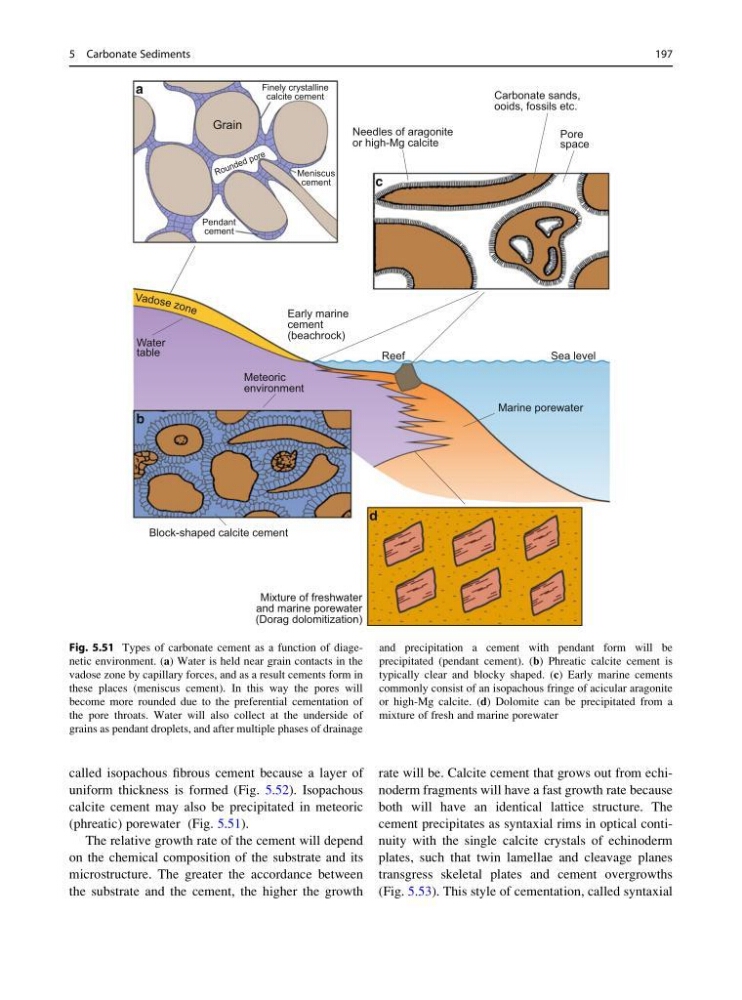
calcite cement may also be precipitated in meteoric
(phreatic) porewater (Fig. 5.51).
The relative growth rate of the cement will depend
on the chemical composition of the substrate and its
microstructure. The greater the accordance between
the substrate and the cement, the higher the growth
rate will be. Calcite cement that grows out from echinoderm fragments will have a fast growth rate because
both will have an identical lattice structure. The
cement precipitates as syntaxial rims in optical continuity with the single calcite crystals of echinoderm
plates, such that twin lamellae and cleavage planes
transgress skeletal plates and cement overgrowths
(Fig. 5.53). This style of cementation, called syntaxial
Reef
Meniscus
cement
Pendant
cement
Grain
R o u n d e d p o re
Finely crystalline
calcite cement
Sea level
Marine porewater
Meteoric
environment
Water
table
Needles of aragonite
or high-Mg calcite
Carbonate sands,
ooids, fossils etc.
Early marine
cement
(beachrock)
Block-shaped calcite cement
Pore
space
Mixture of freshwater
and marine porewater
(Dorag dolomitization)
a
c
b
d
Va do se z o n e
Fig. 5.51 Types of carbonate cement as a function of diagenetic environment. (a) Water is held near grain contacts in the
vadose zone by capillary forces, and as a result cements form in
these places (meniscus cement). In this way the pores will
become more rounded due to the preferential cementation of
the pore throats. Water will also collect at the underside of
grains as pendant droplets, and after multiple phases of drainage
and precipitation a cement with pendant form will be
precipitated (pendant cement). (b) Phreatic calcite cement is
typically clear and blocky shaped. (c) Early marine cements
commonly consist of an isopachous fringe of acicular aragonite
or high-Mg calcite. (d) Dolomite can be precipitated from a
mixture of fresh and marine porewater
5 Carbonate Sediments
197
uniform thickness is formed (Fig. 5.52). Isopachous
calcite cement may also be precipitated in meteoric
(phreatic) porewater (Fig. 5.51).
The relative growth rate of the cement will depend
on the chemical composition of the substrate and its
microstructure. The greater the accordance between
the substrate and the cement, the higher the growth
rate will be. Calcite cement that grows out from echinoderm fragments will have a fast growth rate because
both will have an identical lattice structure. The
cement precipitates as syntaxial rims in optical continuity with the single calcite crystals of echinoderm
plates, such that twin lamellae and cleavage planes
transgress skeletal plates and cement overgrowths
(Fig. 5.53). This style of cementation, called syntaxial
Reef
Meniscus
cement
Pendant
cement
Grain
R o u n d e d p o re
Finely crystalline
calcite cement
Sea level
Marine porewater
Meteoric
environment
Water
table
Needles of aragonite
or high-Mg calcite
Carbonate sands,
ooids, fossils etc.
Early marine
cement
(beachrock)
Block-shaped calcite cement
Pore
space
Mixture of freshwater
and marine porewater
(Dorag dolomitization)
a
c
b
d
Va do se z o n e
Fig. 5.51 Types of carbonate cement as a function of diagenetic environment. (a) Water is held near grain contacts in the
vadose zone by capillary forces, and as a result cements form in
these places (meniscus cement). In this way the pores will
become more rounded due to the preferential cementation of
the pore throats. Water will also collect at the underside of
grains as pendant droplets, and after multiple phases of drainage
and precipitation a cement with pendant form will be
precipitated (pendant cement). (b) Phreatic calcite cement is
typically clear and blocky shaped. (c) Early marine cements
commonly consist of an isopachous fringe of acicular aragonite
or high-Mg calcite. (d) Dolomite can be precipitated from a
mixture of fresh and marine porewater
5 Carbonate Sediments
197