

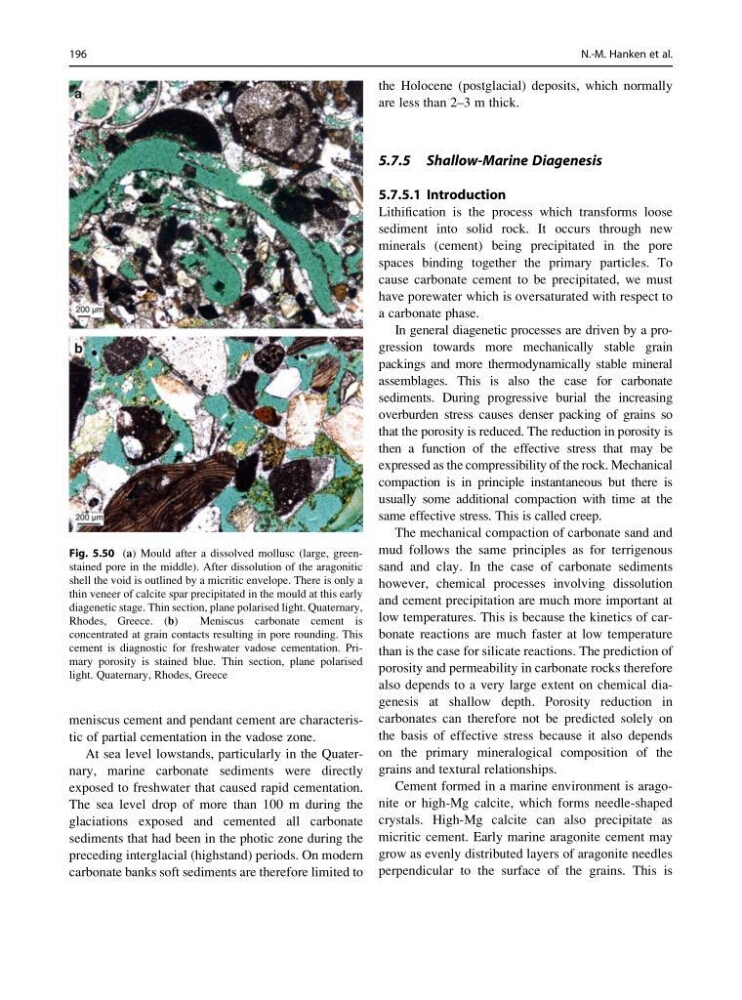
meniscus cement and pendant cement are characteristic of partial cementation in the vadose zone.
At sea level lowstands, particularly in the Quaternary, marine carbonate sediments were directly
exposed to freshwater that caused rapid cementation.
The sea level drop of more than 100 m during the
glaciations exposed and cemented all carbonate
sediments that had been in the photic zone during the
preceding interglacial (highstand) periods. On modern
carbonate banks soft sediments are therefore limited to
the Holocene (postglacial) deposits, which normally
are less than 2–3 m thick.
5.7.5 Shallow-Marine Diagenesis
5.7.5.1 Introduction
Lithification is the process which transforms loose
sediment into solid rock. It occurs through new
minerals (cement) being precipitated in the pore
spaces binding together the primary particles. To
cause carbonate cement to be precipitated, we must
have porewater which is oversaturated with respect to
a carbonate phase.
In general diagenetic processes are driven by a progression towards more mechanically stable grain
packings and more thermodynamically stable mineral
assemblages. This is also the case for carbonate
sediments. During progressive burial the increasing
overburden stress causes denser packing of grains so
that the porosity is reduced. The reduction in porosity is
then a function of the effective stress that may be
expressed as the compressibility of the rock. Mechanical
compaction is in principle instantaneous but there is
usually some additional compaction with time at the
same effective stress. This is called creep.
The mechanical compaction of carbonate sand and
mud follows the same principles as for terrigenous
sand and clay. In the case of carbonate sediments
however, chemical processes involving dissolution
and cement precipitation are much more important at
low temperatures. This is because the kinetics of carbonate reactions are much faster at low temperature
than is the case for silicate reactions. The prediction of
porosity and permeability in carbonate rocks therefore
also depends to a very large extent on chemical diagenesis at shallow depth. Porosity reduction in
carbonates can therefore not be predicted solely on
the basis of effective stress because it also depends
on the primary mineralogical composition of the
grains and textural relationships.
Cement formed in a marine environment is aragonite or high-Mg calcite, which forms needle-shaped
crystals. High-Mg calcite can also precipitate as
micritic cement. Early marine aragonite cement may
grow as evenly distributed layers of aragonite needles
perpendicular to the surface of the grains. This is
Fig. 5.50 (a) Mould after a dissolved mollusc (large, greenstained pore in the middle). After dissolution of the aragonitic
shell the void is outlined by a micritic envelope. There is only a
thin veneer of calcite spar precipitated in the mould at this early
diagenetic stage. Thin section, plane polarised light. Quaternary,
Rhodes, Greece. (b)
Meniscus carbonate cement is
concentrated at grain contacts resulting in pore rounding. This
cement is diagnostic for freshwater vadose cementation. Primary porosity is stained blue. Thin section, plane polarised
light. Quaternary, Rhodes, Greece
196
N.-M. Hanken et al.
At sea level lowstands, particularly in the Quaternary, marine carbonate sediments were directly
exposed to freshwater that caused rapid cementation.
The sea level drop of more than 100 m during the
glaciations exposed and cemented all carbonate
sediments that had been in the photic zone during the
preceding interglacial (highstand) periods. On modern
carbonate banks soft sediments are therefore limited to
the Holocene (postglacial) deposits, which normally
are less than 2–3 m thick.
5.7.5 Shallow-Marine Diagenesis
5.7.5.1 Introduction
Lithification is the process which transforms loose
sediment into solid rock. It occurs through new
minerals (cement) being precipitated in the pore
spaces binding together the primary particles. To
cause carbonate cement to be precipitated, we must
have porewater which is oversaturated with respect to
a carbonate phase.
In general diagenetic processes are driven by a progression towards more mechanically stable grain
packings and more thermodynamically stable mineral
assemblages. This is also the case for carbonate
sediments. During progressive burial the increasing
overburden stress causes denser packing of grains so
that the porosity is reduced. The reduction in porosity is
then a function of the effective stress that may be
expressed as the compressibility of the rock. Mechanical
compaction is in principle instantaneous but there is
usually some additional compaction with time at the
same effective stress. This is called creep.
The mechanical compaction of carbonate sand and
mud follows the same principles as for terrigenous
sand and clay. In the case of carbonate sediments
however, chemical processes involving dissolution
and cement precipitation are much more important at
low temperatures. This is because the kinetics of carbonate reactions are much faster at low temperature
than is the case for silicate reactions. The prediction of
porosity and permeability in carbonate rocks therefore
also depends to a very large extent on chemical diagenesis at shallow depth. Porosity reduction in
carbonates can therefore not be predicted solely on
the basis of effective stress because it also depends
on the primary mineralogical composition of the
grains and textural relationships.
Cement formed in a marine environment is aragonite or high-Mg calcite, which forms needle-shaped
crystals. High-Mg calcite can also precipitate as
micritic cement. Early marine aragonite cement may
grow as evenly distributed layers of aragonite needles
perpendicular to the surface of the grains. This is
Fig. 5.50 (a) Mould after a dissolved mollusc (large, greenstained pore in the middle). After dissolution of the aragonitic
shell the void is outlined by a micritic envelope. There is only a
thin veneer of calcite spar precipitated in the mould at this early
diagenetic stage. Thin section, plane polarised light. Quaternary,
Rhodes, Greece. (b)
Meniscus carbonate cement is
concentrated at grain contacts resulting in pore rounding. This
cement is diagnostic for freshwater vadose cementation. Primary porosity is stained blue. Thin section, plane polarised
light. Quaternary, Rhodes, Greece
196
N.-M. Hanken et al.