

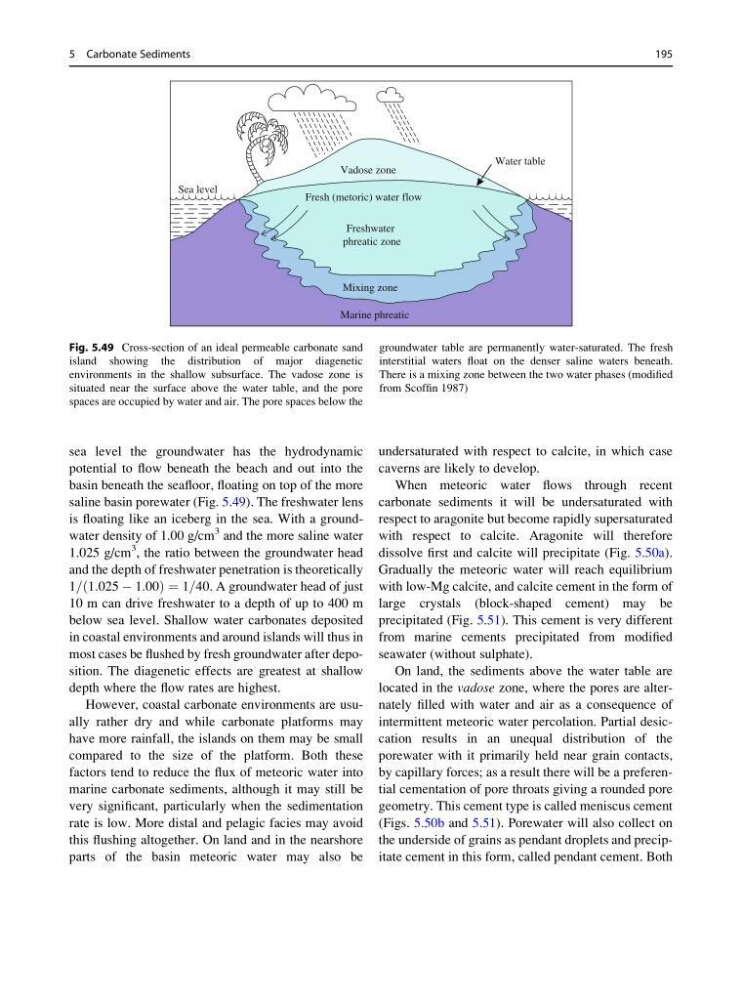
sea level the groundwater has the hydrodynamic
potential to flow beneath the beach and out into the
basin beneath the seafloor, floating on top of the more
saline basin porewater (Fig. 5.49). The freshwater lens
is floating like an iceberg in the sea. With a groundwater density of 1.00 g/cm
3 and the more saline water
1.025 g/cm
3 , the ratio between the groundwater head
and the depth of freshwater penetration is theoretically
1=ð1:025 À 1:00Þ ¼ 1=40. A groundwater head of just
10 m can drive freshwater to a depth of up to 400 m
below sea level. Shallow water carbonates deposited
in coastal environments and around islands will thus in
most cases be flushed by fresh groundwater after deposition. The diagenetic effects are greatest at shallow
depth where the flow rates are highest.
However, coastal carbonate environments are usually rather dry and while carbonate platforms may
have more rainfall, the islands on them may be small
compared to the size of the platform. Both these
factors tend to reduce the flux of meteoric water into
marine carbonate sediments, although it may still be
very significant, particularly when the sedimentation
rate is low. More distal and pelagic facies may avoid
this flushing altogether. On land and in the nearshore
parts of the basin meteoric water may also be
undersaturated with respect to calcite, in which case
caverns are likely to develop.
When meteoric water flows through recent
carbonate sediments it will be undersaturated with
respect to aragonite but become rapidly supersaturated
with respect to calcite. Aragonite will therefore
dissolve first and calcite will precipitate (Fig. 5.50a).
Gradually the meteoric water will reach equilibrium
with low-Mg calcite, and calcite cement in the form of
large crystals (block-shaped cement) may be
precipitated (Fig. 5.51). This cement is very different
from marine cements precipitated from modified
seawater (without sulphate).
On land, the sediments above the water table are
located in the vadose zone, where the pores are alternately filled with water and air as a consequence of
intermittent meteoric water percolation. Partial desiccation results in an unequal distribution of the
porewater with it primarily held near grain contacts,
by capillary forces; as a result there will be a preferential cementation of pore throats giving a rounded pore
geometry. This cement type is called meniscus cement
(Figs. 5.50b and 5.51). Porewater will also collect on
the underside of grains as pendant droplets and precipitate cement in this form, called pendant cement. Both
Vadose zone
Fresh (metoric) water flow
Freshwater
phreatic zone
Marine phreatic
Mixing zone
Sea level
Water table
Fig. 5.49 Cross-section of an ideal permeable carbonate sand
island showing the distribution of major diagenetic
environments in the shallow subsurface. The vadose zone is
situated near the surface above the water table, and the pore
spaces are occupied by water and air. The pore spaces below the
groundwater table are permanently water-saturated. The fresh
interstitial waters float on the denser saline waters beneath.
There is a mixing zone between the two water phases (modified
from Scoffin 1987)
5 Carbonate Sediments
195
potential to flow beneath the beach and out into the
basin beneath the seafloor, floating on top of the more
saline basin porewater (Fig. 5.49). The freshwater lens
is floating like an iceberg in the sea. With a groundwater density of 1.00 g/cm
3 and the more saline water
1.025 g/cm
3 , the ratio between the groundwater head
and the depth of freshwater penetration is theoretically
1=ð1:025 À 1:00Þ ¼ 1=40. A groundwater head of just
10 m can drive freshwater to a depth of up to 400 m
below sea level. Shallow water carbonates deposited
in coastal environments and around islands will thus in
most cases be flushed by fresh groundwater after deposition. The diagenetic effects are greatest at shallow
depth where the flow rates are highest.
However, coastal carbonate environments are usually rather dry and while carbonate platforms may
have more rainfall, the islands on them may be small
compared to the size of the platform. Both these
factors tend to reduce the flux of meteoric water into
marine carbonate sediments, although it may still be
very significant, particularly when the sedimentation
rate is low. More distal and pelagic facies may avoid
this flushing altogether. On land and in the nearshore
parts of the basin meteoric water may also be
undersaturated with respect to calcite, in which case
caverns are likely to develop.
When meteoric water flows through recent
carbonate sediments it will be undersaturated with
respect to aragonite but become rapidly supersaturated
with respect to calcite. Aragonite will therefore
dissolve first and calcite will precipitate (Fig. 5.50a).
Gradually the meteoric water will reach equilibrium
with low-Mg calcite, and calcite cement in the form of
large crystals (block-shaped cement) may be
precipitated (Fig. 5.51). This cement is very different
from marine cements precipitated from modified
seawater (without sulphate).
On land, the sediments above the water table are
located in the vadose zone, where the pores are alternately filled with water and air as a consequence of
intermittent meteoric water percolation. Partial desiccation results in an unequal distribution of the
porewater with it primarily held near grain contacts,
by capillary forces; as a result there will be a preferential cementation of pore throats giving a rounded pore
geometry. This cement type is called meniscus cement
(Figs. 5.50b and 5.51). Porewater will also collect on
the underside of grains as pendant droplets and precipitate cement in this form, called pendant cement. Both
Vadose zone
Fresh (metoric) water flow
Freshwater
phreatic zone
Marine phreatic
Mixing zone
Sea level
Water table
Fig. 5.49 Cross-section of an ideal permeable carbonate sand
island showing the distribution of major diagenetic
environments in the shallow subsurface. The vadose zone is
situated near the surface above the water table, and the pore
spaces are occupied by water and air. The pore spaces below the
groundwater table are permanently water-saturated. The fresh
interstitial waters float on the denser saline waters beneath.
There is a mixing zone between the two water phases (modified
from Scoffin 1987)
5 Carbonate Sediments
195