

solution will often be concentrated at particular
horizons where there has been some enrichment of
clay particles which increases the rate of solution.
Stylolites, which are surfaces where a considerable
amount of solution has taken place, will then form.
The horizon will be enriched with finely divided silicate minerals and other insoluble material in the
limestones (Fig. 5.57). Where carbonate, usually calcite, is dissolved due to pressure solution, the
dissolved material tends to be precipitated in the
neighbouring pore spaces. When the pores between
stylolites are filled with cement, dissolution along the
stylolite ceases. Stylolites may have a relief from
1–2 mm up to several tens of centimetres and a
spacing of typically 1–5 cm. As the rate of solution
Mean sea level
Reef
Island
Circum reefal
calcareous oozes
Reef
talus
Water
Platform from which reef-complex grew up
Lagoonal deposits
Lagoon
Reef
proper
Lagoonal patch reefs
Reef rock
Water
Reef
frame
or
reef
rock
Sandstone
Ancient platform rock – impervious or water soaked
Impervious shale prevents
loss of oil upward
Traces of oil from shale below
Little or no oil
Less oil
Much oil
Shale
a
b
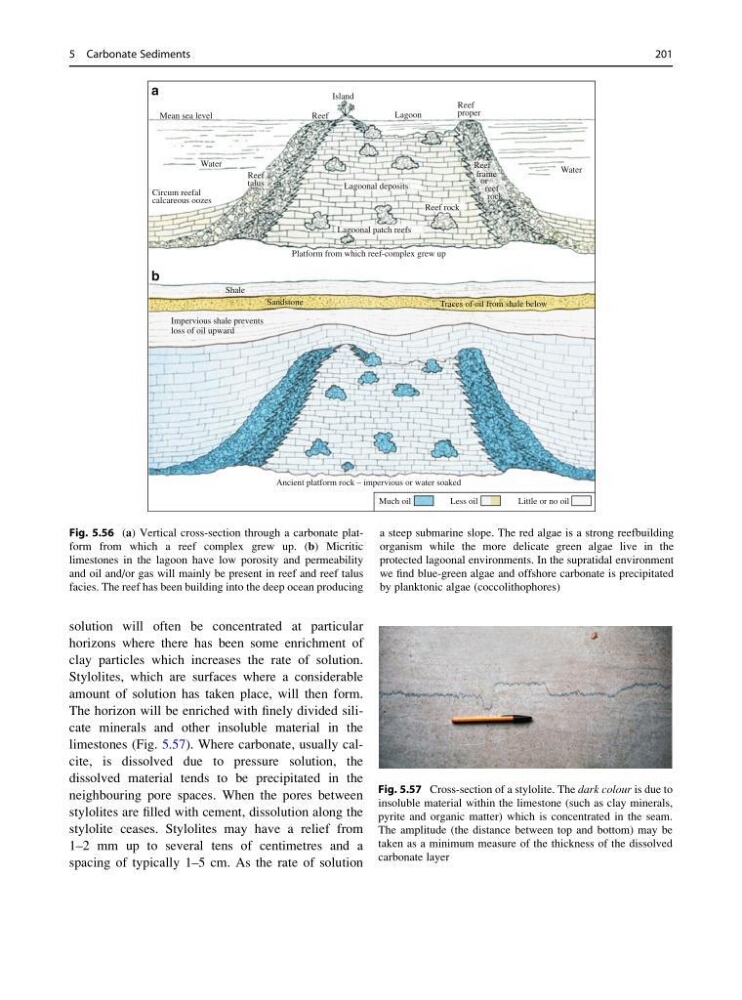
Fig. 5.56 (a) Vertical cross-section through a carbonate platform from which a reef complex grew up. (b) Micritic
limestones in the lagoon have low porosity and permeability
and oil and/or gas will mainly be present in reef and reef talus
facies. The reef has been building into the deep ocean producing
a steep submarine slope. The red algae is a strong reefbuilding
organism while the more delicate green algae live in the
protected lagoonal environments. In the supratidal environment
we find blue-green algae and offshore carbonate is precipitated
by planktonic algae (coccolithophores)
Fig. 5.57 Cross-section of a stylolite. The dark colour is due to
insoluble material within the limestone (such as clay minerals,
pyrite and organic matter) which is concentrated in the seam.
The amplitude (the distance between top and bottom) may be
taken as a minimum measure of the thickness of the dissolved
carbonate layer
5 Carbonate Sediments
201
horizons where there has been some enrichment of
clay particles which increases the rate of solution.
Stylolites, which are surfaces where a considerable
amount of solution has taken place, will then form.
The horizon will be enriched with finely divided silicate minerals and other insoluble material in the
limestones (Fig. 5.57). Where carbonate, usually calcite, is dissolved due to pressure solution, the
dissolved material tends to be precipitated in the
neighbouring pore spaces. When the pores between
stylolites are filled with cement, dissolution along the
stylolite ceases. Stylolites may have a relief from
1–2 mm up to several tens of centimetres and a
spacing of typically 1–5 cm. As the rate of solution
Mean sea level
Reef
Island
Circum reefal
calcareous oozes
Reef
talus
Water
Platform from which reef-complex grew up
Lagoonal deposits
Lagoon
Reef
proper
Lagoonal patch reefs
Reef rock
Water
Reef
frame
or
reef
rock
Sandstone
Ancient platform rock – impervious or water soaked
Impervious shale prevents
loss of oil upward
Traces of oil from shale below
Little or no oil
Less oil
Much oil
Shale
a
b
Fig. 5.56 (a) Vertical cross-section through a carbonate platform from which a reef complex grew up. (b) Micritic
limestones in the lagoon have low porosity and permeability
and oil and/or gas will mainly be present in reef and reef talus
facies. The reef has been building into the deep ocean producing
a steep submarine slope. The red algae is a strong reefbuilding
organism while the more delicate green algae live in the
protected lagoonal environments. In the supratidal environment
we find blue-green algae and offshore carbonate is precipitated
by planktonic algae (coccolithophores)
Fig. 5.57 Cross-section of a stylolite. The dark colour is due to
insoluble material within the limestone (such as clay minerals,
pyrite and organic matter) which is concentrated in the seam.
The amplitude (the distance between top and bottom) may be
taken as a minimum measure of the thickness of the dissolved
carbonate layer
5 Carbonate Sediments
201