

3. If sea level rises faster than the coral reef can grow,
the reef may drop below the photic zone and
“drown”, but this is very rare because they can
gain height rapidly.
4. Reefs provide a favourable ecological environment
for animals which are not part of the reef structure
itself, but which live on other organisms.
5. Many organisms in coral reefs live by filtering
water to trap planktonic organisms and organic
material. If the water contains too much siliciclastic
mud, the clay minerals can choke the filtering
organs so that the organisms die. Corals are particularly sensitive to the clay content in the water and
can only live in clear water. The addition of clay,
for example from a delta, will kill a coral reef.
Pollution will have the same effect.
6. Clear sea water, however, is usually very poor in
nutrients, so the organisms in a reef are dependent
on good water circulation to obtain enough food.
Consequently, reefs tend to grow on the edge of
ocean basins, or as structures projecting high up
from deeper waters. In this way, high water
temperature is combined with low mud content
and good water circulation.
7. The reef facies is built up as a wave-breaking structure, with powerful networks of corals which are
braced by an encrustation of coralline algae. Red
algae are massive and strong and have an important
function in supporting the reef structure so that it can
withstand the strong waves. However, parts of the
most exposed parts of the reef structures can be
mechanically destroyed by wave action during
heavy storms. In this way reef fragments of various
sizes may fall down the fore-reef slope, be
transported up onto the reef flat or be deposited in
gaps and cavities in the reef framework. This
mechanical destruction is aided by the boring and
grazing action of different bioeroding organisms.
The bio-erosion can be so extensive that many of
the primary structures of fossil reefs are destroyed.
Boring mussels are particularly effective, excavating
elongated cavities about 1 cm in diameter in corals,
algae etc. Boring sponges, worms and algae are
also important reef-damaging organisms, typically
Tertiary
Periods
Biotherms
Major skeletal elements
Corals
Corals
Corals
Corals, stromatoporoids
Corals, sponges
Sponges
stromatoporoids
Sponges, Tubiphytes, calcareous algae
Calcisponges, fenestellid bryozoa, corals
Tubular foraminifers
Tubiphytes
Bryozoa
Fenstrate bryozoa
Corals
Bryozoa
Stromatoporoids
Tubiphytes
Phylloid algae
Palaeoaplysina
Stromatoporoids
Stromatoporoids
& corals
Sponges
Archaeocyathids
& calcareous algae
Reef
mounds
Reefs
Calcareous algae
Calcareous algae
Rudists
Rudists
Bryozoa
Cretaceous
Jurassic
Triassic
Permian
Pennsylvanian
Mississippian
Devonian
Silurian
Ordovician
Cambrian
Precambrian
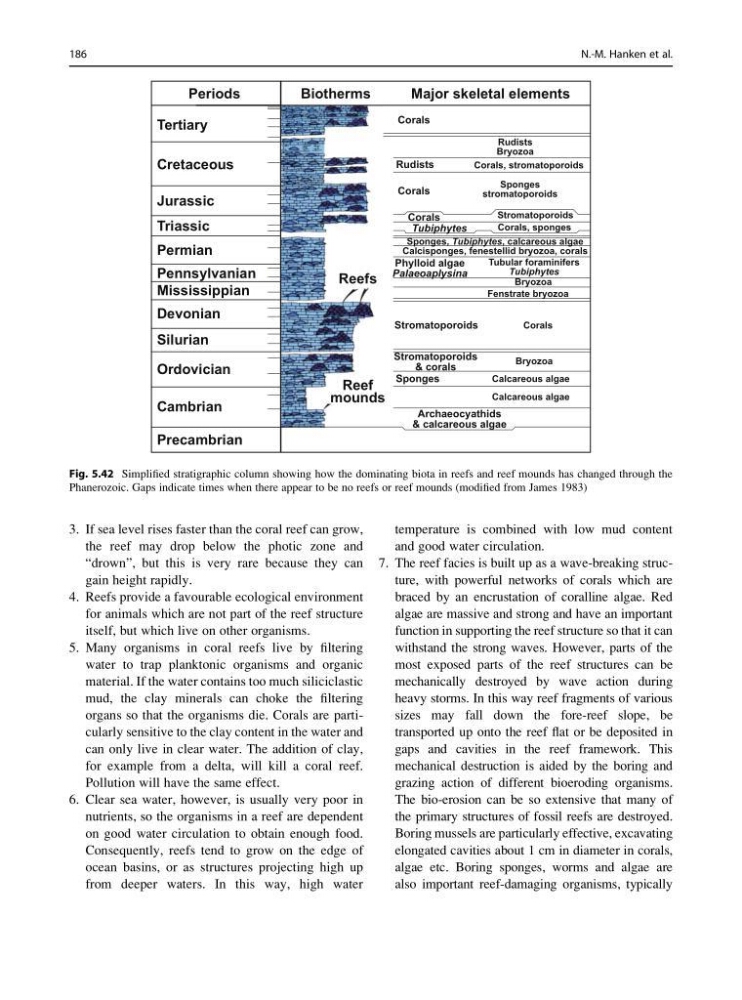
Fig. 5.42 Simplified stratigraphic column showing how the dominating biota in reefs and reef mounds has changed through the
Phanerozoic. Gaps indicate times when there appear to be no reefs or reef mounds (modified from James 1983)
186
N.-M. Hanken et al.
the reef may drop below the photic zone and
“drown”, but this is very rare because they can
gain height rapidly.
4. Reefs provide a favourable ecological environment
for animals which are not part of the reef structure
itself, but which live on other organisms.
5. Many organisms in coral reefs live by filtering
water to trap planktonic organisms and organic
material. If the water contains too much siliciclastic
mud, the clay minerals can choke the filtering
organs so that the organisms die. Corals are particularly sensitive to the clay content in the water and
can only live in clear water. The addition of clay,
for example from a delta, will kill a coral reef.
Pollution will have the same effect.
6. Clear sea water, however, is usually very poor in
nutrients, so the organisms in a reef are dependent
on good water circulation to obtain enough food.
Consequently, reefs tend to grow on the edge of
ocean basins, or as structures projecting high up
from deeper waters. In this way, high water
temperature is combined with low mud content
and good water circulation.
7. The reef facies is built up as a wave-breaking structure, with powerful networks of corals which are
braced by an encrustation of coralline algae. Red
algae are massive and strong and have an important
function in supporting the reef structure so that it can
withstand the strong waves. However, parts of the
most exposed parts of the reef structures can be
mechanically destroyed by wave action during
heavy storms. In this way reef fragments of various
sizes may fall down the fore-reef slope, be
transported up onto the reef flat or be deposited in
gaps and cavities in the reef framework. This
mechanical destruction is aided by the boring and
grazing action of different bioeroding organisms.
The bio-erosion can be so extensive that many of
the primary structures of fossil reefs are destroyed.
Boring mussels are particularly effective, excavating
elongated cavities about 1 cm in diameter in corals,
algae etc. Boring sponges, worms and algae are
also important reef-damaging organisms, typically
Tertiary
Periods
Biotherms
Major skeletal elements
Corals
Corals
Corals
Corals, stromatoporoids
Corals, sponges
Sponges
stromatoporoids
Sponges, Tubiphytes, calcareous algae
Calcisponges, fenestellid bryozoa, corals
Tubular foraminifers
Tubiphytes
Bryozoa
Fenstrate bryozoa
Corals
Bryozoa
Stromatoporoids
Tubiphytes
Phylloid algae
Palaeoaplysina
Stromatoporoids
Stromatoporoids
& corals
Sponges
Archaeocyathids
& calcareous algae
Reef
mounds
Reefs
Calcareous algae
Calcareous algae
Rudists
Rudists
Bryozoa
Cretaceous
Jurassic
Triassic
Permian
Pennsylvanian
Mississippian
Devonian
Silurian
Ordovician
Cambrian
Precambrian
Fig. 5.42 Simplified stratigraphic column showing how the dominating biota in reefs and reef mounds has changed through the
Phanerozoic. Gaps indicate times when there appear to be no reefs or reef mounds (modified from James 1983)
186
N.-M. Hanken et al.