

to 80–100 m and high productivity of molluscs, benthic foraminifera, bryozoans and barnacles. The seafloor sediments are characterised by a Holocene
80–90% pure carbonate sand deposited across the top
of Pleistocene moraines (Bjørlykke et al. 1978). Similar carbonate deposits are encountered on other banks
off North America, for example Grand Bank, and
along the coasts of western Scotland and Norway.
The biological precipitation of carbonate is not
dependent on the water being warm or saturated with
calcium carbonate. On the contrary, we often find the
highest productivity in cold areas because the water
there is richer in nutrients, particularly in areas of
upwelling. Cold seawater is undersaturated with
respect to carbonate minerals so that the skeletal material begins to dissolve as soon the organisms die. Net
accumulation of skeletal material on the sea bottom is
possible because carbonate deposition merely requires
that the biological production rate of carbonate
skeletons exceeds the rate of dissolution. Skeletal
material with a primary aragonite or high-Mg calcite
composition will dissolve faster than that composed of
low-Mg calcite, because of the lower pH due to
increased CO 2 in the cold water.
In the interpretation of ancient limestones we
should not always assume that we can use the wellknown warm water carbonate models, but also consider the possibility that we are dealing with cold
water carbonate sediments at higher latitude.
5.7.3 Modern Environments of Carbonate
Sedimentation
5.7.3.1 Reefs
From a sedimentological point of view a reef may be
defined as a laterally restricted body of carbonate rock
whose composition and relationship with the
surrounding sediments suggest that the bulk of its
biota were bound together as a framework during
deposition, maintaining and developing a positive
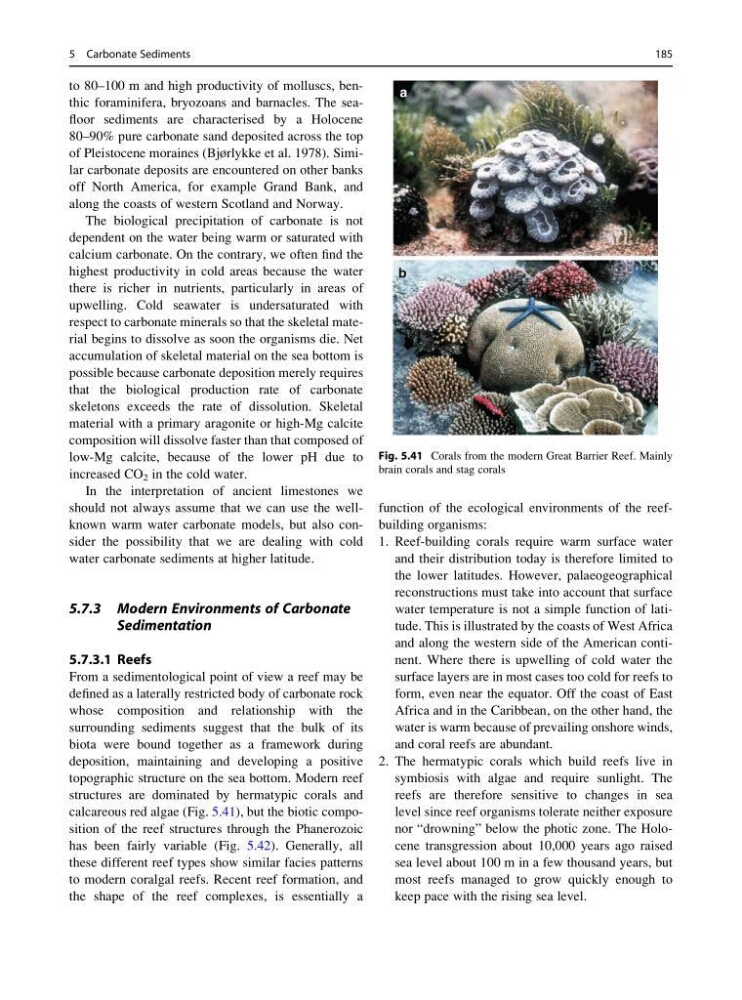
topographic structure on the sea bottom. Modern reef
structures are dominated by hermatypic corals and
calcareous red algae (Fig. 5.41), but the biotic composition of the reef structures through the Phanerozoic
has been fairly variable (Fig. 5.42). Generally, all
these different reef types show similar facies patterns
to modern coralgal reefs. Recent reef formation, and
the shape of the reef complexes, is essentially a
function of the ecological environments of the reefbuilding organisms:
1. Reef-building corals require warm surface water
and their distribution today is therefore limited to
the lower latitudes. However, palaeogeographical
reconstructions must take into account that surface
water temperature is not a simple function of latitude. This is illustrated by the coasts of West Africa
and along the western side of the American continent. Where there is upwelling of cold water the
surface layers are in most cases too cold for reefs to
form, even near the equator. Off the coast of East
Africa and in the Caribbean, on the other hand, the
water is warm because of prevailing onshore winds,
and coral reefs are abundant.
2. The hermatypic corals which build reefs live in
symbiosis with algae and require sunlight. The
reefs are therefore sensitive to changes in sea
level since reef organisms tolerate neither exposure
nor “drowning” below the photic zone. The Holocene transgression about 10,000 years ago raised
sea level about 100 m in a few thousand years, but
most reefs managed to grow quickly enough to
keep pace with the rising sea level.
a
b
Fig. 5.41 Corals from the modern Great Barrier Reef. Mainly
brain corals and stag corals
5 Carbonate Sediments
185
80–90% pure carbonate sand deposited across the top
of Pleistocene moraines (Bjørlykke et al. 1978). Similar carbonate deposits are encountered on other banks
off North America, for example Grand Bank, and
along the coasts of western Scotland and Norway.
The biological precipitation of carbonate is not
dependent on the water being warm or saturated with
calcium carbonate. On the contrary, we often find the
highest productivity in cold areas because the water
there is richer in nutrients, particularly in areas of
upwelling. Cold seawater is undersaturated with
respect to carbonate minerals so that the skeletal material begins to dissolve as soon the organisms die. Net
accumulation of skeletal material on the sea bottom is
possible because carbonate deposition merely requires
that the biological production rate of carbonate
skeletons exceeds the rate of dissolution. Skeletal
material with a primary aragonite or high-Mg calcite
composition will dissolve faster than that composed of
low-Mg calcite, because of the lower pH due to
increased CO 2 in the cold water.
In the interpretation of ancient limestones we
should not always assume that we can use the wellknown warm water carbonate models, but also consider the possibility that we are dealing with cold
water carbonate sediments at higher latitude.
5.7.3 Modern Environments of Carbonate
Sedimentation
5.7.3.1 Reefs
From a sedimentological point of view a reef may be
defined as a laterally restricted body of carbonate rock
whose composition and relationship with the
surrounding sediments suggest that the bulk of its
biota were bound together as a framework during
deposition, maintaining and developing a positive
topographic structure on the sea bottom. Modern reef
structures are dominated by hermatypic corals and
calcareous red algae (Fig. 5.41), but the biotic composition of the reef structures through the Phanerozoic
has been fairly variable (Fig. 5.42). Generally, all
these different reef types show similar facies patterns
to modern coralgal reefs. Recent reef formation, and
the shape of the reef complexes, is essentially a
function of the ecological environments of the reefbuilding organisms:
1. Reef-building corals require warm surface water
and their distribution today is therefore limited to
the lower latitudes. However, palaeogeographical
reconstructions must take into account that surface
water temperature is not a simple function of latitude. This is illustrated by the coasts of West Africa
and along the western side of the American continent. Where there is upwelling of cold water the
surface layers are in most cases too cold for reefs to
form, even near the equator. Off the coast of East
Africa and in the Caribbean, on the other hand, the
water is warm because of prevailing onshore winds,
and coral reefs are abundant.
2. The hermatypic corals which build reefs live in
symbiosis with algae and require sunlight. The
reefs are therefore sensitive to changes in sea
level since reef organisms tolerate neither exposure
nor “drowning” below the photic zone. The Holocene transgression about 10,000 years ago raised
sea level about 100 m in a few thousand years, but
most reefs managed to grow quickly enough to
keep pace with the rising sea level.
a
b
Fig. 5.41 Corals from the modern Great Barrier Reef. Mainly
brain corals and stag corals
5 Carbonate Sediments
185