

platform is a good example of such a setting. Reefs
commonly grow at the edge of deep waters where they
are exposed to light, high wave energies and a steady
supply of nutrients through upwelling.
During periods of global transgressions (highstand) more carbonate is deposited on the continental
shelves leaving less carbonate to be deposited in deepwater environments. In the stratigraphic record an
abundance of carbonate rocks is seen from the Ordovician to Devonian periods and from the Cretaceous.
This is not because more carbonate sediments were
precipitated during these periods, but because more of
what was precipitated was preserved on the cratons.
During transgressions there is little supply of clastic
material that could dilute the carbonate precipitated.
These carbonate deposits therefore generally contain
little clastic material. However, during sea level lowstand more of the carbonate becomes mixed with
clastic sediments to produce carbonate deposits with
a fairly high terrigenous content.
5.7.2 Major Controls on Carbonate
Sedimentation
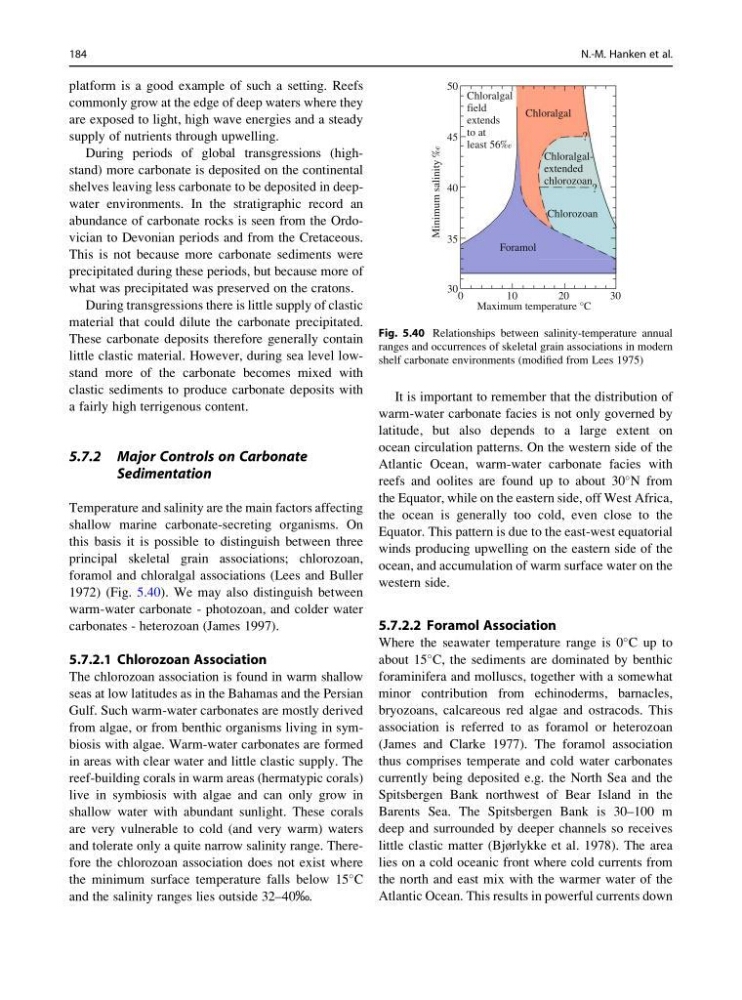
Temperature and salinity are the main factors affecting
shallow marine carbonate-secreting organisms. On
this basis it is possible to distinguish between three
principal skeletal grain associations; chlorozoan,
foramol and chloralgal associations (Lees and Buller
1972) (Fig. 5.40). We may also distinguish between
warm-water carbonate - photozoan, and colder water
carbonates - heterozoan (James 1997).
5.7.2.1 Chlorozoan Association
The chlorozoan association is found in warm shallow
seas at low latitudes as in the Bahamas and the Persian
Gulf. Such warm-water carbonates are mostly derived
from algae, or from benthic organisms living in symbiosis with algae. Warm-water carbonates are formed
in areas with clear water and little clastic supply. The
reef-building corals in warm areas (hermatypic corals)
live in symbiosis with algae and can only grow in
shallow water with abundant sunlight. These corals
are very vulnerable to cold (and very warm) waters
and tolerate only a quite narrow salinity range. Therefore the chlorozoan association does not exist where
the minimum surface temperature falls below 15
C
and the salinity ranges lies outside 32–40‰.
It is important to remember that the distribution of
warm-water carbonate facies is not only governed by
latitude, but also depends to a large extent on
ocean circulation patterns. On the western side of the
Atlantic Ocean, warm-water carbonate facies with
reefs and oolites are found up to about 30
N from
the Equator, while on the eastern side, off West Africa,
the ocean is generally too cold, even close to the
Equator. This pattern is due to the east-west equatorial
winds producing upwelling on the eastern side of the
ocean, and accumulation of warm surface water on the
western side.
5.7.2.2 Foramol Association
Where the seawater temperature range is 0
C up to
about 15
C, the sediments are dominated by benthic
foraminifera and molluscs, together with a somewhat
minor contribution from echinoderms, barnacles,
bryozoans, calcareous red algae and ostracods. This
association is referred to as foramol or heterozoan
(James and Clarke 1977). The foramol association
thus comprises temperate and cold water carbonates
currently being deposited e.g. the North Sea and the
Spitsbergen Bank northwest of Bear Island in the
Barents Sea. The Spitsbergen Bank is 30–100 m
deep and surrounded by deeper channels so receives
little clastic matter (Bjørlykke et al. 1978). The area
lies on a cold oceanic front where cold currents from
the north and east mix with the warmer water of the
Atlantic Ocean. This results in powerful currents down
Foramol
Chloralgal
Chloralgalextended
chlorozoan
Chlorozoan
Chloralgal
field
extends
to at
least 56‰
?
?
50
45
40
35
30
10
0
2 0
3 0
Minimum salinity ‰
Maximum temperature °C
Fig. 5.40 Relationships between salinity-temperature annual
ranges and occurrences of skeletal grain associations in modern
shelf carbonate environments (modified from Lees 1975)
184
N.-M. Hanken et al.
commonly grow at the edge of deep waters where they
are exposed to light, high wave energies and a steady
supply of nutrients through upwelling.
During periods of global transgressions (highstand) more carbonate is deposited on the continental
shelves leaving less carbonate to be deposited in deepwater environments. In the stratigraphic record an
abundance of carbonate rocks is seen from the Ordovician to Devonian periods and from the Cretaceous.
This is not because more carbonate sediments were
precipitated during these periods, but because more of
what was precipitated was preserved on the cratons.
During transgressions there is little supply of clastic
material that could dilute the carbonate precipitated.
These carbonate deposits therefore generally contain
little clastic material. However, during sea level lowstand more of the carbonate becomes mixed with
clastic sediments to produce carbonate deposits with
a fairly high terrigenous content.
5.7.2 Major Controls on Carbonate
Sedimentation
Temperature and salinity are the main factors affecting
shallow marine carbonate-secreting organisms. On
this basis it is possible to distinguish between three
principal skeletal grain associations; chlorozoan,
foramol and chloralgal associations (Lees and Buller
1972) (Fig. 5.40). We may also distinguish between
warm-water carbonate - photozoan, and colder water
carbonates - heterozoan (James 1997).
5.7.2.1 Chlorozoan Association
The chlorozoan association is found in warm shallow
seas at low latitudes as in the Bahamas and the Persian
Gulf. Such warm-water carbonates are mostly derived
from algae, or from benthic organisms living in symbiosis with algae. Warm-water carbonates are formed
in areas with clear water and little clastic supply. The
reef-building corals in warm areas (hermatypic corals)
live in symbiosis with algae and can only grow in
shallow water with abundant sunlight. These corals
are very vulnerable to cold (and very warm) waters
and tolerate only a quite narrow salinity range. Therefore the chlorozoan association does not exist where
the minimum surface temperature falls below 15
C
and the salinity ranges lies outside 32–40‰.
It is important to remember that the distribution of
warm-water carbonate facies is not only governed by
latitude, but also depends to a large extent on
ocean circulation patterns. On the western side of the
Atlantic Ocean, warm-water carbonate facies with
reefs and oolites are found up to about 30
N from
the Equator, while on the eastern side, off West Africa,
the ocean is generally too cold, even close to the
Equator. This pattern is due to the east-west equatorial
winds producing upwelling on the eastern side of the
ocean, and accumulation of warm surface water on the
western side.
5.7.2.2 Foramol Association
Where the seawater temperature range is 0
C up to
about 15
C, the sediments are dominated by benthic
foraminifera and molluscs, together with a somewhat
minor contribution from echinoderms, barnacles,
bryozoans, calcareous red algae and ostracods. This
association is referred to as foramol or heterozoan
(James and Clarke 1977). The foramol association
thus comprises temperate and cold water carbonates
currently being deposited e.g. the North Sea and the
Spitsbergen Bank northwest of Bear Island in the
Barents Sea. The Spitsbergen Bank is 30–100 m
deep and surrounded by deeper channels so receives
little clastic matter (Bjørlykke et al. 1978). The area
lies on a cold oceanic front where cold currents from
the north and east mix with the warmer water of the
Atlantic Ocean. This results in powerful currents down
Foramol
Chloralgal
Chloralgalextended
chlorozoan
Chlorozoan
Chloralgal
field
extends
to at
least 56‰
?
?
50
45
40
35
30
10
0
2 0
3 0
Minimum salinity ‰
Maximum temperature °C
Fig. 5.40 Relationships between salinity-temperature annual
ranges and occurrences of skeletal grain associations in modern
shelf carbonate environments (modified from Lees 1975)
184
N.-M. Hanken et al.