

5.7
Carbonate Environments
5.7.1 Introduction
Most carbonate deposits are due to the production
of skeletal material rather than being precipitated
chemically. The composition of the sediments is
therefore largely a function of the type of organisms
which produced them. Biological precipitation
removes CaCO 3 from seawater at a sufficient rate
that the seawater does not become supersaturated
with respect to calcite, except locally. Shallow seawater may be supersaturated with respect to calcite
and in the tropics also with respect to aragonite and
high-Mg calcite. It is mostly in evaporite basins that
chemical precipitation is dominant but even there it
is often assisted by algae. However, a very large
fraction of the carbonate precipitated by organisms
is dissolved in the water column or soon after deposition at the sea bottom and will therefore not be
incorporated in the geological record. The total
biological production of carbonate is approximately
equal to the total amount of carbonate which
becomes dissolved in the oceans plus the supply of
Ca
2+ released by weathering on land and transported
to the ocean by rivers.
Accumulations of carbonate deposits require:
• A supply of nutrients to feed the carbonateprecipitating organisms.
• Clear water with a low content of suspended clastic
material.
The effect of suspended fine-grained clastic material is to dilute the carbonate content, but it may also
retards the growth of filter feeding organisms like
corals. These sessile organisms require a throughflow of water to obtain enough planktonic organisms
for nutrition, and too much suspended clastic material
tends to clog up their filtering system.
Carbonates accumulate along coastlines with little
clastic supply from rivers. This is often the case when
the adjacent land has a dry climate with little runoff.
Carbonates also accumulate on submarine highs and
carbonate platforms which are surrounded by deeper
water that traps the clastic sediments. The Bahamas
a
b
Oo
Oo
0.7 mm
0.7 mm
0.7 mm
Py
Ve
Ve
Py
Ca
c
d
0.7 mm
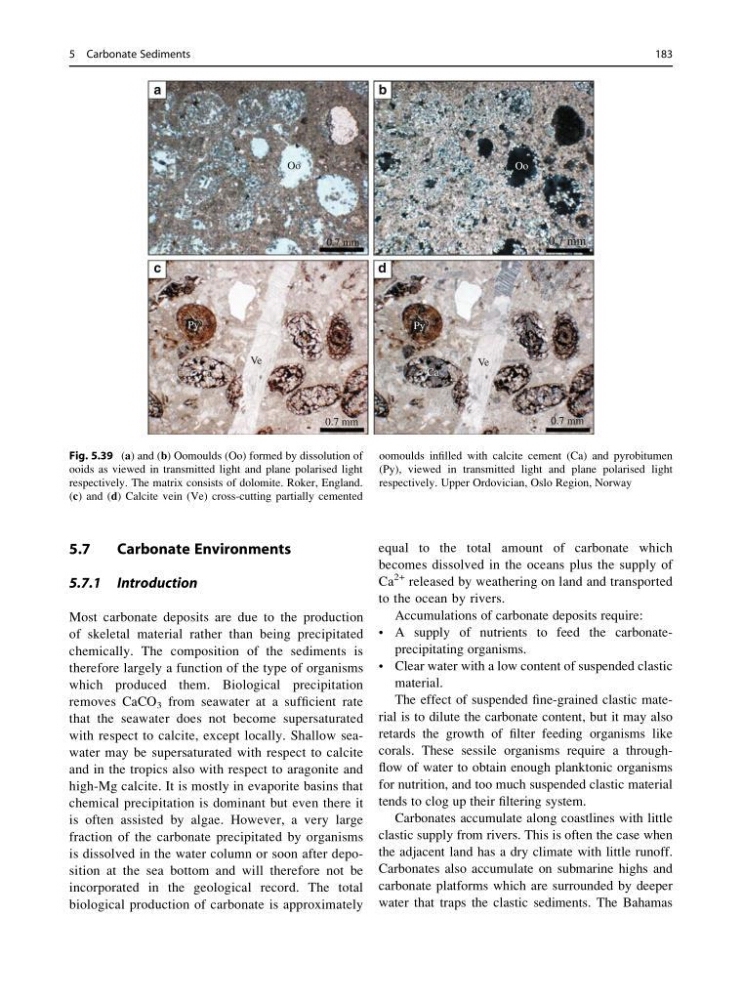
Fig. 5.39 (a) and (b) Oomoulds (Oo) formed by dissolution of
ooids as viewed in transmitted light and plane polarised light
respectively. The matrix consists of dolomite. Roker, England.
(c) and (d) Calcite vein (Ve) cross-cutting partially cemented
oomoulds infilled with calcite cement (Ca) and pyrobitumen
(Py), viewed in transmitted light and plane polarised light
respectively. Upper Ordovician, Oslo Region, Norway
5 Carbonate Sediments
183
Carbonate Environments
5.7.1 Introduction
Most carbonate deposits are due to the production
of skeletal material rather than being precipitated
chemically. The composition of the sediments is
therefore largely a function of the type of organisms
which produced them. Biological precipitation
removes CaCO 3 from seawater at a sufficient rate
that the seawater does not become supersaturated
with respect to calcite, except locally. Shallow seawater may be supersaturated with respect to calcite
and in the tropics also with respect to aragonite and
high-Mg calcite. It is mostly in evaporite basins that
chemical precipitation is dominant but even there it
is often assisted by algae. However, a very large
fraction of the carbonate precipitated by organisms
is dissolved in the water column or soon after deposition at the sea bottom and will therefore not be
incorporated in the geological record. The total
biological production of carbonate is approximately
equal to the total amount of carbonate which
becomes dissolved in the oceans plus the supply of
Ca
2+ released by weathering on land and transported
to the ocean by rivers.
Accumulations of carbonate deposits require:
• A supply of nutrients to feed the carbonateprecipitating organisms.
• Clear water with a low content of suspended clastic
material.
The effect of suspended fine-grained clastic material is to dilute the carbonate content, but it may also
retards the growth of filter feeding organisms like
corals. These sessile organisms require a throughflow of water to obtain enough planktonic organisms
for nutrition, and too much suspended clastic material
tends to clog up their filtering system.
Carbonates accumulate along coastlines with little
clastic supply from rivers. This is often the case when
the adjacent land has a dry climate with little runoff.
Carbonates also accumulate on submarine highs and
carbonate platforms which are surrounded by deeper
water that traps the clastic sediments. The Bahamas
a
b
Oo
Oo
0.7 mm
0.7 mm
0.7 mm
Py
Ve
Ve
Py
Ca
c
d
0.7 mm
Fig. 5.39 (a) and (b) Oomoulds (Oo) formed by dissolution of
ooids as viewed in transmitted light and plane polarised light
respectively. The matrix consists of dolomite. Roker, England.
(c) and (d) Calcite vein (Ve) cross-cutting partially cemented
oomoulds infilled with calcite cement (Ca) and pyrobitumen
(Py), viewed in transmitted light and plane polarised light
respectively. Upper Ordovician, Oslo Region, Norway
5 Carbonate Sediments
183