

core which may consist of small clastic grains or a
carbonate fragment. Similar concentric structures
larger than 2 mm are called pisolites, and these are
usually precipitated by algae.
Modern ooids consist of aragonite with a concentric
tangential structure composed of small aragonite
crystals (<3 μm) with their c-axis parallel to the
lamination.
We find ooids only in very warm marine
environments and in some saline lakes. The water
must be close to saturation with carbonate. Agitation
from waves or tidal currents is necessary to roll the
ooids around to so that precipitation is even and forms
concentric layers. Some studies indicate a thin organic
membrane of bacteria on ooids which helps to
precipitate aragonite, and which also may trap small
aragonite particles in the sediment or suspended in the
bottom water. If direct chemical precipitation was
involved we would expect the needles to orientate
themselves radially on the surface of the ooid, whereas
snowball-type growth through the accumulation of
small aragonite needles would give the observed concentric layers.
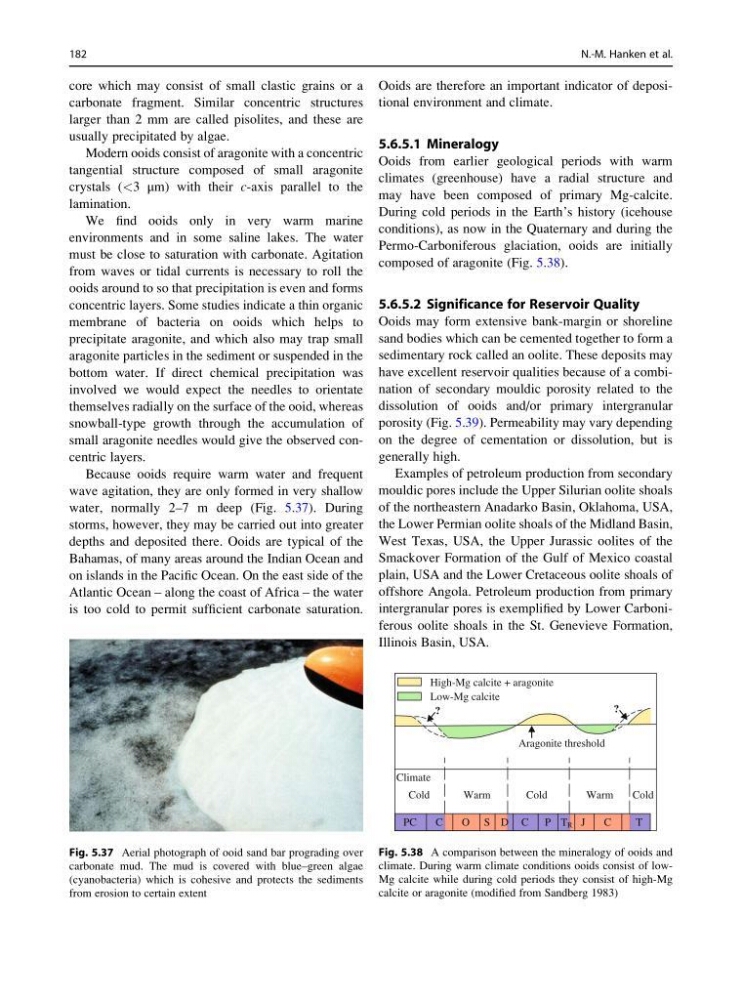
Because ooids require warm water and frequent
wave agitation, they are only formed in very shallow
water, normally 2–7 m deep (Fig. 5.37). During
storms, however, they may be carried out into greater
depths and deposited there. Ooids are typical of the
Bahamas, of many areas around the Indian Ocean and
on islands in the Pacific Ocean. On the east side of the
Atlantic Ocean – along the coast of Africa – the water
is too cold to permit sufficient carbonate saturation.
Ooids are therefore an important indicator of depositional environment and climate.
5.6.5.1 Mineralogy
Ooids from earlier geological periods with warm
climates (greenhouse) have a radial structure and
may have been composed of primary Mg-calcite.
During cold periods in the Earth’s history (icehouse
conditions), as now in the Quaternary and during the
Permo-Carboniferous glaciation, ooids are initially
composed of aragonite (Fig. 5.38).
5.6.5.2 Significance for Reservoir Quality
Ooids may form extensive bank-margin or shoreline
sand bodies which can be cemented together to form a
sedimentary rock called an oolite. These deposits may
have excellent reservoir qualities because of a combination of secondary mouldic porosity related to the
dissolution of ooids and/or primary intergranular
porosity (Fig. 5.39). Permeability may vary depending
on the degree of cementation or dissolution, but is
generally high.
Examples of petroleum production from secondary
mouldic pores include the Upper Silurian oolite shoals
of the northeastern Anadarko Basin, Oklahoma, USA,
the Lower Permian oolite shoals of the Midland Basin,
West Texas, USA, the Upper Jurassic oolites of the
Smackover Formation of the Gulf of Mexico coastal
plain, USA and the Lower Cretaceous oolite shoals of
offshore Angola. Petroleum production from primary
intergranular pores is exemplified by Lower Carboniferous oolite shoals in the St. Genevieve Formation,
Illinois Basin, USA.
Fig. 5.37 Aerial photograph of ooid sand bar prograding over
carbonate mud. The mud is covered with blue–green algae
(cyanobacteria) which is cohesive and protects the sediments
from erosion to certain extent
Climate
Cold
PC
C
C P
J
C
T
T R
O
Cold
Cold
Warm
Warm
S D
High-Mg calcite + aragonite
Low-Mg calcite
Aragonite threshold
?
?
Fig. 5.38 A comparison between the mineralogy of ooids and
climate. During warm climate conditions ooids consist of lowMg calcite while during cold periods they consist of high-Mg
calcite or aragonite (modified from Sandberg 1983)
182
N.-M. Hanken et al.
carbonate fragment. Similar concentric structures
larger than 2 mm are called pisolites, and these are
usually precipitated by algae.
Modern ooids consist of aragonite with a concentric
tangential structure composed of small aragonite
crystals (<3 μm) with their c-axis parallel to the
lamination.
We find ooids only in very warm marine
environments and in some saline lakes. The water
must be close to saturation with carbonate. Agitation
from waves or tidal currents is necessary to roll the
ooids around to so that precipitation is even and forms
concentric layers. Some studies indicate a thin organic
membrane of bacteria on ooids which helps to
precipitate aragonite, and which also may trap small
aragonite particles in the sediment or suspended in the
bottom water. If direct chemical precipitation was
involved we would expect the needles to orientate
themselves radially on the surface of the ooid, whereas
snowball-type growth through the accumulation of
small aragonite needles would give the observed concentric layers.
Because ooids require warm water and frequent
wave agitation, they are only formed in very shallow
water, normally 2–7 m deep (Fig. 5.37). During
storms, however, they may be carried out into greater
depths and deposited there. Ooids are typical of the
Bahamas, of many areas around the Indian Ocean and
on islands in the Pacific Ocean. On the east side of the
Atlantic Ocean – along the coast of Africa – the water
is too cold to permit sufficient carbonate saturation.
Ooids are therefore an important indicator of depositional environment and climate.
5.6.5.1 Mineralogy
Ooids from earlier geological periods with warm
climates (greenhouse) have a radial structure and
may have been composed of primary Mg-calcite.
During cold periods in the Earth’s history (icehouse
conditions), as now in the Quaternary and during the
Permo-Carboniferous glaciation, ooids are initially
composed of aragonite (Fig. 5.38).
5.6.5.2 Significance for Reservoir Quality
Ooids may form extensive bank-margin or shoreline
sand bodies which can be cemented together to form a
sedimentary rock called an oolite. These deposits may
have excellent reservoir qualities because of a combination of secondary mouldic porosity related to the
dissolution of ooids and/or primary intergranular
porosity (Fig. 5.39). Permeability may vary depending
on the degree of cementation or dissolution, but is
generally high.
Examples of petroleum production from secondary
mouldic pores include the Upper Silurian oolite shoals
of the northeastern Anadarko Basin, Oklahoma, USA,
the Lower Permian oolite shoals of the Midland Basin,
West Texas, USA, the Upper Jurassic oolites of the
Smackover Formation of the Gulf of Mexico coastal
plain, USA and the Lower Cretaceous oolite shoals of
offshore Angola. Petroleum production from primary
intergranular pores is exemplified by Lower Carboniferous oolite shoals in the St. Genevieve Formation,
Illinois Basin, USA.
Fig. 5.37 Aerial photograph of ooid sand bar prograding over
carbonate mud. The mud is covered with blue–green algae
(cyanobacteria) which is cohesive and protects the sediments
from erosion to certain extent
Climate
Cold
PC
C
C P
J
C
T
T R
O
Cold
Cold
Warm
Warm
S D
High-Mg calcite + aragonite
Low-Mg calcite
Aragonite threshold
?
?
Fig. 5.38 A comparison between the mineralogy of ooids and
climate. During warm climate conditions ooids consist of lowMg calcite while during cold periods they consist of high-Mg
calcite or aragonite (modified from Sandberg 1983)
182
N.-M. Hanken et al.