

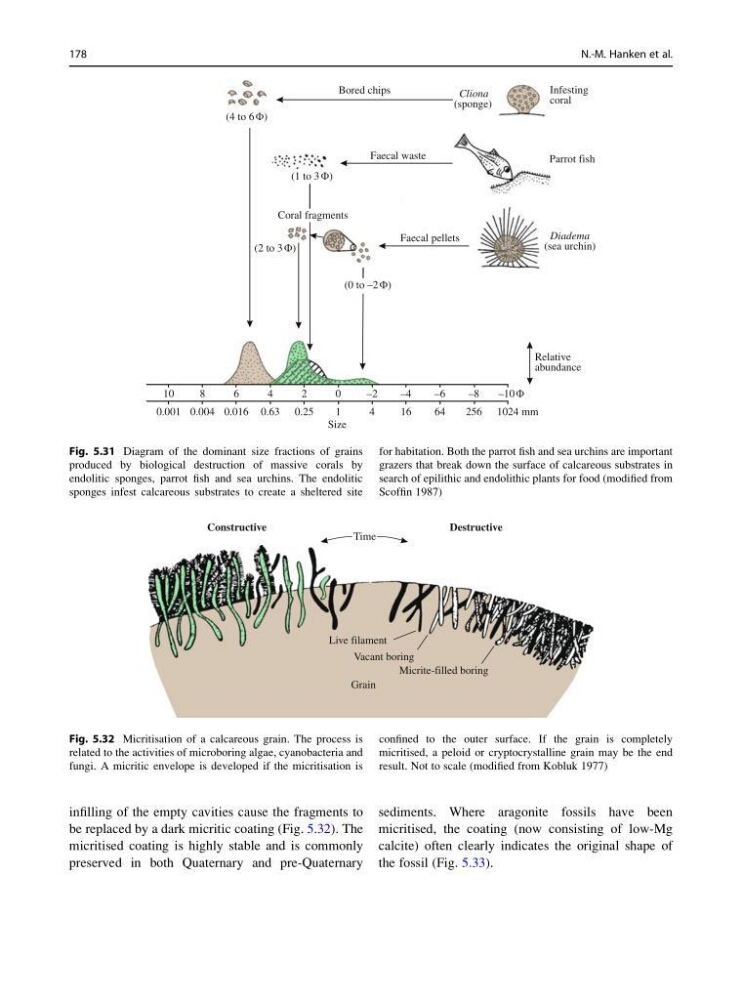
infilling of the empty cavities cause the fragments to
be replaced by a dark micritic coating (Fig. 5.32). The
micritised coating is highly stable and is commonly
preserved in both Quaternary and pre-Quaternary
sediments. Where aragonite fossils have been
micritised, the coating (now consisting of low-Mg
calcite) often clearly indicates the original shape of
the fossil (Fig. 5.33).
Bored chips
Cliona
(sponge)
Infesting
coral
Parrot fish
Diadema
(sea urchin)
(2 to 3 Φ)
(1 to 3 Φ)
(0 to –2 Φ)
(4 to 6 Φ)
Faecal waste
Faecal pellets
Coral fragments
10
8
6
4
2
–2
–4
–6
–8
–10 Φ
0
1
0.25
0.63
0.016
0.004
0.001
4
16
64
256 1024
Size
Relative
abundance
mm
Fig. 5.31 Diagram of the dominant size fractions of grains
produced by biological destruction of massive corals by
endolitic sponges, parrot fish and sea urchins. The endolitic
sponges infest calcareous substrates to create a sheltered site
for habitation. Both the parrot fish and sea urchins are important
grazers that break down the surface of calcareous substrates in
search of epilithic and endolithic plants for food (modified from
Scoffin 1987)
Grain
Live filament
Vacant boring
Micrite-filled boring
Constructive
Destructive
Time
Fig. 5.32 Micritisation of a calcareous grain. The process is
related to the activities of microboring algae, cyanobacteria and
fungi. A micritic envelope is developed if the micritisation is
confined to the outer surface. If the grain is completely
micritised, a peloid or cryptocrystalline grain may be the end
result. Not to scale (modified from Kobluk 1977)
178
N.-M. Hanken et al.
be replaced by a dark micritic coating (Fig. 5.32). The
micritised coating is highly stable and is commonly
preserved in both Quaternary and pre-Quaternary
sediments. Where aragonite fossils have been
micritised, the coating (now consisting of low-Mg
calcite) often clearly indicates the original shape of
the fossil (Fig. 5.33).
Bored chips
Cliona
(sponge)
Infesting
coral
Parrot fish
Diadema
(sea urchin)
(2 to 3 Φ)
(1 to 3 Φ)
(0 to –2 Φ)
(4 to 6 Φ)
Faecal waste
Faecal pellets
Coral fragments
10
8
6
4
2
–2
–4
–6
–8
–10 Φ
0
1
0.25
0.63
0.016
0.004
0.001
4
16
64
256 1024
Size
Relative
abundance
mm
Fig. 5.31 Diagram of the dominant size fractions of grains
produced by biological destruction of massive corals by
endolitic sponges, parrot fish and sea urchins. The endolitic
sponges infest calcareous substrates to create a sheltered site
for habitation. Both the parrot fish and sea urchins are important
grazers that break down the surface of calcareous substrates in
search of epilithic and endolithic plants for food (modified from
Scoffin 1987)
Grain
Live filament
Vacant boring
Micrite-filled boring
Constructive
Destructive
Time
Fig. 5.32 Micritisation of a calcareous grain. The process is
related to the activities of microboring algae, cyanobacteria and
fungi. A micritic envelope is developed if the micritisation is
confined to the outer surface. If the grain is completely
micritised, a peloid or cryptocrystalline grain may be the end
result. Not to scale (modified from Kobluk 1977)
178
N.-M. Hanken et al.