

build-ups in the Midland Basin of West Texas, USA,
are examples of this.
5.5.6 Echinoderms
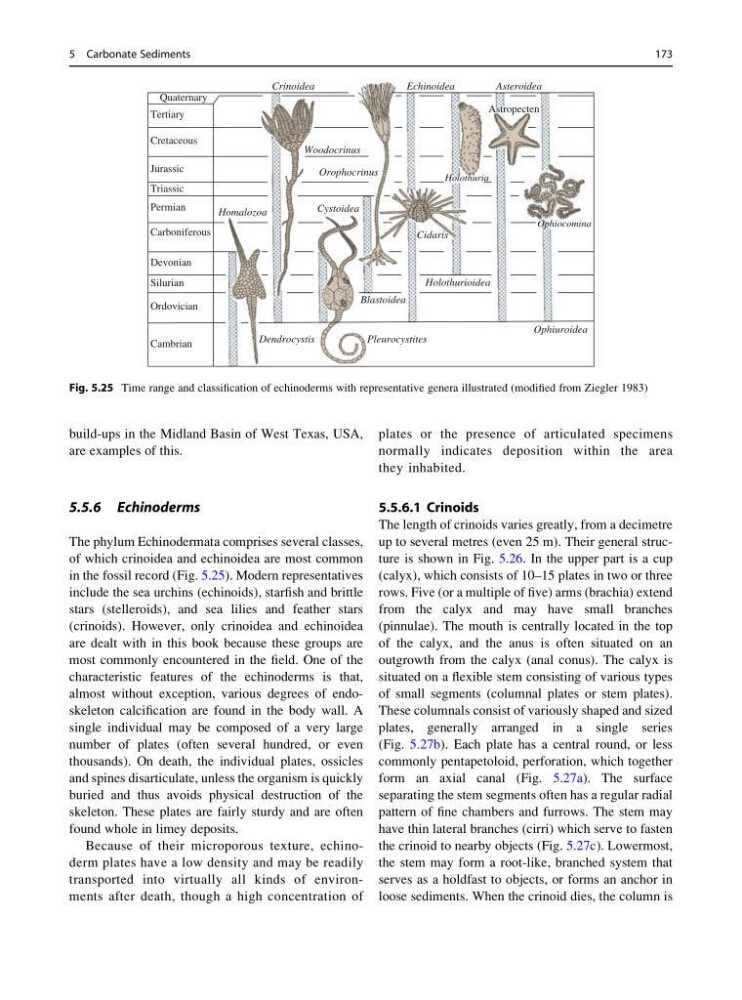
The phylum Echinodermata comprises several classes,
of which crinoidea and echinoidea are most common
in the fossil record (Fig. 5.25). Modern representatives
include the sea urchins (echinoids), starfish and brittle
stars (stelleroids), and sea lilies and feather stars
(crinoids). However, only crinoidea and echinoidea
are dealt with in this book because these groups are
most commonly encountered in the field. One of the
characteristic features of the echinoderms is that,
almost without exception, various degrees of endoskeleton calcification are found in the body wall. A
single individual may be composed of a very large
number of plates (often several hundred, or even
thousands). On death, the individual plates, ossicles
and spines disarticulate, unless the organism is quickly
buried and thus avoids physical destruction of the
skeleton. These plates are fairly sturdy and are often
found whole in limey deposits.
Because of their microporous texture, echinoderm plates have a low density and may be readily
transported into virtually all kinds of environments after death, though a high concentration of
plates or the presence of articulated specimens
normally indicates deposition within the area
they inhabited.
5.5.6.1 Crinoids
The length of crinoids varies greatly, from a decimetre
up to several metres (even 25 m). Their general structure is shown in Fig. 5.26. In the upper part is a cup
(calyx), which consists of 10–15 plates in two or three
rows. Five (or a multiple of five) arms (brachia) extend
from the calyx and may have small branches
(pinnulae). The mouth is centrally located in the top
of the calyx, and the anus is often situated on an
outgrowth from the calyx (anal conus). The calyx is
situated on a flexible stem consisting of various types
of small segments (columnal plates or stem plates).
These columnals consist of variously shaped and sized
plates, generally arranged in a single series
(Fig. 5.27b). Each plate has a central round, or less
commonly pentapetoloid, perforation, which together
form an axial canal (Fig. 5.27a). The surface
separating the stem segments often has a regular radial
pattern of fine chambers and furrows. The stem may
have thin lateral branches (cirri) which serve to fasten
the crinoid to nearby objects (Fig. 5.27c). Lowermost,
the stem may form a root-like, branched system that
serves as a holdfast to objects, or forms an anchor in
loose sediments. When the crinoid dies, the column is
Quaternary
Tertiary
Cretaceous
Jurassic
Triassic
Permian
Carboniferous
Devonian
Silurian
Ordovician
Cambrian
Blastoidea
Holothurioidea
Ophiuroidea
Homalozoa
Cystoidea
Crinoidea
Echinoidea
Asteroidea
Woodocrinus
Orophocrinus
Dendrocystis
Pleurocystites
Cidaris
Holothuria
Ophiocomina
Astropecten
Fig. 5.25 Time range and classification of echinoderms with representative genera illustrated (modified from Ziegler 1983)
5 Carbonate Sediments
173
are examples of this.
5.5.6 Echinoderms
The phylum Echinodermata comprises several classes,
of which crinoidea and echinoidea are most common
in the fossil record (Fig. 5.25). Modern representatives
include the sea urchins (echinoids), starfish and brittle
stars (stelleroids), and sea lilies and feather stars
(crinoids). However, only crinoidea and echinoidea
are dealt with in this book because these groups are
most commonly encountered in the field. One of the
characteristic features of the echinoderms is that,
almost without exception, various degrees of endoskeleton calcification are found in the body wall. A
single individual may be composed of a very large
number of plates (often several hundred, or even
thousands). On death, the individual plates, ossicles
and spines disarticulate, unless the organism is quickly
buried and thus avoids physical destruction of the
skeleton. These plates are fairly sturdy and are often
found whole in limey deposits.
Because of their microporous texture, echinoderm plates have a low density and may be readily
transported into virtually all kinds of environments after death, though a high concentration of
plates or the presence of articulated specimens
normally indicates deposition within the area
they inhabited.
5.5.6.1 Crinoids
The length of crinoids varies greatly, from a decimetre
up to several metres (even 25 m). Their general structure is shown in Fig. 5.26. In the upper part is a cup
(calyx), which consists of 10–15 plates in two or three
rows. Five (or a multiple of five) arms (brachia) extend
from the calyx and may have small branches
(pinnulae). The mouth is centrally located in the top
of the calyx, and the anus is often situated on an
outgrowth from the calyx (anal conus). The calyx is
situated on a flexible stem consisting of various types
of small segments (columnal plates or stem plates).
These columnals consist of variously shaped and sized
plates, generally arranged in a single series
(Fig. 5.27b). Each plate has a central round, or less
commonly pentapetoloid, perforation, which together
form an axial canal (Fig. 5.27a). The surface
separating the stem segments often has a regular radial
pattern of fine chambers and furrows. The stem may
have thin lateral branches (cirri) which serve to fasten
the crinoid to nearby objects (Fig. 5.27c). Lowermost,
the stem may form a root-like, branched system that
serves as a holdfast to objects, or forms an anchor in
loose sediments. When the crinoid dies, the column is
Quaternary
Tertiary
Cretaceous
Jurassic
Triassic
Permian
Carboniferous
Devonian
Silurian
Ordovician
Cambrian
Blastoidea
Holothurioidea
Ophiuroidea
Homalozoa
Cystoidea
Crinoidea
Echinoidea
Asteroidea
Woodocrinus
Orophocrinus
Dendrocystis
Pleurocystites
Cidaris
Holothuria
Ophiocomina
Astropecten
Fig. 5.25 Time range and classification of echinoderms with representative genera illustrated (modified from Ziegler 1983)
5 Carbonate Sediments
173