

quite likely to fall apart to a greater or lesser extent.
Some fossil crinoids have the entire stem and root
system preserved, but fragmental stems and single
columnal plates are much more typical. The skeleton
in Recent echinoderms is exceedingly porous (ca.
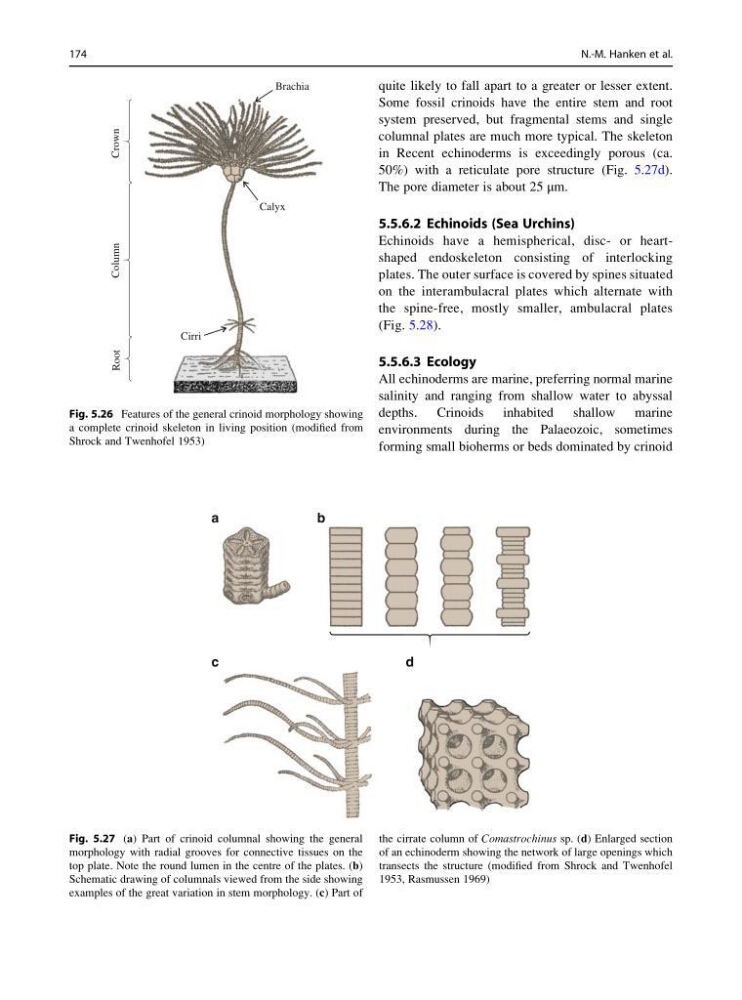
50%) with a reticulate pore structure (Fig. 5.27d).
The pore diameter is about 25 μm.
5.5.6.2 Echinoids (Sea Urchins)
Echinoids have a hemispherical, disc- or heartshaped endoskeleton consisting of interlocking
plates. The outer surface is covered by spines situated
on the interambulacral plates which alternate with
the spine-free, mostly smaller, ambulacral plates
(Fig. 5.28).
5.5.6.3 Ecology
All echinoderms are marine, preferring normal marine
salinity and ranging from shallow water to abyssal
depths. Crinoids inhabited shallow marine
environments during the Palaeozoic, sometimes
forming small bioherms or beds dominated by crinoid
Crown
Calyx
Brachia
Cirri
Column
Root
Fig. 5.26 Features of the general crinoid morphology showing
a complete crinoid skeleton in living position (modified from
Shrock and Twenhofel 1953)
d
c
b
a
Fig. 5.27 (a) Part of crinoid columnal showing the general
morphology with radial grooves for connective tissues on the
top plate. Note the round lumen in the centre of the plates. (b)
Schematic drawing of columnals viewed from the side showing
examples of the great variation in stem morphology. (c) Part of
the cirrate column of Comastrochinus sp. (d) Enlarged section
of an echinoderm showing the network of large openings which
transects the structure (modified from Shrock and Twenhofel
1953, Rasmussen 1969)
174
N.-M. Hanken et al.
Some fossil crinoids have the entire stem and root
system preserved, but fragmental stems and single
columnal plates are much more typical. The skeleton
in Recent echinoderms is exceedingly porous (ca.
50%) with a reticulate pore structure (Fig. 5.27d).
The pore diameter is about 25 μm.
5.5.6.2 Echinoids (Sea Urchins)
Echinoids have a hemispherical, disc- or heartshaped endoskeleton consisting of interlocking
plates. The outer surface is covered by spines situated
on the interambulacral plates which alternate with
the spine-free, mostly smaller, ambulacral plates
(Fig. 5.28).
5.5.6.3 Ecology
All echinoderms are marine, preferring normal marine
salinity and ranging from shallow water to abyssal
depths. Crinoids inhabited shallow marine
environments during the Palaeozoic, sometimes
forming small bioherms or beds dominated by crinoid
Crown
Calyx
Brachia
Cirri
Column
Root
Fig. 5.26 Features of the general crinoid morphology showing
a complete crinoid skeleton in living position (modified from
Shrock and Twenhofel 1953)
d
c
b
a
Fig. 5.27 (a) Part of crinoid columnal showing the general
morphology with radial grooves for connective tissues on the
top plate. Note the round lumen in the centre of the plates. (b)
Schematic drawing of columnals viewed from the side showing
examples of the great variation in stem morphology. (c) Part of
the cirrate column of Comastrochinus sp. (d) Enlarged section
of an echinoderm showing the network of large openings which
transects the structure (modified from Shrock and Twenhofel
1953, Rasmussen 1969)
174
N.-M. Hanken et al.