

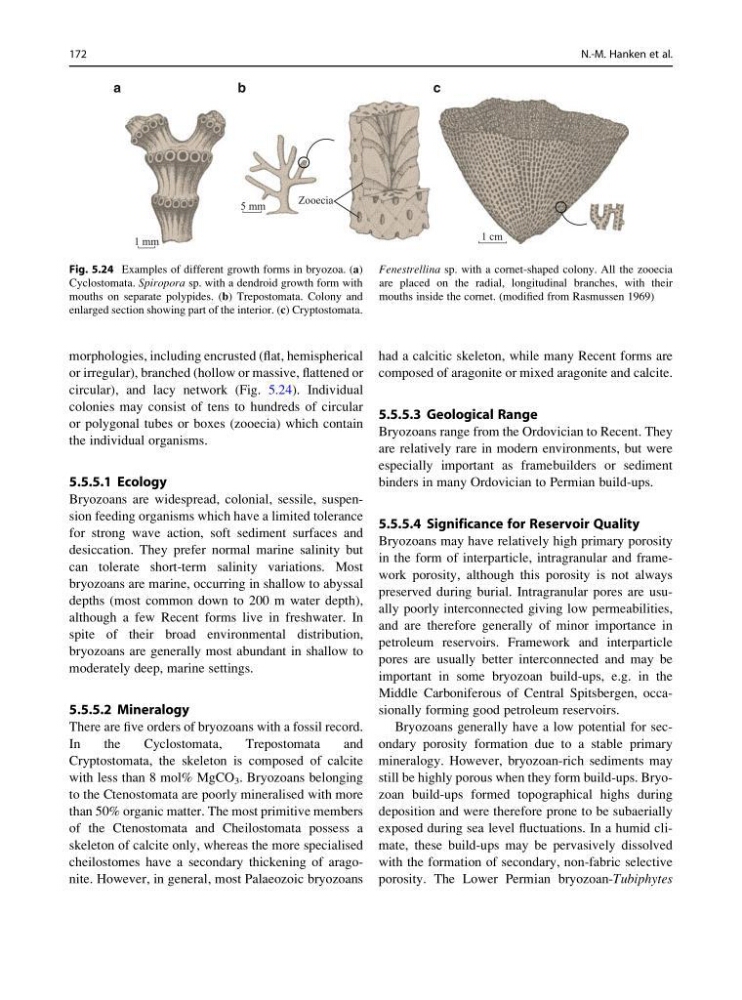
morphologies, including encrusted (flat, hemispherical
or irregular), branched (hollow or massive, flattened or
circular), and lacy network (Fig. 5.24). Individual
colonies may consist of tens to hundreds of circular
or polygonal tubes or boxes (zooecia) which contain
the individual organisms.
5.5.5.1 Ecology
Bryozoans are widespread, colonial, sessile, suspension feeding organisms which have a limited tolerance
for strong wave action, soft sediment surfaces and
desiccation. They prefer normal marine salinity but
can tolerate short-term salinity variations. Most
bryozoans are marine, occurring in shallow to abyssal
depths (most common down to 200 m water depth),
although a few Recent forms live in freshwater. In
spite of their broad environmental distribution,
bryozoans are generally most abundant in shallow to
moderately deep, marine settings.
5.5.5.2 Mineralogy
There are five orders of bryozoans with a fossil record.
In
the
Cyclostomata,
Trepostomata
and
Cryptostomata, the skeleton is composed of calcite
with less than 8 mol% MgCO 3 . Bryozoans belonging
to the Ctenostomata are poorly mineralised with more
than 50% organic matter. The most primitive members
of the Ctenostomata and Cheilostomata possess a
skeleton of calcite only, whereas the more specialised
cheilostomes have a secondary thickening of aragonite. However, in general, most Palaeozoic bryozoans
had a calcitic skeleton, while many Recent forms are
composed of aragonite or mixed aragonite and calcite.
5.5.5.3 Geological Range
Bryozoans range from the Ordovician to Recent. They
are relatively rare in modern environments, but were
especially important as framebuilders or sediment
binders in many Ordovician to Permian build-ups.
5.5.5.4 Significance for Reservoir Quality
Bryozoans may have relatively high primary porosity
in the form of interparticle, intragranular and framework porosity, although this porosity is not always
preserved during burial. Intragranular pores are usually poorly interconnected giving low permeabilities,
and are therefore generally of minor importance in
petroleum reservoirs. Framework and interparticle
pores are usually better interconnected and may be
important in some bryozoan build-ups, e.g. in the
Middle Carboniferous of Central Spitsbergen, occasionally forming good petroleum reservoirs.
Bryozoans generally have a low potential for secondary porosity formation due to a stable primary
mineralogy. However, bryozoan-rich sediments may
still be highly porous when they form build-ups. Bryozoan build-ups formed topographical highs during
deposition and were therefore prone to be subaerially
exposed during sea level fluctuations. In a humid climate, these build-ups may be pervasively dissolved
with the formation of secondary, non-fabric selective
porosity. The Lower Permian bryozoan-Tubiphytes
5 mm
c
b
a
Zooecia
1 cm
1 mm
Fig. 5.24 Examples of different growth forms in bryozoa. (a)
Cyclostomata. Spiropora sp. with a dendroid growth form with
mouths on separate polypides. (b) Trepostomata. Colony and
enlarged section showing part of the interior. (c) Cryptostomata.
Fenestrellina sp. with a cornet-shaped colony. All the zooecia
are placed on the radial, longitudinal branches, with their
mouths inside the cornet. (modified from Rasmussen 1969)
172
N.-M. Hanken et al.
or irregular), branched (hollow or massive, flattened or
circular), and lacy network (Fig. 5.24). Individual
colonies may consist of tens to hundreds of circular
or polygonal tubes or boxes (zooecia) which contain
the individual organisms.
5.5.5.1 Ecology
Bryozoans are widespread, colonial, sessile, suspension feeding organisms which have a limited tolerance
for strong wave action, soft sediment surfaces and
desiccation. They prefer normal marine salinity but
can tolerate short-term salinity variations. Most
bryozoans are marine, occurring in shallow to abyssal
depths (most common down to 200 m water depth),
although a few Recent forms live in freshwater. In
spite of their broad environmental distribution,
bryozoans are generally most abundant in shallow to
moderately deep, marine settings.
5.5.5.2 Mineralogy
There are five orders of bryozoans with a fossil record.
In
the
Cyclostomata,
Trepostomata
and
Cryptostomata, the skeleton is composed of calcite
with less than 8 mol% MgCO 3 . Bryozoans belonging
to the Ctenostomata are poorly mineralised with more
than 50% organic matter. The most primitive members
of the Ctenostomata and Cheilostomata possess a
skeleton of calcite only, whereas the more specialised
cheilostomes have a secondary thickening of aragonite. However, in general, most Palaeozoic bryozoans
had a calcitic skeleton, while many Recent forms are
composed of aragonite or mixed aragonite and calcite.
5.5.5.3 Geological Range
Bryozoans range from the Ordovician to Recent. They
are relatively rare in modern environments, but were
especially important as framebuilders or sediment
binders in many Ordovician to Permian build-ups.
5.5.5.4 Significance for Reservoir Quality
Bryozoans may have relatively high primary porosity
in the form of interparticle, intragranular and framework porosity, although this porosity is not always
preserved during burial. Intragranular pores are usually poorly interconnected giving low permeabilities,
and are therefore generally of minor importance in
petroleum reservoirs. Framework and interparticle
pores are usually better interconnected and may be
important in some bryozoan build-ups, e.g. in the
Middle Carboniferous of Central Spitsbergen, occasionally forming good petroleum reservoirs.
Bryozoans generally have a low potential for secondary porosity formation due to a stable primary
mineralogy. However, bryozoan-rich sediments may
still be highly porous when they form build-ups. Bryozoan build-ups formed topographical highs during
deposition and were therefore prone to be subaerially
exposed during sea level fluctuations. In a humid climate, these build-ups may be pervasively dissolved
with the formation of secondary, non-fabric selective
porosity. The Lower Permian bryozoan-Tubiphytes
5 mm
c
b
a
Zooecia
1 cm
1 mm
Fig. 5.24 Examples of different growth forms in bryozoa. (a)
Cyclostomata. Spiropora sp. with a dendroid growth form with
mouths on separate polypides. (b) Trepostomata. Colony and
enlarged section showing part of the interior. (c) Cryptostomata.
Fenestrellina sp. with a cornet-shaped colony. All the zooecia
are placed on the radial, longitudinal branches, with their
mouths inside the cornet. (modified from Rasmussen 1969)
172
N.-M. Hanken et al.