

aragonite, and it is believed that pre-Quaternary species also had the same mineralogical variations.
5.5.4.3 Geological Range
Rugose corals range from the Middle Ordovician to
the Upper Permian. They were not common until the
Silurian, after which their numbers gradually
increased to a peak in the Lower Carboniferous.
Their numbers and diversity then declined until they
finally became extinct by the end of the Permian.
Tabulate corals occur in rocks of Cambrian (Middle
Ordovician?) to Permian (and possibly Triassic to
Eocene?) age. Scleractinian corals range from the
Middle Triassic to Recent, and alcyonarian corals
range from the Precambrian to Recent. Scleractinian
corals are the dominant coral group today.
5.5.4.4 Significance for Reservoir Quality
Corals may form high primary framework porosity in
reefs. Scleractinian corals have an unstable primary
mineralogy (aragonite) so may develop high secondary mouldic porosity during dissolution. Corals, in
particular scleractinian corals, therefore have relatively high reservoir potential.
5.5.5 Bryozoa
Bryozoans form colonies which are usually 0.5–2 cm
in diameter, but colonies up to about 60 cm are known.
They live permanently fixed to a substrate, which may
be a stone, shell (living or dead), algae or other
objects. The colonies have a wide range of external
Calice
a
d
b
c
Cardinal
fossula
Septa
Tabulae
Epitheca
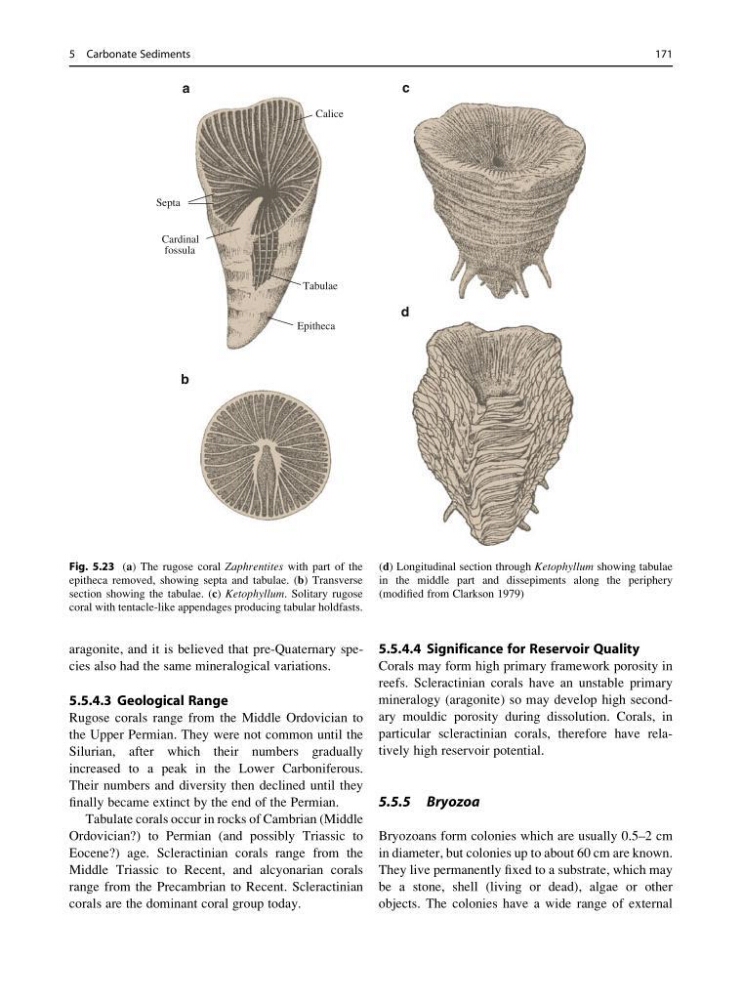
Fig. 5.23 (a) The rugose coral Zaphrentites with part of the
epitheca removed, showing septa and tabulae. (b) Transverse
section showing the tabulae. (c) Ketophyllum. Solitary rugose
coral with tentacle-like appendages producing tabular holdfasts.
(d) Longitudinal section through Ketophyllum showing tabulae
in the middle part and dissepiments along the periphery
(modified from Clarkson 1979)
5 Carbonate Sediments
171
5.5.4.3 Geological Range
Rugose corals range from the Middle Ordovician to
the Upper Permian. They were not common until the
Silurian, after which their numbers gradually
increased to a peak in the Lower Carboniferous.
Their numbers and diversity then declined until they
finally became extinct by the end of the Permian.
Tabulate corals occur in rocks of Cambrian (Middle
Ordovician?) to Permian (and possibly Triassic to
Eocene?) age. Scleractinian corals range from the
Middle Triassic to Recent, and alcyonarian corals
range from the Precambrian to Recent. Scleractinian
corals are the dominant coral group today.
5.5.4.4 Significance for Reservoir Quality
Corals may form high primary framework porosity in
reefs. Scleractinian corals have an unstable primary
mineralogy (aragonite) so may develop high secondary mouldic porosity during dissolution. Corals, in
particular scleractinian corals, therefore have relatively high reservoir potential.
5.5.5 Bryozoa
Bryozoans form colonies which are usually 0.5–2 cm
in diameter, but colonies up to about 60 cm are known.
They live permanently fixed to a substrate, which may
be a stone, shell (living or dead), algae or other
objects. The colonies have a wide range of external
Calice
a
d
b
c
Cardinal
fossula
Septa
Tabulae
Epitheca
Fig. 5.23 (a) The rugose coral Zaphrentites with part of the
epitheca removed, showing septa and tabulae. (b) Transverse
section showing the tabulae. (c) Ketophyllum. Solitary rugose
coral with tentacle-like appendages producing tabular holdfasts.
(d) Longitudinal section through Ketophyllum showing tabulae
in the middle part and dissepiments along the periphery
(modified from Clarkson 1979)
5 Carbonate Sediments
171