

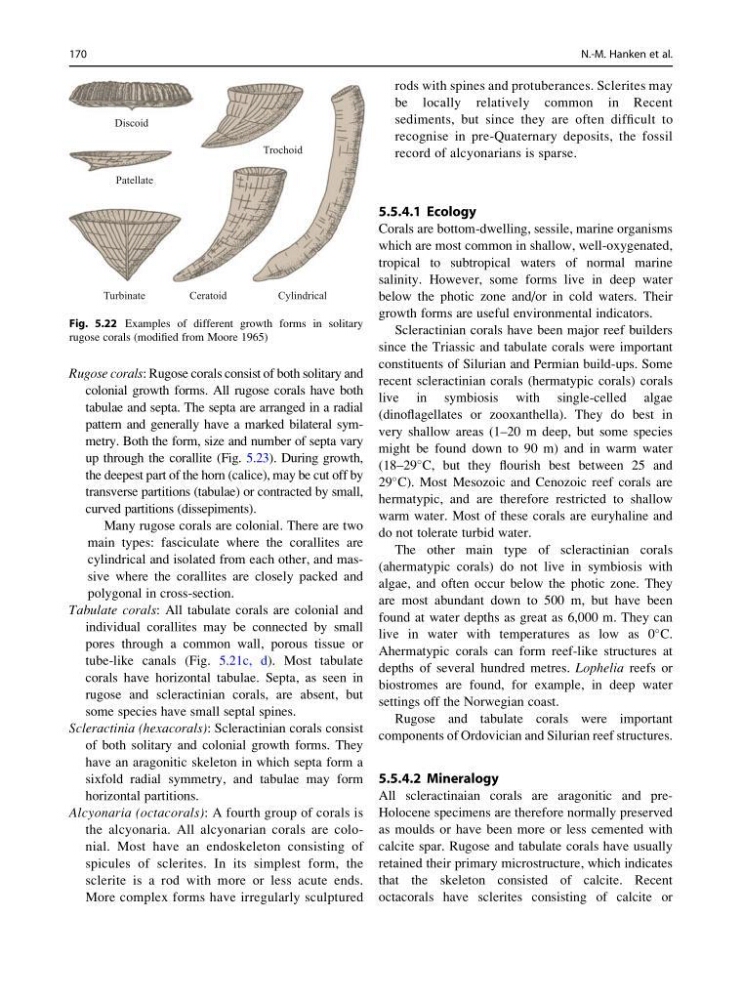
Rugose corals: Rugose corals consist of both solitary and
colonial growth forms. All rugose corals have both
tabulae and septa. The septa are arranged in a radial
pattern and generally have a marked bilateral symmetry. Both the form, size and number of septa vary
up through the corallite (Fig. 5.23). During growth,
the deepest part of the horn (calice), may be cut off by
transverse partitions (tabulae) or contracted by small,
curved partitions (dissepiments).
Many rugose corals are colonial. There are two
main types: fasciculate where the corallites are
cylindrical and isolated from each other, and massive where the corallites are closely packed and
polygonal in cross-section.
Tabulate corals: All tabulate corals are colonial and
individual corallites may be connected by small
pores through a common wall, porous tissue or
tube-like canals (Fig. 5.21c, d). Most tabulate
corals have horizontal tabulae. Septa, as seen in
rugose and scleractinian corals, are absent, but
some species have small septal spines.
Scleractinia (hexacorals): Scleractinian corals consist
of both solitary and colonial growth forms. They
have an aragonitic skeleton in which septa form a
sixfold radial symmetry, and tabulae may form
horizontal partitions.
Alcyonaria (octacorals): A fourth group of corals is
the alcyonaria. All alcyonarian corals are colonial. Most have an endoskeleton consisting of
spicules of sclerites. In its simplest form, the
sclerite is a rod with more or less acute ends.
More complex forms have irregularly sculptured
rods with spines and protuberances. Sclerites may
be locally relatively common in Recent
sediments, but since they are often difficult to
recognise in pre-Quaternary deposits, the fossil
record of alcyonarians is sparse.
5.5.4.1 Ecology
Corals are bottom-dwelling, sessile, marine organisms
which are most common in shallow, well-oxygenated,
tropical to subtropical waters of normal marine
salinity. However, some forms live in deep water
below the photic zone and/or in cold waters. Their
growth forms are useful environmental indicators.
Scleractinian corals have been major reef builders
since the Triassic and tabulate corals were important
constituents of Silurian and Permian build-ups. Some
recent scleractinian corals (hermatypic corals) corals
live in symbiosis with single-celled algae
(dinoflagellates or zooxanthella). They do best in
very shallow areas (1–20 m deep, but some species
might be found down to 90 m) and in warm water
(18–29
C, but they flourish best between 25 and
29
C). Most Mesozoic and Cenozoic reef corals are
hermatypic, and are therefore restricted to shallow
warm water. Most of these corals are euryhaline and
do not tolerate turbid water.
The other main type of scleractinian corals
(ahermatypic corals) do not live in symbiosis with
algae, and often occur below the photic zone. They
are most abundant down to 500 m, but have been
found at water depths as great as 6,000 m. They can
live in water with temperatures as low as 0
C.
Ahermatypic corals can form reef-like structures at
depths of several hundred metres. Lophelia reefs or
biostromes are found, for example, in deep water
settings off the Norwegian coast.
Rugose and tabulate corals were important
components of Ordovician and Silurian reef structures.
5.5.4.2 Mineralogy
All scleractinaian corals are aragonitic and preHolocene specimens are therefore normally preserved
as moulds or have been more or less cemented with
calcite spar. Rugose and tabulate corals have usually
retained their primary microstructure, which indicates
that the skeleton consisted of calcite. Recent
octacorals have sclerites consisting of calcite or
Discoid
Trochoid
Patellate
Turbinate
Ceratoid
Cylindrical
Fig. 5.22 Examples of different growth forms in solitary
rugose corals (modified from Moore 1965)
170
N.-M. Hanken et al.
colonial growth forms. All rugose corals have both
tabulae and septa. The septa are arranged in a radial
pattern and generally have a marked bilateral symmetry. Both the form, size and number of septa vary
up through the corallite (Fig. 5.23). During growth,
the deepest part of the horn (calice), may be cut off by
transverse partitions (tabulae) or contracted by small,
curved partitions (dissepiments).
Many rugose corals are colonial. There are two
main types: fasciculate where the corallites are
cylindrical and isolated from each other, and massive where the corallites are closely packed and
polygonal in cross-section.
Tabulate corals: All tabulate corals are colonial and
individual corallites may be connected by small
pores through a common wall, porous tissue or
tube-like canals (Fig. 5.21c, d). Most tabulate
corals have horizontal tabulae. Septa, as seen in
rugose and scleractinian corals, are absent, but
some species have small septal spines.
Scleractinia (hexacorals): Scleractinian corals consist
of both solitary and colonial growth forms. They
have an aragonitic skeleton in which septa form a
sixfold radial symmetry, and tabulae may form
horizontal partitions.
Alcyonaria (octacorals): A fourth group of corals is
the alcyonaria. All alcyonarian corals are colonial. Most have an endoskeleton consisting of
spicules of sclerites. In its simplest form, the
sclerite is a rod with more or less acute ends.
More complex forms have irregularly sculptured
rods with spines and protuberances. Sclerites may
be locally relatively common in Recent
sediments, but since they are often difficult to
recognise in pre-Quaternary deposits, the fossil
record of alcyonarians is sparse.
5.5.4.1 Ecology
Corals are bottom-dwelling, sessile, marine organisms
which are most common in shallow, well-oxygenated,
tropical to subtropical waters of normal marine
salinity. However, some forms live in deep water
below the photic zone and/or in cold waters. Their
growth forms are useful environmental indicators.
Scleractinian corals have been major reef builders
since the Triassic and tabulate corals were important
constituents of Silurian and Permian build-ups. Some
recent scleractinian corals (hermatypic corals) corals
live in symbiosis with single-celled algae
(dinoflagellates or zooxanthella). They do best in
very shallow areas (1–20 m deep, but some species
might be found down to 90 m) and in warm water
(18–29
C, but they flourish best between 25 and
29
C). Most Mesozoic and Cenozoic reef corals are
hermatypic, and are therefore restricted to shallow
warm water. Most of these corals are euryhaline and
do not tolerate turbid water.
The other main type of scleractinian corals
(ahermatypic corals) do not live in symbiosis with
algae, and often occur below the photic zone. They
are most abundant down to 500 m, but have been
found at water depths as great as 6,000 m. They can
live in water with temperatures as low as 0
C.
Ahermatypic corals can form reef-like structures at
depths of several hundred metres. Lophelia reefs or
biostromes are found, for example, in deep water
settings off the Norwegian coast.
Rugose and tabulate corals were important
components of Ordovician and Silurian reef structures.
5.5.4.2 Mineralogy
All scleractinaian corals are aragonitic and preHolocene specimens are therefore normally preserved
as moulds or have been more or less cemented with
calcite spar. Rugose and tabulate corals have usually
retained their primary microstructure, which indicates
that the skeleton consisted of calcite. Recent
octacorals have sclerites consisting of calcite or
Discoid
Trochoid
Patellate
Turbinate
Ceratoid
Cylindrical
Fig. 5.22 Examples of different growth forms in solitary
rugose corals (modified from Moore 1965)
170
N.-M. Hanken et al.