

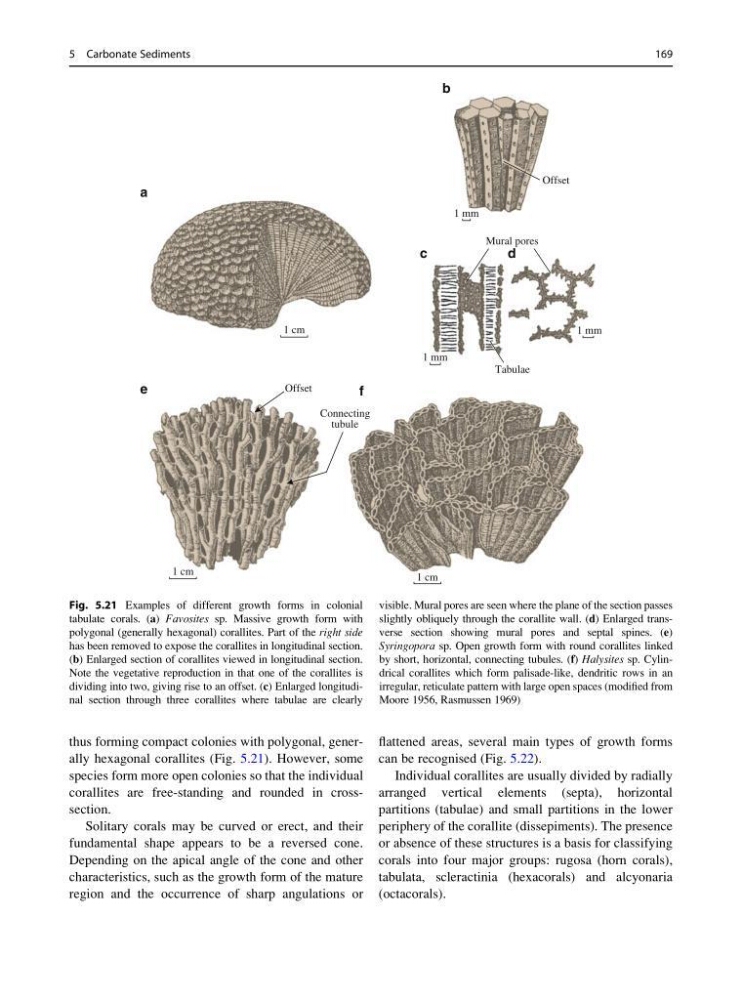
thus forming compact colonies with polygonal, generally hexagonal corallites (Fig. 5.21). However, some
species form more open colonies so that the individual
corallites are free-standing and rounded in crosssection.
Solitary corals may be curved or erect, and their
fundamental shape appears to be a reversed cone.
Depending on the apical angle of the cone and other
characteristics, such as the growth form of the mature
region and the occurrence of sharp angulations or
flattened areas, several main types of growth forms
can be recognised (Fig. 5.22).
Individual corallites are usually divided by radially
arranged vertical elements (septa), horizontal
partitions (tabulae) and small partitions in the lower
periphery of the corallite (dissepiments). The presence
or absence of these structures is a basis for classifying
corals into four major groups: rugosa (horn corals),
tabulata, scleractinia (hexacorals) and alcyonaria
(octacorals).
Offset
Mural pores
Tabulae
a
Offset
Connecting
tubule
c
b
d
e
f
1 mm
1 mm
1 mm
1 cm
1 cm
1 cm
Fig. 5.21 Examples of different growth forms in colonial
tabulate corals. (a) Favosites sp. Massive growth form with
polygonal (generally hexagonal) corallites. Part of the right side
has been removed to expose the corallites in longitudinal section.
(b) Enlarged section of corallites viewed in longitudinal section.
Note the vegetative reproduction in that one of the corallites is
dividing into two, giving rise to an offset. (c) Enlarged longitudinal section through three corallites where tabulae are clearly
visible. Mural pores are seen where the plane of the section passes
slightly obliquely through the corallite wall. (d) Enlarged transverse section showing mural pores and septal spines. (e)
Syringopora sp. Open growth form with round corallites linked
by short, horizontal, connecting tubules. (f) Halysites sp. Cylindrical corallites which form palisade-like, dendritic rows in an
irregular, reticulate pattern with large open spaces (modified from
Moore 1956, Rasmussen 1969)
5 Carbonate Sediments
169
species form more open colonies so that the individual
corallites are free-standing and rounded in crosssection.
Solitary corals may be curved or erect, and their
fundamental shape appears to be a reversed cone.
Depending on the apical angle of the cone and other
characteristics, such as the growth form of the mature
region and the occurrence of sharp angulations or
flattened areas, several main types of growth forms
can be recognised (Fig. 5.22).
Individual corallites are usually divided by radially
arranged vertical elements (septa), horizontal
partitions (tabulae) and small partitions in the lower
periphery of the corallite (dissepiments). The presence
or absence of these structures is a basis for classifying
corals into four major groups: rugosa (horn corals),
tabulata, scleractinia (hexacorals) and alcyonaria
(octacorals).
Offset
Mural pores
Tabulae
a
Offset
Connecting
tubule
c
b
d
e
f
1 mm
1 mm
1 mm
1 cm
1 cm
1 cm
Fig. 5.21 Examples of different growth forms in colonial
tabulate corals. (a) Favosites sp. Massive growth form with
polygonal (generally hexagonal) corallites. Part of the right side
has been removed to expose the corallites in longitudinal section.
(b) Enlarged section of corallites viewed in longitudinal section.
Note the vegetative reproduction in that one of the corallites is
dividing into two, giving rise to an offset. (c) Enlarged longitudinal section through three corallites where tabulae are clearly
visible. Mural pores are seen where the plane of the section passes
slightly obliquely through the corallite wall. (d) Enlarged transverse section showing mural pores and septal spines. (e)
Syringopora sp. Open growth form with round corallites linked
by short, horizontal, connecting tubules. (f) Halysites sp. Cylindrical corallites which form palisade-like, dendritic rows in an
irregular, reticulate pattern with large open spaces (modified from
Moore 1956, Rasmussen 1969)
5 Carbonate Sediments
169