

size and shape. They are commonly from a few
centimetres to about a metre in diameter and their
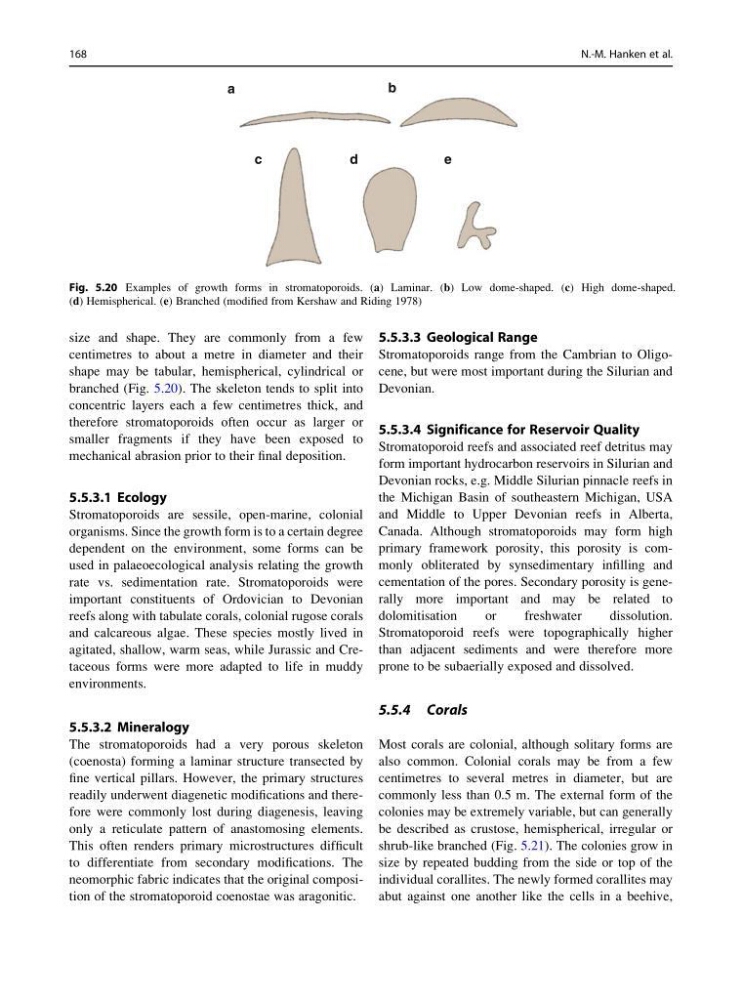
shape may be tabular, hemispherical, cylindrical or
branched (Fig. 5.20). The skeleton tends to split into
concentric layers each a few centimetres thick, and
therefore stromatoporoids often occur as larger or
smaller fragments if they have been exposed to
mechanical abrasion prior to their final deposition.
5.5.3.1 Ecology
Stromatoporoids are sessile, open-marine, colonial
organisms. Since the growth form is to a certain degree
dependent on the environment, some forms can be
used in palaeoecological analysis relating the growth
rate vs. sedimentation rate. Stromatoporoids were
important constituents of Ordovician to Devonian
reefs along with tabulate corals, colonial rugose corals
and calcareous algae. These species mostly lived in
agitated, shallow, warm seas, while Jurassic and Cretaceous forms were more adapted to life in muddy
environments.
5.5.3.2 Mineralogy
The stromatoporoids had a very porous skeleton
(coenosta) forming a laminar structure transected by
fine vertical pillars. However, the primary structures
readily underwent diagenetic modifications and therefore were commonly lost during diagenesis, leaving
only a reticulate pattern of anastomosing elements.
This often renders primary microstructures difficult
to differentiate from secondary modifications. The
neomorphic fabric indicates that the original composition of the stromatoporoid coenostae was aragonitic.
5.5.3.3 Geological Range
Stromatoporoids range from the Cambrian to Oligocene, but were most important during the Silurian and
Devonian.
5.5.3.4 Significance for Reservoir Quality
Stromatoporoid reefs and associated reef detritus may
form important hydrocarbon reservoirs in Silurian and
Devonian rocks, e.g. Middle Silurian pinnacle reefs in
the Michigan Basin of southeastern Michigan, USA
and Middle to Upper Devonian reefs in Alberta,
Canada. Although stromatoporoids may form high
primary framework porosity, this porosity is commonly obliterated by synsedimentary infilling and
cementation of the pores. Secondary porosity is generally more important and may be related to
dolomitisation
or
freshwater
dissolution.
Stromatoporoid reefs were topographically higher
than adjacent sediments and were therefore more
prone to be subaerially exposed and dissolved.
5.5.4 Corals
Most corals are colonial, although solitary forms are
also common. Colonial corals may be from a few
centimetres to several metres in diameter, but are
commonly less than 0.5 m. The external form of the
colonies may be extremely variable, but can generally
be described as crustose, hemispherical, irregular or
shrub-like branched (Fig. 5.21). The colonies grow in
size by repeated budding from the side or top of the
individual corallites. The newly formed corallites may
abut against one another like the cells in a beehive,
a
b
c
d
e
Fig. 5.20 Examples of growth forms in stromatoporoids. (a) Laminar. (b) Low dome-shaped. (c) High dome-shaped.
(d) Hemispherical. (e) Branched (modified from Kershaw and Riding 1978)
168
N.-M. Hanken et al.
centimetres to about a metre in diameter and their
shape may be tabular, hemispherical, cylindrical or
branched (Fig. 5.20). The skeleton tends to split into
concentric layers each a few centimetres thick, and
therefore stromatoporoids often occur as larger or
smaller fragments if they have been exposed to
mechanical abrasion prior to their final deposition.
5.5.3.1 Ecology
Stromatoporoids are sessile, open-marine, colonial
organisms. Since the growth form is to a certain degree
dependent on the environment, some forms can be
used in palaeoecological analysis relating the growth
rate vs. sedimentation rate. Stromatoporoids were
important constituents of Ordovician to Devonian
reefs along with tabulate corals, colonial rugose corals
and calcareous algae. These species mostly lived in
agitated, shallow, warm seas, while Jurassic and Cretaceous forms were more adapted to life in muddy
environments.
5.5.3.2 Mineralogy
The stromatoporoids had a very porous skeleton
(coenosta) forming a laminar structure transected by
fine vertical pillars. However, the primary structures
readily underwent diagenetic modifications and therefore were commonly lost during diagenesis, leaving
only a reticulate pattern of anastomosing elements.
This often renders primary microstructures difficult
to differentiate from secondary modifications. The
neomorphic fabric indicates that the original composition of the stromatoporoid coenostae was aragonitic.
5.5.3.3 Geological Range
Stromatoporoids range from the Cambrian to Oligocene, but were most important during the Silurian and
Devonian.
5.5.3.4 Significance for Reservoir Quality
Stromatoporoid reefs and associated reef detritus may
form important hydrocarbon reservoirs in Silurian and
Devonian rocks, e.g. Middle Silurian pinnacle reefs in
the Michigan Basin of southeastern Michigan, USA
and Middle to Upper Devonian reefs in Alberta,
Canada. Although stromatoporoids may form high
primary framework porosity, this porosity is commonly obliterated by synsedimentary infilling and
cementation of the pores. Secondary porosity is generally more important and may be related to
dolomitisation
or
freshwater
dissolution.
Stromatoporoid reefs were topographically higher
than adjacent sediments and were therefore more
prone to be subaerially exposed and dissolved.
5.5.4 Corals
Most corals are colonial, although solitary forms are
also common. Colonial corals may be from a few
centimetres to several metres in diameter, but are
commonly less than 0.5 m. The external form of the
colonies may be extremely variable, but can generally
be described as crustose, hemispherical, irregular or
shrub-like branched (Fig. 5.21). The colonies grow in
size by repeated budding from the side or top of the
individual corallites. The newly formed corallites may
abut against one another like the cells in a beehive,
a
b
c
d
e
Fig. 5.20 Examples of growth forms in stromatoporoids. (a) Laminar. (b) Low dome-shaped. (c) High dome-shaped.
(d) Hemispherical. (e) Branched (modified from Kershaw and Riding 1978)
168
N.-M. Hanken et al.