

on death and spicule-bearing forms are therefore
seldom preserved intact. The spicules may occur in
two different sizes within a single individual. The
large spicules (megascleres) vary from 0.1 to 1 mm
and constitute the skeleton proper. The small spicules
(microscleres) vary from 0.01 to 0.1 mm and are found
isolated in the sponges, especially around the pores.
The megascleres may occur as isolated spicules, be in
close contact with each other, or be firmly intergrown
to form a skeleton.
5.5.2.1 Ecology
Nearly all sponges are marine although a few freshwater forms are known. Sponges live mostly in relatively clear water, from the littoral zone down to
abyssal depths. Siliceous sponges are generally found
in deep water, whereas calcareous forms are more
common in shallow-water environments. Most
sponges lived attached to the bottom.
Many sponges are important boring organisms
which help to break down calcareous rocks and carbonate skeletons produced by larger organisms into
finer-grained material. The holes are 0.2–1 mm in
diameter, forming thin holes up to 0.5 cm long.
5.5.2.2 Mineralogy
The main division of the sponges is based on the
chemical composition of the spicules and the symmetry of the skeletal elements. Calcispongiea (calcareous
sponges) have spicules of calcite or aragonite. These
spicules are characterised by having a monocrystalline
microstructure where each individual spicule
extinguishes as a single entity in polarised light.
Hyalospongiea (siliceous sponges) have spicules of
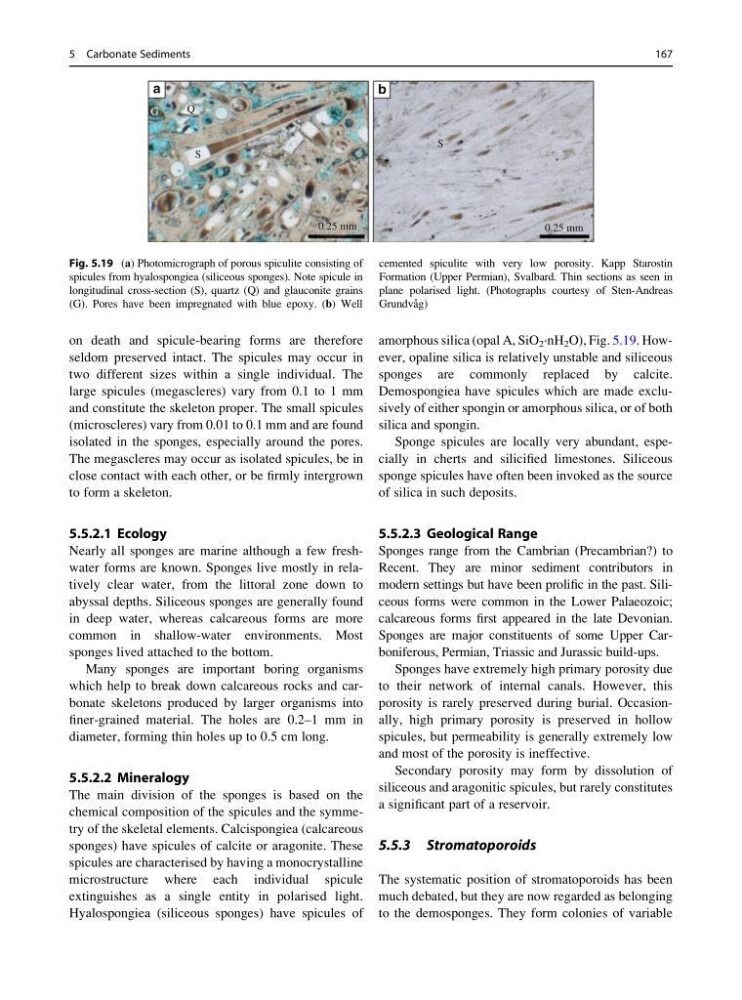
amorphous silica (opal A, SiO 2 ·nH 2 O), Fig. 5.19. However, opaline silica is relatively unstable and siliceous
sponges are commonly replaced by calcite.
Demospongiea have spicules which are made exclusively of either spongin or amorphous silica, or of both
silica and spongin.
Sponge spicules are locally very abundant, especially in cherts and silicified limestones. Siliceous
sponge spicules have often been invoked as the source
of silica in such deposits.
5.5.2.3 Geological Range
Sponges range from the Cambrian (Precambrian?) to
Recent. They are minor sediment contributors in
modern settings but have been prolific in the past. Siliceous forms were common in the Lower Palaeozoic;
calcareous forms first appeared in the late Devonian.
Sponges are major constituents of some Upper Carboniferous, Permian, Triassic and Jurassic build-ups.
Sponges have extremely high primary porosity due
to their network of internal canals. However, this
porosity is rarely preserved during burial. Occasionally, high primary porosity is preserved in hollow
spicules, but permeability is generally extremely low
and most of the porosity is ineffective.
Secondary porosity may form by dissolution of
siliceous and aragonitic spicules, but rarely constitutes
a significant part of a reservoir.
5.5.3 Stromatoporoids
The systematic position of stromatoporoids has been
much debated, but they are now regarded as belonging
to the demosponges. They form colonies of variable
a
b
G
Q
S
0.25 mm
0.25 mm
S
Fig. 5.19 (a) Photomicrograph of porous spiculite consisting of
spicules from hyalospongiea (siliceous sponges). Note spicule in
longitudinal cross-section (S), quartz (Q) and glauconite grains
(G). Pores have been impregnated with blue epoxy. (b) Well
cemented spiculite with very low porosity. Kapp Starostin
Formation (Upper Permian), Svalbard. Thin sections as seen in
plane polarised light. (Photographs courtesy of Sten-Andreas
Grundva ˚g)
5 Carbonate Sediments
167
seldom preserved intact. The spicules may occur in
two different sizes within a single individual. The
large spicules (megascleres) vary from 0.1 to 1 mm
and constitute the skeleton proper. The small spicules
(microscleres) vary from 0.01 to 0.1 mm and are found
isolated in the sponges, especially around the pores.
The megascleres may occur as isolated spicules, be in
close contact with each other, or be firmly intergrown
to form a skeleton.
5.5.2.1 Ecology
Nearly all sponges are marine although a few freshwater forms are known. Sponges live mostly in relatively clear water, from the littoral zone down to
abyssal depths. Siliceous sponges are generally found
in deep water, whereas calcareous forms are more
common in shallow-water environments. Most
sponges lived attached to the bottom.
Many sponges are important boring organisms
which help to break down calcareous rocks and carbonate skeletons produced by larger organisms into
finer-grained material. The holes are 0.2–1 mm in
diameter, forming thin holes up to 0.5 cm long.
5.5.2.2 Mineralogy
The main division of the sponges is based on the
chemical composition of the spicules and the symmetry of the skeletal elements. Calcispongiea (calcareous
sponges) have spicules of calcite or aragonite. These
spicules are characterised by having a monocrystalline
microstructure where each individual spicule
extinguishes as a single entity in polarised light.
Hyalospongiea (siliceous sponges) have spicules of
amorphous silica (opal A, SiO 2 ·nH 2 O), Fig. 5.19. However, opaline silica is relatively unstable and siliceous
sponges are commonly replaced by calcite.
Demospongiea have spicules which are made exclusively of either spongin or amorphous silica, or of both
silica and spongin.
Sponge spicules are locally very abundant, especially in cherts and silicified limestones. Siliceous
sponge spicules have often been invoked as the source
of silica in such deposits.
5.5.2.3 Geological Range
Sponges range from the Cambrian (Precambrian?) to
Recent. They are minor sediment contributors in
modern settings but have been prolific in the past. Siliceous forms were common in the Lower Palaeozoic;
calcareous forms first appeared in the late Devonian.
Sponges are major constituents of some Upper Carboniferous, Permian, Triassic and Jurassic build-ups.
Sponges have extremely high primary porosity due
to their network of internal canals. However, this
porosity is rarely preserved during burial. Occasionally, high primary porosity is preserved in hollow
spicules, but permeability is generally extremely low
and most of the porosity is ineffective.
Secondary porosity may form by dissolution of
siliceous and aragonitic spicules, but rarely constitutes
a significant part of a reservoir.
5.5.3 Stromatoporoids
The systematic position of stromatoporoids has been
much debated, but they are now regarded as belonging
to the demosponges. They form colonies of variable
a
b
G
Q
S
0.25 mm
0.25 mm
S
Fig. 5.19 (a) Photomicrograph of porous spiculite consisting of
spicules from hyalospongiea (siliceous sponges). Note spicule in
longitudinal cross-section (S), quartz (Q) and glauconite grains
(G). Pores have been impregnated with blue epoxy. (b) Well
cemented spiculite with very low porosity. Kapp Starostin
Formation (Upper Permian), Svalbard. Thin sections as seen in
plane polarised light. (Photographs courtesy of Sten-Andreas
Grundva ˚g)
5 Carbonate Sediments
167