

ramp and platform deposits. They are particularly
useful as an index fossil in Cenozoic marine deposits
of the Mediterranean Sea region. Foraminifera provide
the basis for much of the stratigraphic subdivision of
the Upper Palaeozoic, Mesozoic and Cenozoic.
5.5.1.4 Significance for the Petroleum
Industry
Foraminifera commonly have a low reservoir potential
due to their small particle size and stable primary
mineralogy or neomorphic replacement. Some primary intragranular porosity may be of local significance, but generally connectivity is poor, giving low
permeability.
Important hydrocarbon reservoirs along the North
African coastline (Tunisia and Libya) and those in the
South China Seas are largely composed of nummulitid
foraminifera. The high amount of intra-skeletal porosity
and the low density of Nummulites tests and clasts make
them easily transportable by bottom and wave currents.
Apparently their hydrodynamic behaviour controlled
their distribution and the predominance of them in
reservoir facies mainly found as banks or bars of
grainstones and packstones.
5.5.2 Sponges
Sponges may vary considerably in size, commonly
from a few centimetres to more than a metre in diameter. Their external morphology is also highly variable, but plate-shaped, globular, vase- or bowl-shaped
forms are common. In its simplest form, the body is
sac-shaped with a large internal cavity which opens
upwards, the closed end being attached to the substrate. The wall is perforated by numerous small
pores leading to the central cavity.
The skeleton is internal and may be spongin (an
iodine-bearing protein which is rarely preserved in the
geological record), siliceous or calcareous. Some
sponges may incorporate foreign particles like sand
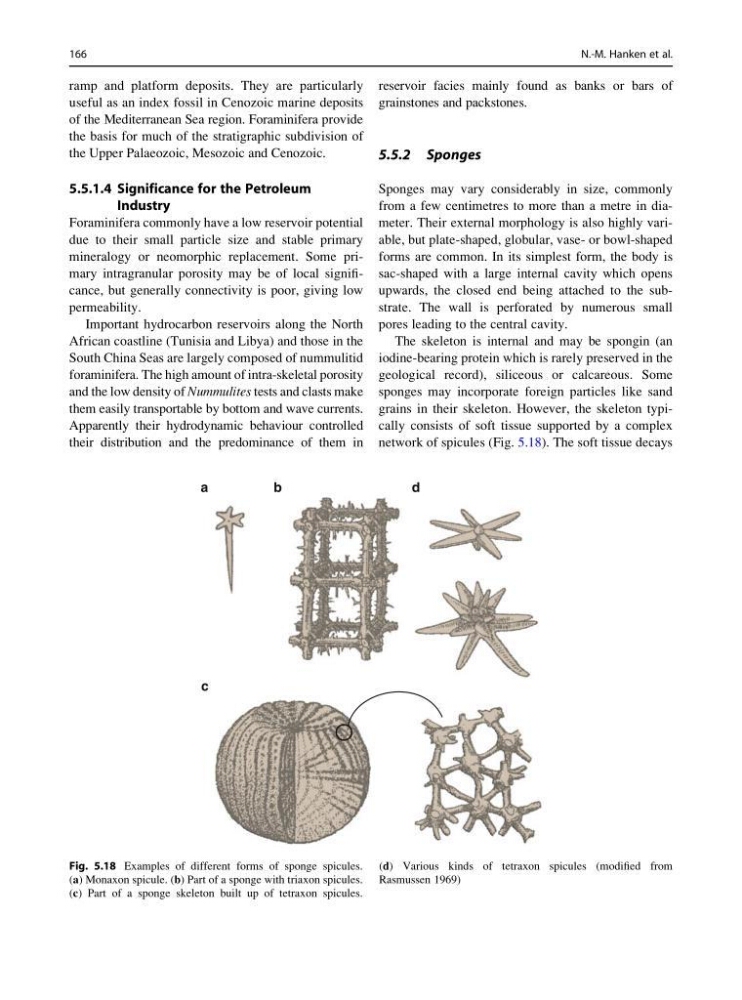
grains in their skeleton. However, the skeleton typically consists of soft tissue supported by a complex
network of spicules (Fig. 5.18). The soft tissue decays
c
a
d
b
Fig. 5.18 Examples of different forms of sponge spicules.
(a) Monaxon spicule. (b) Part of a sponge with triaxon spicules.
(c) Part of a sponge skeleton built up of tetraxon spicules.
(d) Various kinds of tetraxon spicules (modified from
Rasmussen 1969)
166
N.-M. Hanken et al.
useful as an index fossil in Cenozoic marine deposits
of the Mediterranean Sea region. Foraminifera provide
the basis for much of the stratigraphic subdivision of
the Upper Palaeozoic, Mesozoic and Cenozoic.
5.5.1.4 Significance for the Petroleum
Industry
Foraminifera commonly have a low reservoir potential
due to their small particle size and stable primary
mineralogy or neomorphic replacement. Some primary intragranular porosity may be of local significance, but generally connectivity is poor, giving low
permeability.
Important hydrocarbon reservoirs along the North
African coastline (Tunisia and Libya) and those in the
South China Seas are largely composed of nummulitid
foraminifera. The high amount of intra-skeletal porosity
and the low density of Nummulites tests and clasts make
them easily transportable by bottom and wave currents.
Apparently their hydrodynamic behaviour controlled
their distribution and the predominance of them in
reservoir facies mainly found as banks or bars of
grainstones and packstones.
5.5.2 Sponges
Sponges may vary considerably in size, commonly
from a few centimetres to more than a metre in diameter. Their external morphology is also highly variable, but plate-shaped, globular, vase- or bowl-shaped
forms are common. In its simplest form, the body is
sac-shaped with a large internal cavity which opens
upwards, the closed end being attached to the substrate. The wall is perforated by numerous small
pores leading to the central cavity.
The skeleton is internal and may be spongin (an
iodine-bearing protein which is rarely preserved in the
geological record), siliceous or calcareous. Some
sponges may incorporate foreign particles like sand
grains in their skeleton. However, the skeleton typically consists of soft tissue supported by a complex
network of spicules (Fig. 5.18). The soft tissue decays
c
a
d
b
Fig. 5.18 Examples of different forms of sponge spicules.
(a) Monaxon spicule. (b) Part of a sponge with triaxon spicules.
(c) Part of a sponge skeleton built up of tetraxon spicules.
(d) Various kinds of tetraxon spicules (modified from
Rasmussen 1969)
166
N.-M. Hanken et al.