

animals, e.g. snails. In high-energy nearshore
environments we find red algae.
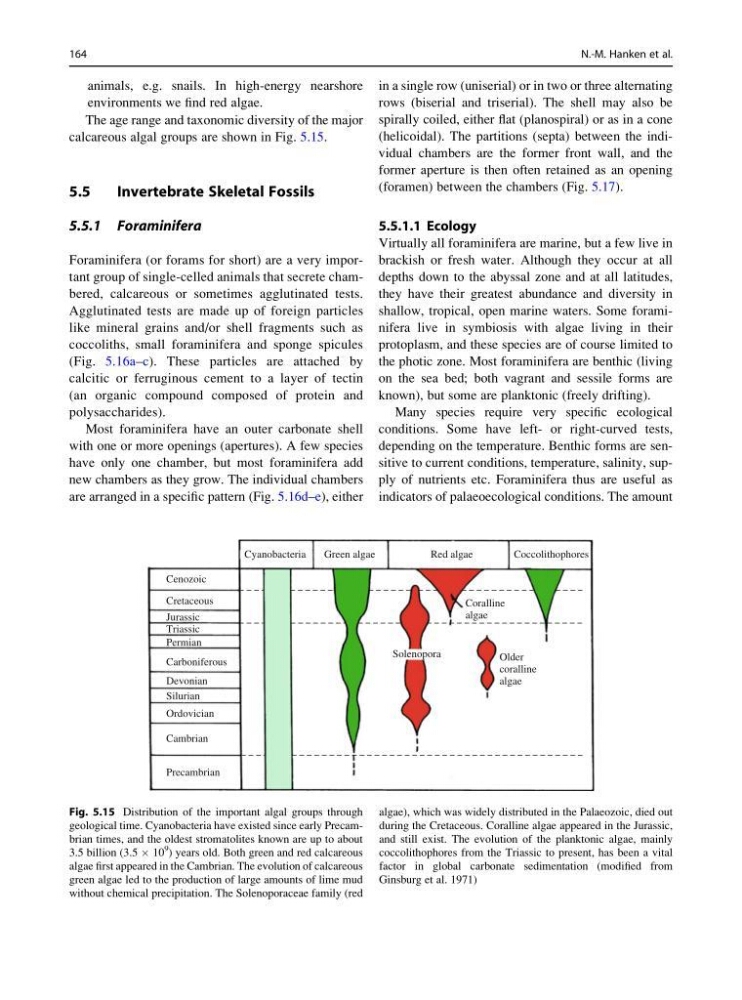
The age range and taxonomic diversity of the major
calcareous algal groups are shown in Fig. 5.15.
5.5
Invertebrate Skeletal Fossils
5.5.1 Foraminifera
Foraminifera (or forams for short) are a very important group of single-celled animals that secrete chambered, calcareous or sometimes agglutinated tests.
Agglutinated tests are made up of foreign particles
like mineral grains and/or shell fragments such as
coccoliths, small foraminifera and sponge spicules
(Fig. 5.16a–c). These particles are attached by
calcitic or ferruginous cement to a layer of tectin
(an organic compound composed of protein and
polysaccharides).
Most foraminifera have an outer carbonate shell
with one or more openings (apertures). A few species
have only one chamber, but most foraminifera add
new chambers as they grow. The individual chambers
are arranged in a specific pattern (Fig. 5.16d–e), either
in a single row (uniserial) or in two or three alternating
rows (biserial and triserial). The shell may also be
spirally coiled, either flat (planospiral) or as in a cone
(helicoidal). The partitions (septa) between the individual chambers are the former front wall, and the
former aperture is then often retained as an opening
(foramen) between the chambers (Fig. 5.17).
5.5.1.1 Ecology
Virtually all foraminifera are marine, but a few live in
brackish or fresh water. Although they occur at all
depths down to the abyssal zone and at all latitudes,
they have their greatest abundance and diversity in
shallow, tropical, open marine waters. Some foraminifera live in symbiosis with algae living in their
protoplasm, and these species are of course limited to
the photic zone. Most foraminifera are benthic (living
on the sea bed; both vagrant and sessile forms are
known), but some are planktonic (freely drifting).
Many species require very specific ecological
conditions. Some have left- or right-curved tests,
depending on the temperature. Benthic forms are sensitive to current conditions, temperature, salinity, supply of nutrients etc. Foraminifera thus are useful as
indicators of palaeoecological conditions. The amount
Cenozoic
Cyanobacteria
Green algae
Red algae
Coccolithophores
Coralline
algae
Older
coralline
algae
Solenopora
Cretaceous
Jurassic
Triassic
Permian
Carboniferous
Devonian
Silurian
Ordovician
Cambrian
Precambrian
Fig. 5.15 Distribution of the important algal groups through
geological time. Cyanobacteria have existed since early Precambrian times, and the oldest stromatolites known are up to about
3.5 billion (3.5 Â 10
9
) years old. Both green and red calcareous
algae first appeared in the Cambrian. The evolution of calcareous
green algae led to the production of large amounts of lime mud
without chemical precipitation. The Solenoporaceae family (red
algae), which was widely distributed in the Palaeozoic, died out
during the Cretaceous. Coralline algae appeared in the Jurassic,
and still exist. The evolution of the planktonic algae, mainly
coccolithophores from the Triassic to present, has been a vital
factor in global carbonate sedimentation (modified from
Ginsburg et al. 1971)
164
N.-M. Hanken et al.
environments we find red algae.
The age range and taxonomic diversity of the major
calcareous algal groups are shown in Fig. 5.15.
5.5
Invertebrate Skeletal Fossils
5.5.1 Foraminifera
Foraminifera (or forams for short) are a very important group of single-celled animals that secrete chambered, calcareous or sometimes agglutinated tests.
Agglutinated tests are made up of foreign particles
like mineral grains and/or shell fragments such as
coccoliths, small foraminifera and sponge spicules
(Fig. 5.16a–c). These particles are attached by
calcitic or ferruginous cement to a layer of tectin
(an organic compound composed of protein and
polysaccharides).
Most foraminifera have an outer carbonate shell
with one or more openings (apertures). A few species
have only one chamber, but most foraminifera add
new chambers as they grow. The individual chambers
are arranged in a specific pattern (Fig. 5.16d–e), either
in a single row (uniserial) or in two or three alternating
rows (biserial and triserial). The shell may also be
spirally coiled, either flat (planospiral) or as in a cone
(helicoidal). The partitions (septa) between the individual chambers are the former front wall, and the
former aperture is then often retained as an opening
(foramen) between the chambers (Fig. 5.17).
5.5.1.1 Ecology
Virtually all foraminifera are marine, but a few live in
brackish or fresh water. Although they occur at all
depths down to the abyssal zone and at all latitudes,
they have their greatest abundance and diversity in
shallow, tropical, open marine waters. Some foraminifera live in symbiosis with algae living in their
protoplasm, and these species are of course limited to
the photic zone. Most foraminifera are benthic (living
on the sea bed; both vagrant and sessile forms are
known), but some are planktonic (freely drifting).
Many species require very specific ecological
conditions. Some have left- or right-curved tests,
depending on the temperature. Benthic forms are sensitive to current conditions, temperature, salinity, supply of nutrients etc. Foraminifera thus are useful as
indicators of palaeoecological conditions. The amount
Cenozoic
Cyanobacteria
Green algae
Red algae
Coccolithophores
Coralline
algae
Older
coralline
algae
Solenopora
Cretaceous
Jurassic
Triassic
Permian
Carboniferous
Devonian
Silurian
Ordovician
Cambrian
Precambrian
Fig. 5.15 Distribution of the important algal groups through
geological time. Cyanobacteria have existed since early Precambrian times, and the oldest stromatolites known are up to about
3.5 billion (3.5 Â 10
9
) years old. Both green and red calcareous
algae first appeared in the Cambrian. The evolution of calcareous
green algae led to the production of large amounts of lime mud
without chemical precipitation. The Solenoporaceae family (red
algae), which was widely distributed in the Palaeozoic, died out
during the Cretaceous. Coralline algae appeared in the Jurassic,
and still exist. The evolution of the planktonic algae, mainly
coccolithophores from the Triassic to present, has been a vital
factor in global carbonate sedimentation (modified from
Ginsburg et al. 1971)
164
N.-M. Hanken et al.