

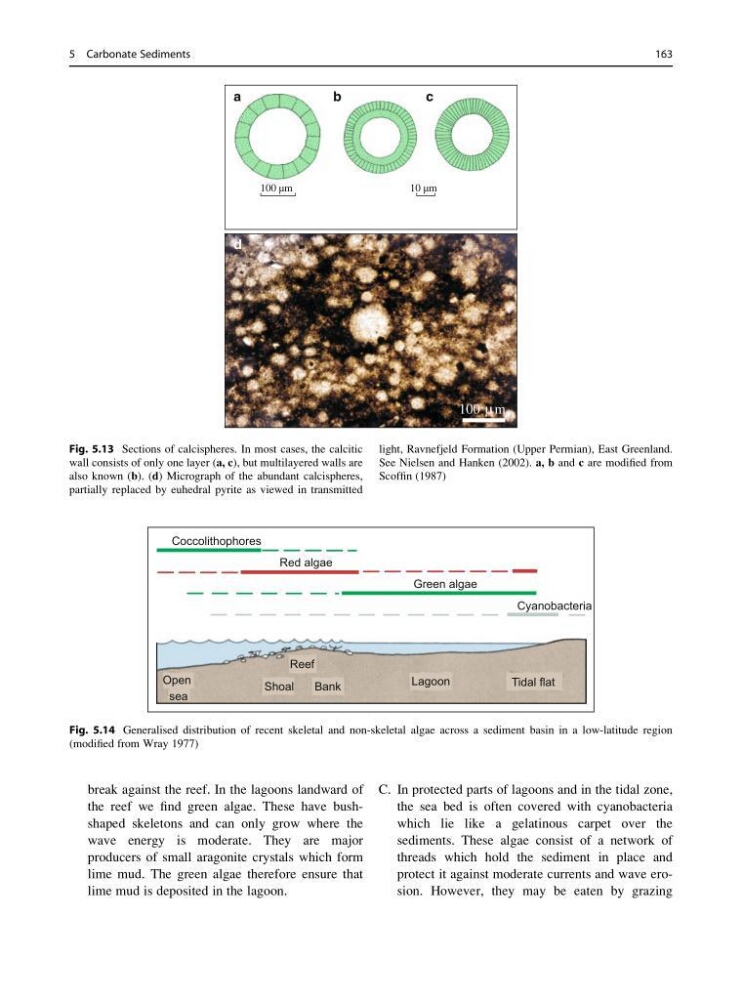
break against the reef. In the lagoons landward of
the reef we find green algae. These have bushshaped skeletons and can only grow where the
wave energy is moderate. They are major
producers of small aragonite crystals which form
lime mud. The green algae therefore ensure that
lime mud is deposited in the lagoon.
C. In protected parts of lagoons and in the tidal zone,
the sea bed is often covered with cyanobacteria
which lie like a gelatinous carpet over the
sediments. These algae consist of a network of
threads which hold the sediment in place and
protect it against moderate currents and wave erosion. However, they may be eaten by grazing
Open
sea
Shoal
Bank
Lagoon
Tidal flat
Reef
Coccolithophores
Red algae
Green algae
Cyanobacteria
Fig. 5.14 Generalised distribution of recent skeletal and non-skeletal algae across a sediment basin in a low-latitude region
(modified from Wray 1977)
c
b
a
µ
100 m
d
100 µm
10 µm
Fig. 5.13 Sections of calcispheres. In most cases, the calcitic
wall consists of only one layer (a, c), but multilayered walls are
also known (b). (d) Micrograph of the abundant calcispheres,
partially replaced by euhedral pyrite as viewed in transmitted
light, Ravnefjeld Formation (Upper Permian), East Greenland.
See Nielsen and Hanken (2002). a, b and c are modified from
Scoffin (1987)
5 Carbonate Sediments
163
the reef we find green algae. These have bushshaped skeletons and can only grow where the
wave energy is moderate. They are major
producers of small aragonite crystals which form
lime mud. The green algae therefore ensure that
lime mud is deposited in the lagoon.
C. In protected parts of lagoons and in the tidal zone,
the sea bed is often covered with cyanobacteria
which lie like a gelatinous carpet over the
sediments. These algae consist of a network of
threads which hold the sediment in place and
protect it against moderate currents and wave erosion. However, they may be eaten by grazing
Open
sea
Shoal
Bank
Lagoon
Tidal flat
Reef
Coccolithophores
Red algae
Green algae
Cyanobacteria
Fig. 5.14 Generalised distribution of recent skeletal and non-skeletal algae across a sediment basin in a low-latitude region
(modified from Wray 1977)
c
b
a
µ
100 m
d
100 µm
10 µm
Fig. 5.13 Sections of calcispheres. In most cases, the calcitic
wall consists of only one layer (a, c), but multilayered walls are
also known (b). (d) Micrograph of the abundant calcispheres,
partially replaced by euhedral pyrite as viewed in transmitted
light, Ravnefjeld Formation (Upper Permian), East Greenland.
See Nielsen and Hanken (2002). a, b and c are modified from
Scoffin (1987)
5 Carbonate Sediments
163