

of metres. The build-ups can be situated close together
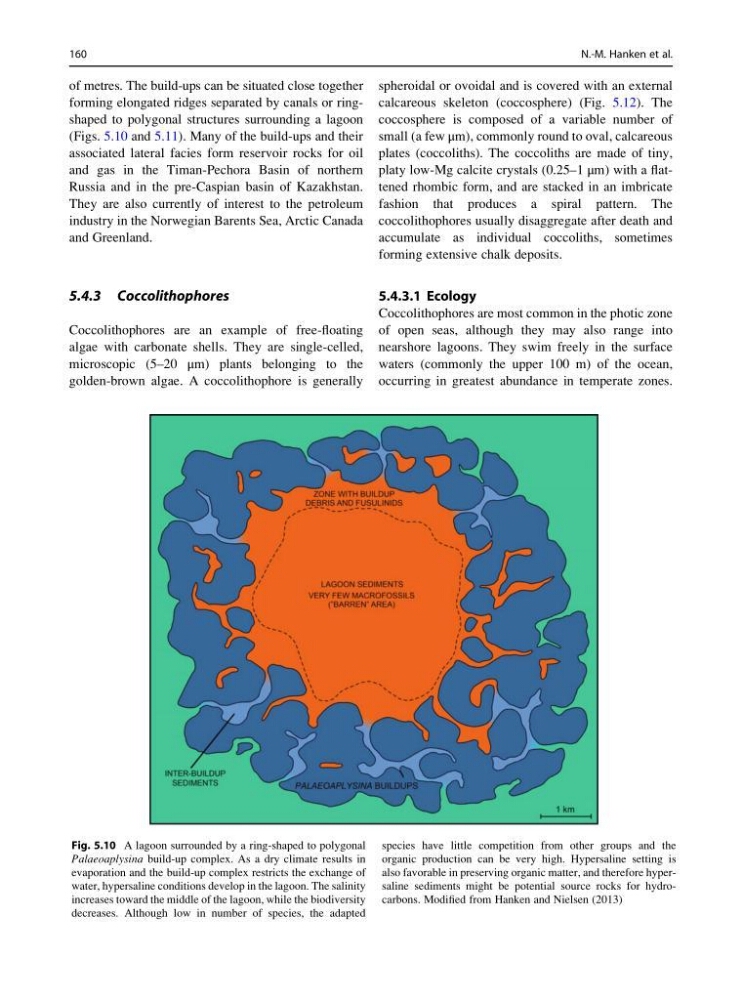
forming elongated ridges separated by canals or ringshaped to polygonal structures surrounding a lagoon
(Figs. 5.10 and 5.11). Many of the build-ups and their
associated lateral facies form reservoir rocks for oil
and gas in the Timan-Pechora Basin of northern
Russia and in the pre-Caspian basin of Kazakhstan.
They are also currently of interest to the petroleum
industry in the Norwegian Barents Sea, Arctic Canada
and Greenland.
5.4.3 Coccolithophores
Coccolithophores are an example of free-floating
algae with carbonate shells. They are single-celled,
microscopic (5–20 μm) plants belonging to the
golden-brown algae. A coccolithophore is generally
spheroidal or ovoidal and is covered with an external
calcareous skeleton (coccosphere) (Fig. 5.12). The
coccosphere is composed of a variable number of
small (a few μm), commonly round to oval, calcareous
plates (coccoliths). The coccoliths are made of tiny,
platy low-Mg calcite crystals (0.25–1 μm) with a flattened rhombic form, and are stacked in an imbricate
fashion that produces a spiral pattern. The
coccolithophores usually disaggregate after death and
accumulate as individual coccoliths, sometimes
forming extensive chalk deposits.
5.4.3.1 Ecology
Coccolithophores are most common in the photic zone
of open seas, although they may also range into
nearshore lagoons. They swim freely in the surface
waters (commonly the upper 100 m) of the ocean,
occurring in greatest abundance in temperate zones.
Fig. 5.10 A lagoon surrounded by a ring-shaped to polygonal
Palaeoaplysina build-up complex. As a dry climate results in
evaporation and the build-up complex restricts the exchange of
water, hypersaline conditions develop in the lagoon. The salinity
increases toward the middle of the lagoon, while the biodiversity
decreases. Although low in number of species, the adapted
species have little competition from other groups and the
organic production can be very high. Hypersaline setting is
also favorable in preserving organic matter, and therefore hypersaline sediments might be potential source rocks for hydrocarbons. Modified from Hanken and Nielsen (2013)
160
N.-M. Hanken et al.
forming elongated ridges separated by canals or ringshaped to polygonal structures surrounding a lagoon
(Figs. 5.10 and 5.11). Many of the build-ups and their
associated lateral facies form reservoir rocks for oil
and gas in the Timan-Pechora Basin of northern
Russia and in the pre-Caspian basin of Kazakhstan.
They are also currently of interest to the petroleum
industry in the Norwegian Barents Sea, Arctic Canada
and Greenland.
5.4.3 Coccolithophores
Coccolithophores are an example of free-floating
algae with carbonate shells. They are single-celled,
microscopic (5–20 μm) plants belonging to the
golden-brown algae. A coccolithophore is generally
spheroidal or ovoidal and is covered with an external
calcareous skeleton (coccosphere) (Fig. 5.12). The
coccosphere is composed of a variable number of
small (a few μm), commonly round to oval, calcareous
plates (coccoliths). The coccoliths are made of tiny,
platy low-Mg calcite crystals (0.25–1 μm) with a flattened rhombic form, and are stacked in an imbricate
fashion that produces a spiral pattern. The
coccolithophores usually disaggregate after death and
accumulate as individual coccoliths, sometimes
forming extensive chalk deposits.
5.4.3.1 Ecology
Coccolithophores are most common in the photic zone
of open seas, although they may also range into
nearshore lagoons. They swim freely in the surface
waters (commonly the upper 100 m) of the ocean,
occurring in greatest abundance in temperate zones.
Fig. 5.10 A lagoon surrounded by a ring-shaped to polygonal
Palaeoaplysina build-up complex. As a dry climate results in
evaporation and the build-up complex restricts the exchange of
water, hypersaline conditions develop in the lagoon. The salinity
increases toward the middle of the lagoon, while the biodiversity
decreases. Although low in number of species, the adapted
species have little competition from other groups and the
organic production can be very high. Hypersaline setting is
also favorable in preserving organic matter, and therefore hypersaline sediments might be potential source rocks for hydrocarbons. Modified from Hanken and Nielsen (2013)
160
N.-M. Hanken et al.